 Back
BackBacteria and Archaea: Structure, Growth, and Classification
Study Guide - Smart Notes
 Tailored notes based on your materials, expanded with key definitions, examples, and context.
Bacterial Structure and Growth
Introduction to Bacteria
Bacteria are prokaryotic, unicellular organisms capable of independent life. They can exist as single cells or in colonies, such as biofilms, and are able to perform all essential life processes, including metabolism and reproduction.
Bacterial Shapes and Arrangements
Bacteria exhibit a variety of shapes and arrangements, which are important for identification and classification.
Cocci: Spherical or nearly spherical cells.
Bacilli: Rod-shaped cells; some can form endospores.
Pleomorphic: Variable or morphologically indistinct shapes (e.g., coccobacilli).
Spirals: Includes vibrio (comma-shaped), spirillum (thick, rigid spirals), and spirochetes (thin, flexible spirals).
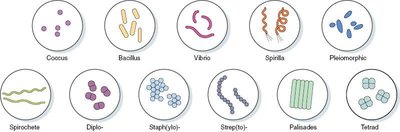
Bacterial arrangements are determined by the pattern of cell division and how cells remain attached:
Diplococci: Pairs (e.g., Streptococcus pneumoniae).
Streptococci: Chains (e.g., Streptococcus pyogenes).
Tetrads: Groups of four.
Sarcinae: Cubes of eight.
Staphylococci: Grape-like clusters.
Diplobacilli: Paired rods.
Streptobacilli: Chains of rods.
Examples of Pathogens by Shape
Pathogenic bacteria can be classified by their shape, reservoir, and associated diseases.
Organism | Shape | Reservoir | Diseases |
|---|---|---|---|
Staphylococcus aureus | Coccus | Skin, nose, GI tract | Food poisoning, toxic shock, wound infections |
Bacillus anthracis | Bacillus | Soil | Anthrax |
Vibrio cholerae | Vibrio | Water, food | Cholera |
Borrelia burgdorferi | Spirochete | Rodents, ticks | Lyme disease |
Bacterial Growth
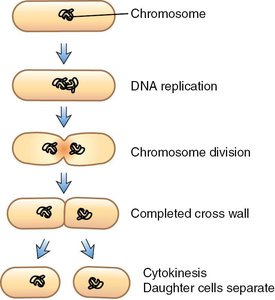
Basis of Bacterial Growth: Binary Fission
Bacteria reproduce primarily by binary fission, a process resulting in two genetically identical daughter cells. This process requires sufficient nutrients and a cascade of regulatory events to initiate DNA replication and cell division.
Bacterial Population Growth Curve
Bacterial populations grow in a characteristic pattern when cultured in a closed system:
Lag Phase: Cells adapt to the environment; no division occurs.
Log (Exponential) Phase: Rapid cell division; population doubles at a constant rate (generation time).
Stationary Phase: Nutrient depletion and waste accumulation halt growth; cell division equals cell death.
Death Phase: Cell death exceeds cell division due to harsh conditions.
Measuring Microbial Growth
Microbial growth can be measured by cell mass or cell number:
Dry Weight: Cells are dried and weighed for accurate estimation.
Turbidity: Cloudiness measured by spectrophotometer; higher turbidity indicates more cells.
Direct Cell Count: Counting chambers (e.g., Petroff-Hauser) are used for microscopic counts.
Viable Counts: Only living cells are counted using pour plating, spread plating, or most probable number methods.
Factors Influencing Microbial Growth
Nutritional Requirements
Bacteria require sources of carbon, nitrogen, energy, water, and minerals for growth. They are classified based on their energy and carbon sources:
Phototrophs: Use light as an energy source.
Chemotrophs: Use chemical compounds for energy.
Autotrophs: Obtain carbon from CO2.
Heterotrophs: Obtain carbon from organic compounds.
Photoautotrophs: Use sunlight and CO2 (e.g., cyanobacteria).
Chemoautotrophs: Use inorganic chemicals and CO2.
Photoheterotrophs: Use sunlight and organic compounds.
Chemoheterotrophs: Use organic compounds for both energy and carbon.
Temperature
Bacteria are classified by their optimal temperature ranges:
Mesophiles: 25–40°C (most bacteria, including human pathogens).
Thermophiles: 45°C or higher (e.g., hot springs).
Psychrophiles: 0–15°C (e.g., Arctic environments).
Psychrotrophs: Grow slowly at 0°C, optimal at 25–30°C (cause food spoilage).
Type | Pathogens | Nonpathogens |
|---|---|---|
Mesophiles | Salmonella typhi | Micrococcus luteus |
Thermophiles | Campylobacter spp. | Bacillus thermophilus |
Psychrophiles | Yersinia enterocolitica | Pseudomonas spp. |
Psychrotrophs | Listeria monocytogenes | Bacillus spp. |
Osmotic Pressure
Bacteria vary in their tolerance to solute concentrations:
Osmotolerant: Can withstand some osmotic pressure.
Osmophiles: Require high solute concentrations.
Halophiles: Require or tolerate high salt concentrations (e.g., Halobacterium).
Hydrostatic Pressure
Some bacteria can survive or thrive under high hydrostatic pressure:
Barotolerant: Survive increased pressure.
Barophiles: Grow best under high pressure (deep ocean).
Atmospheric Conditions
Bacteria are classified by their oxygen requirements:
Obligate aerobes: Require oxygen.
Obligate anaerobes: Killed by oxygen.
Aerotolerant anaerobes: Tolerate but do not use oxygen.
Facultative anaerobes: Can grow with or without oxygen.
Microaerophiles: Require low oxygen levels.
Capnophiles: Require elevated CO2 levels.
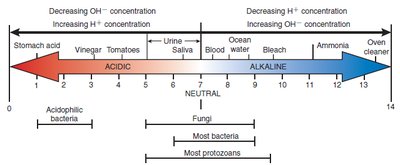
Bacteria have optimal pH ranges for growth:
Neutrophiles: pH 5–8 (most bacteria).
Acidophiles: pH below 5.5 (e.g., Helicobacter pylori).
Alkaliphiles: pH above 8.5 (e.g., Vibrio cholerae).
Criteria for Classification
Bacteria and archaea are classified based on morphological, biochemical, and genetic characteristics. Bergey’s Manual of Systematic Bacteriology is a key reference for bacterial taxonomy. The binomial system of nomenclature, developed by Carl Linnaeus, is used for naming species.
Major Groups of Bacteria and Archaea
Spirochetes: Helical, motile bacteria (e.g., Treponema pallidum causes syphilis).
Gram-negative aerobic rods and cocci: Diverse group, includes pathogens like Neisseria and Pseudomonas.
Facultative anaerobic gram-negative rods: Includes enteric bacteria such as Escherichia coli and Salmonella.
Gram-positive cocci: Includes Staphylococcus and Streptococcus.
Endospore-forming gram-positive rods: Includes Bacillus and Clostridium.
Archaea: Includes methanogens, thermophiles, and halophiles, often found in extreme environments.
