 Back
BackBio 102 Exam II Review – Study Guidance and Practice Questions
Study Guide - Smart Notes
 Tailored notes based on your materials, expanded with key definitions, examples, and context.
Q1. Which phylum has a water vascular system?
Background
Topic: Invertebrate Diversity – Phylum Characteristics
This question tests your understanding of the unique physiological systems that distinguish major animal phyla, specifically the water vascular system.
Key Terms:
Water vascular system: A network of hydraulic canals unique to one animal phylum, used for locomotion, feeding, and gas exchange.
Phylum: A major taxonomic group of animals sharing a basic body plan or significant features.
Step-by-Step Guidance
Recall the main animal phyla discussed in class: Mollusca, Echinodermata, Cnidaria, Annelida, Arthropoda.
Review the defining features of each phylum, focusing on unique organ systems.
Identify which phylum is known for having a water vascular system, often associated with tube feet and movement.
Eliminate phyla that do not possess this system by recalling their main characteristics (e.g., segmentation, exoskeleton, stinging cells).
Try solving on your own before revealing the answer!
Q2. A major difference between the two divisions of annelids, the errantians and sedentarians, is that _____.
Background
Topic: Invertebrate Diversity – Annelid Classification
This question examines your ability to distinguish between the two main groups of segmented worms (annelids) based on their mobility and anatomical features.
Key Terms:
Errantians: Mostly mobile, marine annelids with parapodia.
Sedentarians: Less mobile, often burrowing or tube-dwelling annelids.
Parapodia: Paired, fleshy protrusions used for movement and gas exchange.
Step-by-Step Guidance
Recall the two main groups of annelids and their typical habitats and behaviors.
Think about which group is more mobile and which is more sedentary.
Review which group contains parapodia and which includes leeches.
Match the correct description to each group based on your notes or textbook.
Try solving on your own before revealing the answer!
Q3. Which statement about arthropods is incorrect?
Background
Topic: Invertebrate Diversity – Arthropod Anatomy and Physiology
This question tests your knowledge of the defining features of arthropods, including their circulatory system, sensory organs, and body covering.
Key Terms:
Open circulatory system: Circulatory fluid (hemolymph) is not always contained within vessels.
Cuticle: A tough, flexible exoskeleton covering the body.
Sensory organs: Structures specialized for detecting environmental stimuli.
Step-by-Step Guidance
Review the main characteristics of arthropods, especially their circulatory system and body structure.
Consider the location of sensory organs in arthropods (anterior vs. posterior).
Identify which statement does not match what you know about arthropods.
Eliminate statements that are true based on your lecture notes or textbook.
Try solving on your own before revealing the answer!
Q4. Your friend, who was setting up a lab on arthropods for your class, put out specimens of the following groups. Which needs to be removed?
Background
Topic: Invertebrate Diversity – Arthropod Subgroups
This question asks you to identify which group listed is not actually an arthropod, requiring you to know the major subgroups of arthropods.
Key Terms:
Chelicerates: Arthropods including spiders, scorpions, and horseshoe crabs.
Myriapods: Arthropods including centipedes and millipedes.
Pancrustaceans: Arthropods including crustaceans and insects.
Nematodes: Roundworms, not arthropods.
Step-by-Step Guidance
List the main subgroups of arthropods and recall examples of each.
Identify which group in the list is not an arthropod based on your knowledge of animal phyla.
Recall the defining features of nematodes and how they differ from arthropods.
Choose the group that should be removed from the arthropod lab specimens.
Try solving on your own before revealing the answer!
Q5. If you discovered a new organism with 10 jointed legs, you would expect it to also have _____.
Background
Topic: Invertebrate Diversity – Arthropod Anatomy
This question tests your ability to connect the presence of jointed appendages with other characteristic features of arthropods.
Key Terms:
Jointed legs: A hallmark of arthropods, allowing for complex movement.
Exoskeleton: A rigid external covering that provides support and protection.
Muscle attachment: Muscles attach to the inside of the exoskeleton in arthropods.
Step-by-Step Guidance
Recall which animal phylum is characterized by jointed appendages.
Think about the other features that typically accompany jointed legs in this group.
Review the function of the exoskeleton and how muscles interact with it.
Eliminate options that do not fit with the arthropod body plan.
Try solving on your own before revealing the answer!
Q6. Based on the picture, the skeletal components of jaws are derived from which of the four shared derived characters of chordates?
Background
Topic: Vertebrate Evolution – Chordate Characteristics
This question asks you to connect the evolutionary origin of jaws to one of the four key chordate features, using a diagram for reference.
Key Terms:
Chordate characteristics: Notochord, dorsal hollow nerve cord, pharyngeal arches/slits, post-anal tail.
Pharyngeal arches: Structures in the embryonic pharynx that give rise to various anatomical features, including jaws in vertebrates.
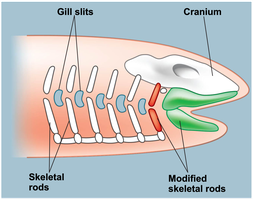
Step-by-Step Guidance
Review the four shared derived characters of chordates.
Examine the diagram to see which structure is modified to form the jaws.
Recall which embryonic structure gives rise to the skeletal components of jaws in vertebrates.
Match the correct chordate feature to the origin of jaws as shown in the image.
Try solving on your own before revealing the answer!
