 Back
BackBIOB 160 Exam #1 Study Guidance: Functional Groups, Electron Configurations, Chemical Bonds, and Macromolecules
Study Guide - Smart Notes
 Tailored notes based on your materials, expanded with key definitions, examples, and context.
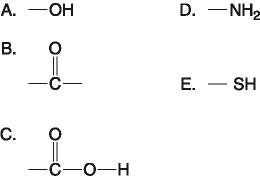
Q1. Identify the functional groups shown in the diagram.
Background
Topic: Functional Groups in Organic Molecules
This question tests your ability to recognize and name common functional groups found in biological molecules, which are critical for understanding molecular structure and function in biochemistry.
Key Terms:
Functional group: A specific group of atoms within a molecule that is responsible for characteristic chemical reactions.
Examples: Hydroxyl, carbonyl, carboxyl, amino, sulfhydryl.
Step-by-Step Guidance
Examine each structure in the diagram and note the atoms and bonds present.
Recall the defining features of each functional group (e.g., hydroxyl is -OH, carboxyl is -COOH, amino is -NH2, sulfhydryl is -SH, carbonyl is C=O).
Match each structure to its correct functional group name based on these features.
Consider which functional groups are present in all amino acids (think about the general structure of an amino acid).
Try solving on your own before revealing the answer!
Final Answer:
A: Hydroxyl group
B: Carbonyl group
C: Carboxyl group
D: Amino group
E: Sulfhydryl group
The carboxyl and amino groups are found on all amino acids.
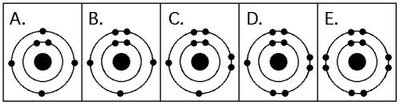
Q2. Which drawing depicts the electron configuration of an atom capable of forming three covalent bonds?
Background
Topic: Electron Configuration and Chemical Bonding
This question tests your understanding of how electron configurations determine an atom's bonding capacity, specifically the number of covalent bonds it can form.
Key Terms:
Valence electrons: Electrons in the outermost shell, involved in bonding.
Covalent bond: A chemical bond formed by sharing electrons between atoms.
Step-by-Step Guidance
Count the number of valence electrons in each diagram.
Recall that atoms typically form covalent bonds to fill their valence shell (usually 8 electrons for main group elements).
Determine which atom has three unpaired electrons, indicating it can form three covalent bonds.
Try solving on your own before revealing the answer!
Final Answer:
Diagram C depicts the electron configuration of an atom capable of forming three covalent bonds, as it has three unpaired electrons in its valence shell.
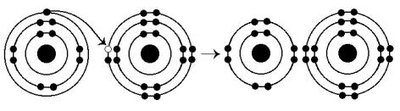
Q3. What results from the chemical reaction illustrated in the diagram?
Background
Topic: Ionic Bond Formation
This question tests your understanding of how atoms transfer electrons to form ions, resulting in ionic bonds.
Key Terms:
Cation: A positively charged ion.
Anion: A negatively charged ion.
Ionic bond: A bond formed by the electrostatic attraction between oppositely charged ions.
Step-by-Step Guidance
Observe the electron transfer in the diagram (one atom gives up an electron, another receives it).
Determine the resulting charges on each atom after the transfer.
Identify which atom becomes a cation and which becomes an anion.
Try solving on your own before revealing the answer!
Final Answer:
The reaction results in a cation with a net charge of +1 and an anion with a net charge of -1, due to the transfer of one electron.
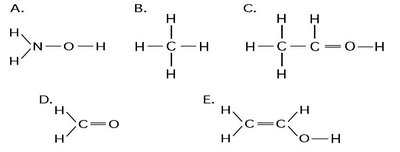
Q4. Which of the structures illustrated below is an impossible covalently bonded molecule?
Background
Topic: Covalent Bonding and Valence Rules
This question tests your ability to recognize valid and invalid covalent bonding based on the number of bonds each atom can form (valence).
Key Terms:
Valence: The number of bonds an atom can form, based on its number of valence electrons.
Covalent bond: A bond formed by sharing electrons.
Step-by-Step Guidance
Examine each molecule and count the number of bonds for each atom.
Recall typical valence values: Carbon (4), Nitrogen (3), Oxygen (2), Hydrogen (1).
Identify any molecule where an atom exceeds its typical valence.
Try solving on your own before revealing the answer!
Final Answer:
Structure C is impossible because the central carbon atom forms five bonds, which exceeds its valence of four.
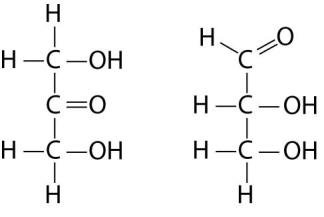
Q5. Choose the term that correctly describes the relationship between these two sugar molecules.
Background
Topic: Isomers in Organic Chemistry
This question tests your understanding of different types of isomers, specifically structural, cis-trans, and enantiomers, as they relate to sugar molecules.
Key Terms:
Isomer: Molecules with the same molecular formula but different structures.
Structural isomer: Differ in the covalent arrangement of atoms.
Cis-trans isomer: Differ in spatial arrangement around a double bond.
Enantiomer: Mirror-image isomers.
Step-by-Step Guidance
Compare the arrangement of atoms in each sugar molecule.
Determine if the molecules are mirror images, have different connectivity, or differ around a double bond.
Identify the correct isomer type based on these observations.
Try solving on your own before revealing the answer!
Final Answer:
The two sugar molecules are structural isomers, as they have the same molecular formula but different covalent arrangements of atoms.
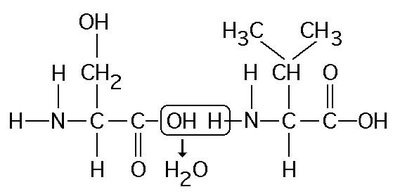
Q6. Which of the following is true regarding the reaction shown below?
Background
Topic: Macromolecule Synthesis and Peptide Bond Formation
This question tests your understanding of how macromolecules are formed, specifically the formation of peptide bonds between amino acids.
Key Terms:
Peptide bond: A covalent bond formed between two amino acids during protein synthesis.
Hydrolysis: A reaction that breaks bonds using water.
Dehydration synthesis: A reaction that forms bonds by removing water.
Step-by-Step Guidance
Examine the reactants and products in the diagram.
Identify the functional groups involved and the bond formed.
Determine if water is released or consumed in the reaction.
Try solving on your own before revealing the answer!
Final Answer:
The reaction results in the formation of a peptide bond between two amino acids, with water released as a byproduct (dehydration synthesis).
