 Back
BackBiology 121 – Foundational Concepts and Molecular Structures Study Guide
Study Guide - Smart Notes
 Tailored notes based on your materials, expanded with key definitions, examples, and context.
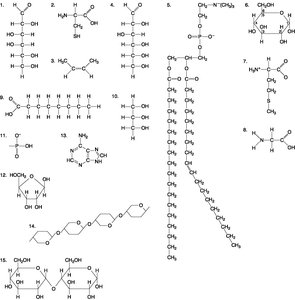
Q1. Identify the molecules below.
Background
Topic: Biological Molecules
This question tests your ability to recognize and name common biological molecules based on their structural formulas. These may include carbohydrates, lipids, proteins, and nucleic acids.
Key Terms:
Monosaccharide: Simple sugar molecule (e.g., glucose, fructose).
Disaccharide: Two monosaccharides joined together (e.g., sucrose, lactose).
Polysaccharide: Many monosaccharides linked together (e.g., starch, cellulose, glycogen).
Lipid: Includes fats, oils, and steroids; characterized by long hydrocarbon chains.
Amino Acid: Building block of proteins, contains amino and carboxyl groups.
Nucleotide: Building block of nucleic acids (DNA/RNA), contains a sugar, phosphate, and nitrogenous base.
Step-by-Step Guidance
Examine each molecular structure and look for characteristic features (e.g., ring structures for sugars, long hydrocarbon chains for lipids, peptide bonds for proteins).
Identify functional groups present (e.g., hydroxyl, carboxyl, amino, phosphate) to help classify the molecule.
Compare the structure to known examples from your textbook or notes (e.g., glucose has a six-membered ring, fatty acids have long chains, nucleotides have a phosphate-sugar-base structure).
Label each molecule with its most specific name (e.g., glucose, triglyceride, amino acid, nucleotide) based on your analysis.
Try solving on your own before revealing the answer!
Q2. What is the pH of a solution with a hydrogen ion [H+] of 10-8 molar?
Background
Topic: Acids, Bases, and pH
This question tests your understanding of the pH scale and how to calculate pH from hydrogen ion concentration.
Key Formula:
Step-by-Step Guidance
Recall that pH is calculated as the negative logarithm (base 10) of the hydrogen ion concentration.
Substitute the given value into the formula.
Set up the calculation: .
Try solving on your own before revealing the answer!
Q3. What is the [OH-] concentration?
Background
Topic: Water Ionization and pH/pOH Relationship
This question tests your understanding of the relationship between hydrogen ion and hydroxide ion concentrations in aqueous solutions.
Key Formula:
Step-by-Step Guidance
Recall that the product of and in water at 25°C is always .
Substitute the given into the formula.
Rearrange to solve for : .
Try solving on your own before revealing the answer!
Q4. Name and DESCRIBE the different polysaccharides (Structural and Storage).
Background
Topic: Carbohydrates – Polysaccharides
This question tests your knowledge of the major types of polysaccharides, their functions, and examples in living organisms.
Key Terms:
Structural Polysaccharides: Provide support and structure (e.g., cellulose in plants, chitin in fungi and arthropods).
Storage Polysaccharides: Store energy (e.g., starch in plants, glycogen in animals).
Step-by-Step Guidance
List the main structural polysaccharides and describe their roles and where they are found.
List the main storage polysaccharides and describe their roles and where they are found.
For each, mention the type of monomer (e.g., glucose) and the type of glycosidic linkage if relevant.
Try solving on your own before revealing the answer!
Q5. Name the trace elements.
Background
Topic: Essential Elements in Biology
This question tests your knowledge of elements required in small amounts for life, such as iron, zinc, copper, etc.
Key Terms:
Trace Elements: Elements required by an organism in only minute quantities.
Step-by-Step Guidance
Recall the definition of trace elements and why they are important for biological processes.
List several common trace elements found in living organisms.
Try solving on your own before revealing the answer!
