 Back
BackCell Membrane Transport: Diffusion, Osmosis, and Active Transport
Study Guide - Smart Notes
 Tailored notes based on your materials, expanded with key definitions, examples, and context.
Q1. Which of the following substances would have the most trouble crossing a biological membrane by diffusing through the lipid bilayer?
Background
Topic: Membrane Permeability
This question tests your understanding of how different types of molecules interact with the lipid bilayer of cell membranes, and which are able to diffuse through it easily.
Key Terms:
Lipid bilayer: The double layer of phospholipids that forms the cell membrane.
Diffusion: Passive movement of molecules from high to low concentration.
Nonpolar molecules: Molecules without a charge, often able to pass through the membrane easily.
Ions: Charged particles, such as Na+, which typically cannot pass through the lipid bilayer without assistance.
Step-by-Step Guidance
Recall that the lipid bilayer is hydrophobic, so nonpolar molecules can diffuse through it more easily than polar or charged molecules.
Consider the properties of each substance listed: O2 and CO2 are small, nonpolar gases; butane (C4H10) is a small, nonpolar molecule; Na+ is a charged ion.
Think about which type of molecule would require a transport protein to cross the membrane.
Identify the molecule that would have the most difficulty diffusing through the lipid bilayer based on its charge and polarity.
Try solving on your own before revealing the answer!
Final Answer: Na+ (C)
Charged ions like Na+ cannot diffuse through the hydrophobic lipid bilayer without the help of transport proteins.
Q2. Diffusion does not require the cell to expend ATP. Therefore, diffusion is considered a type of:
Background
Topic: Types of Membrane Transport
This question tests your understanding of the difference between passive and active transport mechanisms in cells.
Key Terms:
Diffusion: Movement of molecules from high to low concentration without energy input.
Passive transport: Transport that does not require cellular energy (ATP).
Active transport: Transport that requires energy to move substances against their concentration gradient.
Step-by-Step Guidance
Recall the definition of diffusion and whether it requires energy input from the cell.
Compare diffusion to other types of transport, such as active transport and bulk transport (endocytosis/exocytosis).
Identify which type of transport diffusion falls under based on its energy requirements.
Try solving on your own before revealing the answer!
Final Answer: Passive transport (B)
Diffusion is a form of passive transport because it does not require ATP.
Q3. In the lab, you use a special balloon that is permeable to water but not sucrose to make an "artificial cell." The balloon is filled with a solution of 20% sucrose and 80% water and is immersed in a beaker containing a solution of 40% sucrose and 60% water. Which of the following will occur?
Background
Topic: Osmosis and Selective Permeability
This question tests your understanding of osmosis, the movement of water across a selectively permeable membrane.
Key Terms:
Osmosis: Diffusion of water across a membrane.
Selective permeability: The membrane allows some substances to pass but not others.
Hypertonic: Solution with higher solute concentration.
Hypotonic: Solution with lower solute concentration.
Step-by-Step Guidance
Compare the concentrations of sucrose and water inside the balloon and in the beaker.
Determine which direction water will move based on the concentration gradient.
Remember that the membrane is permeable to water but not sucrose.
Predict the net movement of water.
Try solving on your own before revealing the answer!
Final Answer: Water will leave the balloon (A)
Water moves from an area of higher concentration to lower concentration, so it leaves the balloon.
Q4. A cell that has neither a net gain of water nor net loss of water when it is immersed in a solution must be:
Background
Topic: Tonicity and Cell Volume Regulation
This question tests your understanding of isotonic, hypertonic, and hypotonic solutions and their effects on cells.
Key Terms:
Isotonic: Equal solute concentration inside and outside the cell.
Hypertonic: Higher solute concentration outside the cell.
Hypotonic: Lower solute concentration outside the cell.
Step-by-Step Guidance
Recall the definitions of isotonic, hypertonic, and hypotonic solutions.
Consider what happens to water movement in each type of solution.
Identify which condition results in no net movement of water.
Try solving on your own before revealing the answer!
Final Answer: Isotonic to its environment (A)
In an isotonic solution, water moves equally in and out, so there is no net gain or loss.
Q5. You are adrift in the Atlantic Ocean and, being thirsty, drink the surrounding seawater. As a result:
Background
Topic: Osmosis and Effects of Hypertonic Solutions
This question tests your understanding of how drinking seawater affects cell water balance.
Key Terms:
Hypertonic solution: Seawater has a higher solute concentration than your cells.
Osmosis: Water moves out of cells into the hypertonic environment.
Dehydration: Loss of water from cells.
Step-by-Step Guidance
Consider the concentration of solutes in seawater compared to your cells.
Recall what happens to cells in a hypertonic environment.
Predict the effect on your cells after drinking seawater.
Try solving on your own before revealing the answer!
Final Answer: You dehydrate yourself (C)
Water leaves your cells to balance the solute concentration, causing dehydration.
Q6. Facilitated diffusion across a biological membrane requires ________ and moves a substance ________ its concentration gradient.
Background
Topic: Facilitated Diffusion
This question tests your understanding of how facilitated diffusion works and its requirements.
Key Terms:
Facilitated diffusion: Passive transport using transport proteins.
Transport proteins: Help move substances across the membrane.
Concentration gradient: Difference in concentration across a membrane.
Step-by-Step Guidance
Recall that facilitated diffusion does not require energy (ATP).
Identify the role of transport proteins in facilitated diffusion.
Determine whether substances move down or against their concentration gradient in facilitated diffusion.
Try solving on your own before revealing the answer!
Final Answer: Transport proteins; down (B)
Facilitated diffusion uses transport proteins to move substances down their concentration gradient.
Q7. Which of the following statements regarding active transport is false?
Background
Topic: Active Transport
This question tests your understanding of the characteristics of active transport.
Key Terms:
Active transport: Movement of substances against their concentration gradient using energy (ATP).
ATP: Energy molecule used in active transport.
Concentration gradient: Direction of movement in active vs. passive transport.
Step-by-Step Guidance
Review the characteristics of active transport, including energy use and direction of movement.
Identify which statement does not accurately describe active transport.
Compare each statement to your knowledge of active transport.
Try solving on your own before revealing the answer!
Final Answer: Active transport is driven by the concentration gradient (D)
Active transport is driven by ATP, not the concentration gradient.
Q8. The process of a white blood cell engulfing a bacterium is:
Background
Topic: Endocytosis and Cellular Defense
This question tests your understanding of the mechanisms cells use to take in large particles.
Key Terms:
Phagocytosis: "Cell eating"; engulfing large particles.
Endocytosis: General process of taking substances into the cell.
Pinocytosis: "Cell drinking"; taking in fluids.
Receptor-mediated endocytosis: Specific uptake of molecules.
Step-by-Step Guidance
Recall the different types of endocytosis and their functions.
Identify which process is used by white blood cells to engulf bacteria.
Match the process to the correct term.
Try solving on your own before revealing the answer!
Final Answer: Phagocytosis (D)
White blood cells use phagocytosis to engulf and digest bacteria.
Q9. The carrier molecules used in active transport to transport molecules across the cell membrane are:
Background
Topic: Active Transport Mechanisms
This question tests your understanding of the role of carrier molecules in active transport.
Key Terms:
Carrier proteins: Proteins that move substances across the membrane.
Active transport: Requires carrier proteins and energy.
Step-by-Step Guidance
Recall what type of molecules are used as carriers in active transport.
Consider the options and identify which is correct based on your knowledge of cell biology.
Try solving on your own before revealing the answer!
Final Answer: Proteins (B)
Carrier proteins are responsible for active transport across the cell membrane.
Q10. Which of the following describes the substance that is dissolved in a liquid?
Background
Topic: Solutions and Solubility
This question tests your understanding of the terminology used to describe solutions.
Key Terms:
Solute: The substance dissolved in a solvent.
Solvent: The liquid in which the solute is dissolved.
Solution: The mixture of solute and solvent.
Step-by-Step Guidance
Recall the definitions of solute, solvent, and solution.
Identify which term refers to the substance being dissolved.
Try solving on your own before revealing the answer!
Final Answer: Solute (C)
The solute is the substance that is dissolved in a solvent.
Q11. Which choice below is the most logical explanation for what has occurred to the rate of diffusion?
Background
Topic: Diffusion and Equilibrium
This question tests your understanding of how diffusion rates change as equilibrium is approached.
Key Terms:
Diffusion: Movement of molecules from high to low concentration.
Equilibrium: State where concentrations are equal and net movement stops.
Step-by-Step Guidance
Examine the graph or data provided (image_1) and note the trend in diffusion rate.
Recall what happens to diffusion rate as equilibrium is reached.
Identify the explanation that best fits the observed change in diffusion rate.
Try solving on your own before revealing the answer!
Final Answer: Equilibrium was reached (D)
As equilibrium is reached, the rate of diffusion decreases and eventually stops.
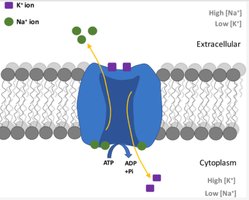
Q12. In order for nerve and muscle cells to function properly, they require a high concentration of potassium ions inside the cells and a high concentration of sodium ions outside the cells. What type of transport is shown in the example above?
Background
Topic: Active Transport and Ion Gradients
This question tests your understanding of how cells maintain ion gradients using active transport.
Key Terms:
Active transport: Movement of ions against their concentration gradient using energy (ATP).
Sodium-potassium pump: Protein that moves Na+ out and K+ in.
ATP: Energy source for active transport.
Step-by-Step Guidance
Examine the diagram (image_2) showing movement of Na+ and K+ ions across the membrane.
Recall that maintaining these gradients requires energy input.
Identify the type of transport responsible for moving ions against their concentration gradients.
Try solving on your own before revealing the answer!
Final Answer: Active transport
The sodium-potassium pump uses ATP to move ions against their concentration gradients.
