 Back
BackCellular Respiration: Citric Acid Cycle & Electron Transport System
Study Guide - Smart Notes
 Tailored notes based on your materials, expanded with key definitions, examples, and context.
Cellular Respiration: Citric Acid Cycle & Electron Transport System
Overview of Cellular Respiration
Cellular respiration is a multi-stage process by which cells extract energy from glucose and other biomolecules. The process involves glycolysis, the citric acid cycle (Krebs cycle), and the electron transport system, each contributing to the production of ATP, the cell's energy currency.
Citric Acid Cycle (Krebs Cycle): Occurs in the inner membrane region of the mitochondria and processes acetyl groups derived from glucose.
Electron Transport System: Utilizes coenzymes NADH and FADH2 to generate a large amount of ATP via oxidative phosphorylation.
Citric Acid Cycle (Krebs Cycle)
The citric acid cycle is the third stage of cellular respiration, responsible for the complete oxidation of acetyl CoA derived from glucose, fats, or proteins. Each glucose molecule results in two turns of the cycle, as two acetyl groups are produced.
Acetyl CoA Entry: Acetyl CoA combines with oxaloacetate to form citric acid.
Decarboxylation: Carbon atoms are removed and released as CO2.
Coenzyme Reduction: NAD+ and FAD are reduced to NADH and FADH2, carrying high-energy electrons to the electron transport system.
ATP Production: ATP is produced by substrate-level phosphorylation.
Summary for both acetyl groups:
2 ATP produced
6 NADH and 2 FADH2 generated
4 CO2 released as waste
Electron Transport System (ETS)
The electron transport system is the final stage of cellular respiration, occurring in the inner mitochondrial membrane. It converts the energy stored in NADH and FADH2 into ATP.
Electron Transfer: NADH and FADH2 release electrons to carrier proteins, which pass them along a chain, losing energy at each step.
Proton Gradient: Energy from electrons is used to pump H+ ions to the outer membrane, creating a concentration gradient.
ATP Synthesis: H+ ions diffuse back through ATP synthase, catalyzing the formation of ATP from ADP and inorganic phosphate ().
Oxidative Phosphorylation: This process requires oxygen and results in the production of water as a waste product ().
Summary:
Approximately 34 ATP produced
6 molecules of water generated
NAD+ and FAD are recycled
Energy Production Recap
Complete catabolism of glucose involves over 20 chemical reactions, resulting in the following products:
10 NADH
2 FADH2
38 ATP (gross), with a net gain of 36 ATP after accounting for energy used to shuttle NADH
6 CO2 and 6 H2O as waste
Other Energy Sources: Catabolism of Fats, Glycogen, and Proteins
When glycogen stores are depleted, the body utilizes fats and proteins for energy. Fats provide the majority of energy reserves, followed by proteins.
Glycogen: Only about 1% of energy reserves; broken down to glucose for glycolysis.
Fats: About 78% of energy reserves; triglycerides are broken into glycerol and fatty acids. Glycerol can enter glycolysis or be converted to pyruvate, while fatty acids are converted to acetyl groups for the citric acid cycle.
Proteins: About 21% of energy reserves; proteins are broken into amino acids, which are deaminated (NH2 removed as urea) and their carbon backbones enter the citric acid cycle.
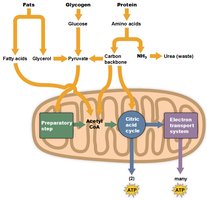
Fat and Protein Catabolism
Fats yield about twice as much ATP as glycogen. Triglycerides are broken down into glycerol and fatty acids, which are processed through glycolysis, the preparatory step, or directly into the citric acid cycle. Proteins are catabolized during starvation, leading to muscle wasting.
Fats: Glycerol enters glycolysis or is converted to pyruvate; fatty acids become acetyl groups for the citric acid cycle.
Proteins: Amino acids are deaminated; carbon backbones enter the citric acid cycle at various points.
Anaerobic Respiration
Anaerobic respiration allows cells to produce ATP without oxygen, typically for short periods. Glycolysis is the main anaerobic pathway, and in the absence of oxygen, pyruvate is converted to lactic acid, causing muscle fatigue and cramping.
Glycolysis: Occurs in the cytoplasm; produces ATP anaerobically.
Lactic Acid Formation: Pyruvate is converted to lactic acid instead of entering the mitochondria.
Key Terms and Definitions
ATP (Adenosine Triphosphate): The primary energy carrier in cells.
NAD+ (Nicotinamide Adenine Dinucleotide): A coenzyme that carries electrons and hydrogen ions.
FAD (Flavin Adenine Dinucleotide): Another coenzyme involved in electron transport.
Oxidative Phosphorylation: The process of ATP formation using energy from electron transport and requiring oxygen.
Substrate-Level Phosphorylation: Direct formation of ATP from ADP and a substrate.
Summary Table: Energy Yield from Cellular Respiration
Stage | ATP Produced | NADH Produced | FADH2 Produced | CO2 Produced | H2O Produced |
|---|---|---|---|---|---|
Glycolysis | 2 | 2 | 0 | 0 | 0 |
Citric Acid Cycle | 2 | 6 | 2 | 4 | 0 |
Electron Transport System | 34 | 0 | 0 | 0 | 6 |
Total | 38 (net 36) | 8 | 2 | 6 | 6 |
Additional info: Table values are based on standard cellular respiration; actual values may vary depending on cell type and conditions.
