 Back
BackCellular Respiration: Citric Acid Cycle, Electron Transport System, and Alternative Energy Pathways
Study Guide - Smart Notes
 Tailored notes based on your materials, expanded with key definitions, examples, and context.
Cellular Respiration: Citric Acid Cycle & Electron Transport System
Overview of Cellular Respiration
Cellular respiration is the process by which cells extract energy from nutrients, primarily glucose, to produce ATP, the universal energy currency. This process involves a series of metabolic pathways, including glycolysis, the citric acid cycle (Krebs cycle), and the electron transport system. The mitochondrion is the primary site for the latter two stages.

The Citric Acid Cycle (Krebs Cycle)
Location and General Function
The citric acid cycle, also known as the Krebs cycle, occurs in the inner membrane region of the mitochondria. It is the central metabolic pathway that completes the oxidation of glucose derivatives, generating high-energy electron carriers and ATP.
Occurs in the mitochondrial matrix.
Each glucose molecule yields two acetyl-CoA, so the cycle turns twice per glucose.
Main products: NADH, FADH2, ATP, and CO2 (waste).
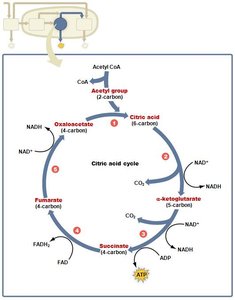
Steps of the Citric Acid Cycle
Acetyl CoA delivers acetyl group (2C) to oxaloacetate (4C), forming citric acid (6C).
Citric acid is metabolized: One carbon is removed as CO2; NAD+ is reduced to NADH; forms α-ketoglutarate (5C).
α-Ketoglutarate is metabolized: Another carbon is removed as CO2; NAD+ is reduced to NADH; ADP is phosphorylated to ATP; forms succinate (4C).
Succinate is metabolized: FAD is reduced to FADH2; forms fumarate (4C).
Fumarate is metabolized: NAD+ is reduced to NADH; regenerates oxaloacetate (4C).
Note: These steps are for one acetyl group; double the totals for one glucose molecule.
Coenzymes in the Citric Acid Cycle
NAD+ (Nicotinamide adenine dinucleotide): Accepts electrons and hydrogen ions to become NADH.
FAD (Flavin adenine dinucleotide): Accepts two electrons and two hydrogen ions to become FADH2.
Summary Table: Citric Acid Cycle Products (per glucose)
Product | Number Produced | Fate |
|---|---|---|
ATP | 2 | Used for cellular work |
NADH | 6 | Electron transport system |
FADH2 | 2 | Electron transport system |
CO2 | 4 | Waste (exhaled) |
Oxaloacetate | 2 | Regenerated for next cycle |
Electron Transport System (ETS)
Mechanism and Location
The electron transport system is the final stage of aerobic respiration, occurring in the inner mitochondrial membrane (cristae). It uses electrons from NADH and FADH2 to generate a proton gradient, which drives ATP synthesis.
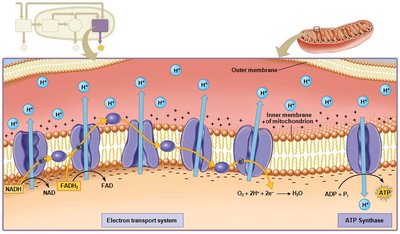
NADH and FADH2 donate electrons to carrier proteins in the membrane.
Electrons are passed along the chain, releasing energy used to pump H+ ions into the intermembrane space.
This creates a high concentration of H+ outside the inner membrane.
H+ ions flow back through ATP synthase, catalyzing the formation of ATP from ADP and inorganic phosphate (Pi).
Oxygen acts as the final electron acceptor, forming water:
ATP Yield from Electron Transport
Approximately 34 ATP molecules are produced by oxidative phosphorylation.
NAD+ and FAD are regenerated for reuse.
Water is produced as a waste product.
Overall Summary of Cellular Respiration (Glycolysis, Citric Acid Cycle, ETS)
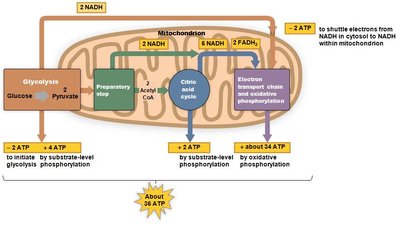
Stage | ATP Produced | Electron Carriers Produced |
|---|---|---|
Glycolysis | 2 | 2 NADH |
Preparatory Step | 0 | 2 NADH |
Citric Acid Cycle | 2 | 6 NADH, 2 FADH2 |
Electron Transport | ~34 | - |
Total | ~38 (net 36) | - |
Note: 2 ATP are used to shuttle NADH from the cytoplasm into the mitochondria, resulting in a net gain of 36 ATP per glucose molecule.
Alternative Energy Sources: Fats and Proteins
Catabolism of Fats
Fats are the largest energy reserve in the body (~78%).
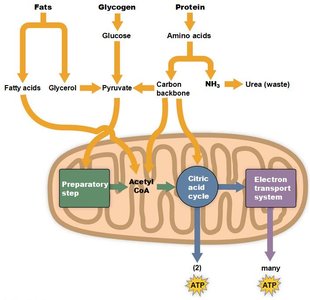
Triglycerides are broken down into glycerol and fatty acids.
Glycerol can be converted to glucose (glycolysis) or pyruvate (preparatory step).
Fatty acids are converted into acetyl groups, which enter the citric acid cycle.
Fat metabolism yields about twice as much ATP as glycogen.
Catabolism of Proteins
Proteins are used for energy primarily during starvation (~21% of reserves).
Proteins are broken into amino acids; the amine group (NH2) is removed and excreted as urea.
The remaining carbon backbone enters the citric acid cycle at various points.
Excessive protein catabolism leads to muscle wasting.
Anaerobic Respiration
ATP Production Without Oxygen
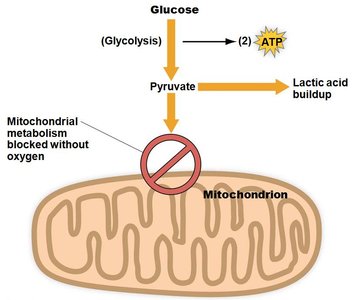
Anaerobic respiration allows cells to produce ATP in the absence of oxygen, but only for short periods. Glycolysis is the main anaerobic pathway in humans.
During anaerobic conditions, pyruvate does not enter the mitochondria.
Instead, pyruvate is converted to lactic acid, which accumulates in muscle tissue and causes burning and cramping sensations.
Only 2 ATP are produced per glucose molecule during anaerobic glycolysis.
Key Terms and Concepts
Substrate-level phosphorylation: Direct transfer of a phosphate group to ADP to form ATP during glycolysis and the citric acid cycle.
Oxidative phosphorylation: ATP synthesis powered by the transfer of electrons through the electron transport chain and the resulting proton gradient.
Coenzymes: Molecules such as NAD+ and FAD that carry electrons and hydrogen ions during cellular respiration.
ATP synthase: Enzyme complex that synthesizes ATP as protons flow through it down their concentration gradient.
Summary Table: Energy Yield and Waste Products
Product | Amount (per glucose) |
|---|---|
ATP (net) | 36 |
CO2 (waste) | 6 |
H2O (waste) | 6 |
Additional info: The efficiency of cellular respiration is due to the stepwise release of energy, preventing excessive heat loss and allowing cells to harness energy for biological work.
