Back
BackCellular Respiration: Pathways That Harvest Chemical Energy
Study Guide - Smart Notes
 Tailored notes based on your materials, expanded with key definitions, examples, and context.
Overview of Cellular Respiration
Introduction to Cellular Respiration
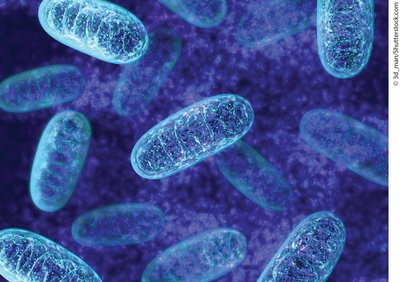
Cellular respiration is a series of metabolic pathways that extract energy from glucose and other organic molecules to produce ATP, the cell’s main energy currency. This process involves oxidation-reduction (redox) reactions and occurs in distinct stages within specific cellular compartments.
ATP (Adenosine Triphosphate): The universal energy carrier in cells, produced through substrate-level and oxidative phosphorylation.
Metabolic Pathways: Organized sequences of enzyme-catalyzed reactions, often compartmentalized in eukaryotic cells.
Key Principle: Energy is harvested in small, controlled steps to maximize efficiency and minimize loss as heat.
Redox Reactions in Cellular Respiration
Oxidation and Reduction
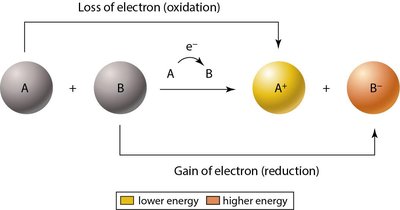
Redox reactions are central to cellular respiration, involving the transfer of electrons and energy from one molecule to another. Oxidation is the loss of electrons, while reduction is the gain of electrons.
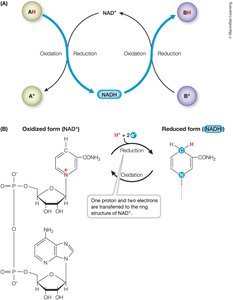
Electron Carriers: Molecules like NAD+ and FAD that shuttle electrons during metabolic reactions.
Dehydrogenation: The removal of hydrogen atoms (protons and electrons) from substrates, often coupled to the reduction of NAD+ to NADH.
Stages of Cellular Respiration
Overview of the Pathway
Cellular respiration consists of four major stages: glycolysis, pyruvate oxidation, the citric acid cycle, and the electron transport chain (ETC) with oxidative phosphorylation. Each stage occurs in a specific cellular location and serves a distinct purpose in energy extraction.
Glycolysis: Occurs in the cytoplasm; breaks down glucose into pyruvate.
Pyruvate Oxidation: Converts pyruvate to acetyl-CoA in the mitochondrial matrix.
Citric Acid Cycle (Krebs Cycle): Completes the oxidation of acetyl-CoA, generating NADH and FADH2.
Electron Transport Chain & Oxidative Phosphorylation: Uses electrons from NADH and FADH2 to generate ATP in the inner mitochondrial membrane.
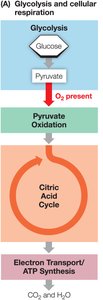
Glycolysis
Phases and Key Reactions
Glycolysis is a ten-step pathway that converts one molecule of glucose into two molecules of pyruvate, producing a net gain of ATP and NADH. It is divided into three phases:
Preparatory (Investment) Phase: Steps 1-3; ATP is consumed to phosphorylate glucose and its intermediates.
Cleavage Phase: Steps 4-5; the 6-carbon sugar is split into two 3-carbon molecules.
Payoff (Oxidation) Phase: Steps 6-10; ATP and NADH are produced.
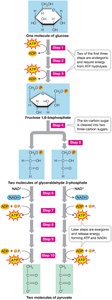
Key Glycolytic Reactions
Step 1: Phosphorylation of glucose to glucose-6-phosphate (uses 1 ATP).
Step 3: Phosphorylation of fructose-6-phosphate to fructose-1,6-bisphosphate (uses 1 ATP).
Step 7 & 10: Substrate-level phosphorylation produces ATP.
Step 6: Oxidation of glyceraldehyde-3-phosphate to 1,3-bisphosphoglycerate (produces NADH).
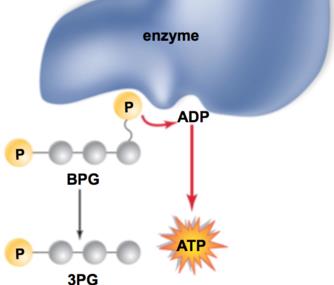
Net Reaction of Glycolysis
The overall reaction for glycolysis is:
Pyruvate Oxidation
Link Between Glycolysis and the Citric Acid Cycle
Pyruvate produced in glycolysis is transported into the mitochondrion, where it undergoes oxidative decarboxylation to form acetyl-CoA, CO2, and NADH. This reaction is catalyzed by the pyruvate dehydrogenase complex.
Net Reaction:
Location: Mitochondrial matrix
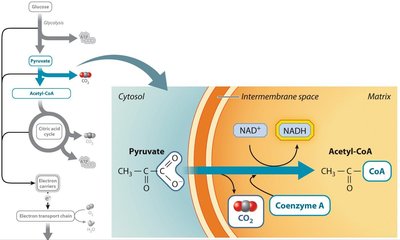
The Citric Acid Cycle (Krebs Cycle)
Overview and Key Steps
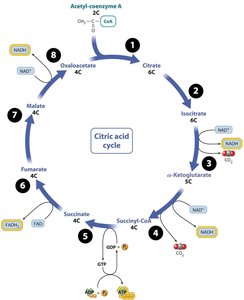
The citric acid cycle is a series of eight enzyme-catalyzed reactions that fully oxidize acetyl-CoA to CO2. The cycle generates high-energy electron carriers (NADH, FADH2) and GTP (or ATP) via substrate-level phosphorylation.
Location: Mitochondrial matrix
Key Steps:
Step 1: Condensation of acetyl-CoA with oxaloacetate to form citrate.
Steps 3 & 4: Oxidative decarboxylation, releasing CO2 and producing NADH.
Step 5: Substrate-level phosphorylation (GTP/ATP formation).
Step 6: Oxidation of succinate to fumarate (produces FADH2).
Step 8: Oxidation of malate to oxaloacetate (produces NADH).
Net Products of One Turn of the Citric Acid Cycle
Product | Quantity (per Acetyl-CoA) |
|---|---|
CO2 | 2 |
NADH | 3 |
FADH2 | 1 |
GTP (or ATP) | 1 |
Electron Transport Chain and Oxidative Phosphorylation
Mechanism and ATP Synthesis
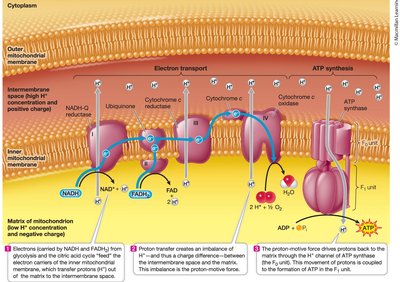
The electron transport chain (ETC) is a series of membrane-bound protein complexes in the inner mitochondrial membrane. Electrons from NADH and FADH2 are transferred through the ETC to oxygen, the final electron acceptor, forming water. The energy released pumps protons (H+) across the membrane, creating a proton gradient.
ATP Synthase: Uses the proton-motive force to synthesize ATP from ADP and Pi (chemiosmotic mechanism).
Oxidative Phosphorylation: The process of ATP formation driven by the transfer of electrons to oxygen.
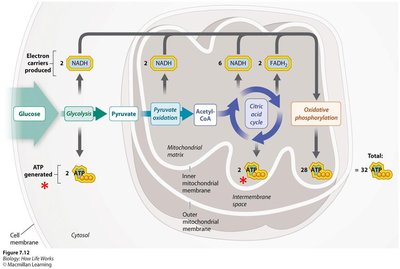
Theoretical ATP Yield from One Glucose Molecule
Stage | ATP Produced |
|---|---|
Glycolysis (substrate-level) | 2 |
Citric Acid Cycle (substrate-level) | 2 |
Oxidative Phosphorylation | 28 |
Total | 32 |
Fermentation and Anaerobic Respiration
ATP Production Without Oxygen
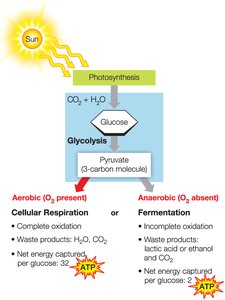
When oxygen is not available, cells can generate ATP through fermentation. In fermentation, organic molecules such as pyruvate serve as the final electron acceptor, resulting in products like lactate or ethanol. Anaerobic respiration in some prokaryotes uses alternative electron acceptors (e.g., sulfate, nitrate).
Lactic Acid Fermentation: Pyruvate is reduced to lactate.
Alcoholic Fermentation: Pyruvate is converted to ethanol and CO2.
ATP Yield: Fermentation produces only 2 ATP per glucose, compared to 32 ATP in aerobic respiration.
Regulation and Integration of Metabolic Pathways
Allosteric Regulation and Energy Balance
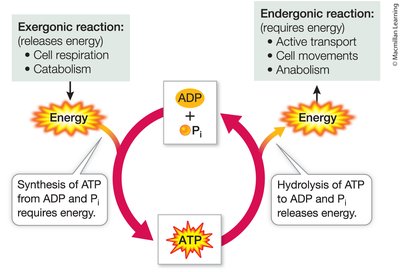
Cellular respiration is tightly regulated by the cell’s energy needs. Key enzymes are subject to allosteric regulation by ATP, ADP, NADH, and NAD+. High ATP or NADH levels inhibit energy-producing pathways, while high ADP or NAD+ levels activate them.
Feedback Inhibition: ATP acts as an allosteric inhibitor of phosphofructokinase in glycolysis.
Feedback Activation: ADP stimulates key enzymes to increase ATP production.
Integration with Other Metabolic Pathways
Carbohydrates, lipids, and proteins can all be catabolized to provide energy. Fatty acids enter as acetyl-CoA, and amino acids are converted to intermediates of glycolysis or the citric acid cycle.
Comparison: Cellular Respiration vs. Photosynthesis
Energy Flow in Cells
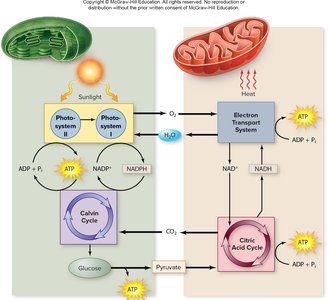
Cellular respiration and photosynthesis are complementary processes. Photosynthesis captures light energy to synthesize glucose, while respiration breaks down glucose to release energy as ATP.
Oxidative Phosphorylation: ATP synthesis driven by electron transfer to O2 in mitochondria.
Photophosphorylation: ATP synthesis driven by light energy in chloroplasts.