 Back
BackChapter 1: Biology – The Study of Scientific Life
Study Guide - Smart Notes
 Tailored notes based on your materials, expanded with key definitions, examples, and context.
Biology: The Study of Scientific Life
What is Science?
Science is a systematic approach to understanding the natural world through observation, experimentation, and evidence-based reasoning. It is distinct from other ways of knowing, such as art or politics, because it relies on testable explanations and predictions.
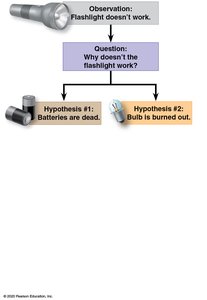
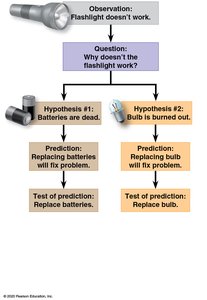
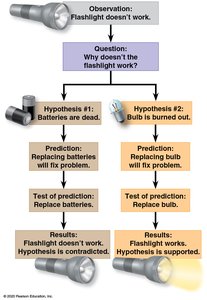
Science as a Process: Involves making observations, forming hypotheses, making predictions, conducting experiments, and analyzing data.
Fact: An objectively true observation or data point (e.g., "Earth orbits the sun").
Hypothesis: A tentative explanation for a set of observations that must be testable.
Experiment: A test of a hypothesis, designed to manipulate one variable (independent variable) and measure the outcome (dependent variable).
Theory: A comprehensive explanation supported by abundant evidence, capable of generating new hypotheses (e.g., cell theory, theory of evolution).
Law: A universal description of what will happen under specific circumstances.
Principle: Similar to a law but less universal, applying to more constrained circumstances.
Science vs. Technology: Science seeks to understand the universe, while technology applies scientific knowledge to achieve practical goals. Both fields overlap and depend on each other.
Major Themes of Biology
Biology is the scientific study of life, encompassing a wide range of topics from molecules to ecosystems. The field is unified by several major themes:
Unity of Life: All living things share fundamental characteristics, such as being composed of cells, having DNA, and carrying out metabolism.
Diversity of Life: Life is incredibly diverse, with millions of species adapted to different environments.
The Breadth of Biology
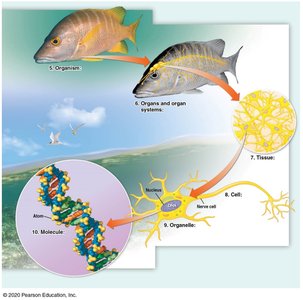
Biology covers multiple levels of organization, from the smallest molecules to the entire biosphere:
Biochemistry: Study of life at the molecular and cellular level.
Cell Biology: Study of cellular structure and function.
Organismal Biology: Focuses on anatomy, physiology, genetics, and ecology at the level of the organism.
Population Biology: Study of populations, including growth, genetics, and life history.
Ecology: Study of relationships between living things and their environment.
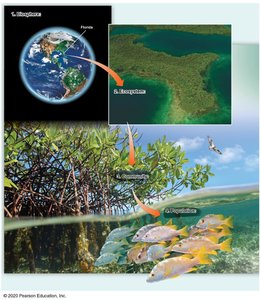
Ecological Roles
Organisms can be classified by their ecological roles:
Autotroph (Producer): Makes organic molecules from inorganic substances.
Heterotroph (Consumer): Consumes organic molecules from other living things.
Herbivore: Primary consumer, eats producers.
Carnivore: Secondary or higher-level consumer, eats other consumers.
Omnivore: Eats both producers and consumers.
Decomposer: Breaks down dead organic matter.
Unity and Diversity: The Three Domains of Life
All living things are classified into three domains based on cellular and genetic characteristics:
Bacteria: Prokaryotic, unicellular organisms.
Archaea: Prokaryotic, often found in extreme environments.
Eukarya: Eukaryotic organisms, including protists, plants, fungi, and animals.
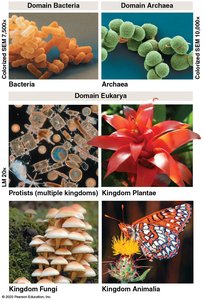
Hierarchical Classification
Biological classification organizes living things into a hierarchy of increasingly specific categories:
Domain
Kingdom
Phylum
Class
Order
Family
Genus
Species
The two-part scientific naming system is called binomial nomenclature (Genus species).
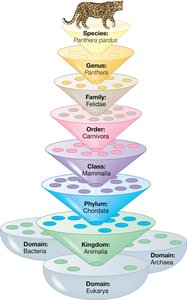
Defining Life
Properties of Living Things
Living things share several defining properties:
Order: Living things have complex but ordered organization.
Cells: All living things are made of one or more cells, which have a plasma membrane, cytosol, DNA-based chromosomes, and ribosomes.
Regulation (Homeostasis): Ability to maintain a stable internal environment.
Growth and Development: Living things grow and develop according to specific instructions coded in their DNA.
Energy Processing (Metabolism): Living things obtain and use energy. - Catabolism: Breaking down complex molecules. - Anabolism: Building complex molecules from simpler ones.
Response to Environment: Ability to respond to external stimuli.
Reproduction: Ability to produce new individuals.
Evolutionary Adaptation: Populations evolve over generations through mutations and natural selection.
Summary Table: Properties of Life
Property | Description |
|---|---|
Order | Highly organized structure |
Cells | Basic unit of life |
Regulation | Maintaining internal balance (homeostasis) |
Growth & Development | Increase in size and complexity |
Energy Processing | Metabolism (catabolism & anabolism) |
Response to Environment | Reacting to stimuli |
Reproduction | Producing offspring |
Evolutionary Adaptation | Change over generations |
Example: A chameleon (an animal) displays all these properties: it is made of cells, grows, maintains homeostasis, processes energy, responds to its environment, reproduces, and evolves.
Additional info: Viruses, prions, and other entities may display some but not all properties of life, leading to debates about their classification as living or non-living.
