 Back
BackChapter 23: The Evolution of Populations – Study Notes
Study Guide - Smart Notes
 Tailored notes based on your materials, expanded with key definitions, examples, and context.
Chapter 23: The Evolution of Populations
Introduction to Population Evolution
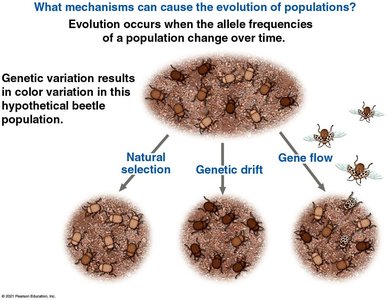
Evolution at the population level involves changes in allele frequencies over generations. While natural selection acts on individuals, only populations evolve. Understanding the mechanisms that drive these changes is fundamental to evolutionary biology.
Natural selection acts on heritable traits, leading to adaptation.
Genetic drift involves random changes in allele frequencies, especially in small populations.
Gene flow is the transfer of alleles between populations, which can increase or decrease genetic variation.
Genetic Variation and Its Sources
Genetic Variation: The Raw Material for Evolution
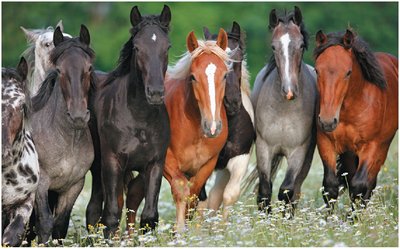
Genetic variation refers to differences in genes or DNA sequences among individuals. It is essential for evolution by natural selection, as only genetically based variation can be inherited and acted upon by evolutionary forces.
Phenotype is the observable trait, influenced by genotype and environment.
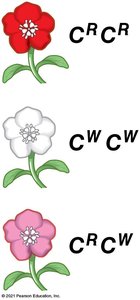
Variation can be discrete (either-or, e.g., flower color) or quantitative (continuous, e.g., height).
Measuring Genetic Variation
Genetic variation can be quantified at different levels:
At the gene level: percentage of heterozygous loci in a population.
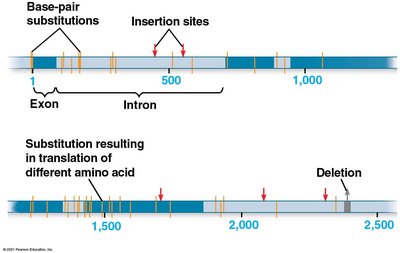
At the molecular level: nucleotide differences between individuals.
Sources of Genetic Variation
Genetic variation arises through several mechanisms:
Mutation: Changes in DNA sequence, including point mutations, insertions, deletions, and duplications.
Gene duplication: Can lead to new gene functions over time.
Sexual reproduction: Recombines existing alleles through crossing over, independent assortment, and fertilization.
Most mutations are neutral or harmful, but some can be beneficial. In multicellular organisms, only mutations in gamete-producing cells are heritable.
The Hardy-Weinberg Principle
Gene Pools and Allele Frequencies
A gene pool includes all alleles at all loci in a population. The frequency of each allele and genotype can be calculated to describe the genetic structure of a population.
The Hardy-Weinberg Equation
The Hardy-Weinberg equation predicts genotype frequencies in a non-evolving population:
For two alleles, p and q:
$p + q = 1$
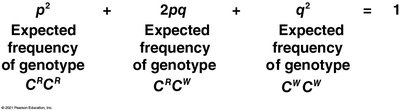
$p^2 + 2pq + q^2 = 1$
p2: Frequency of homozygous dominant genotype
2pq: Frequency of heterozygous genotype
q2: Frequency of homozygous recessive genotype
Conditions for Hardy-Weinberg Equilibrium
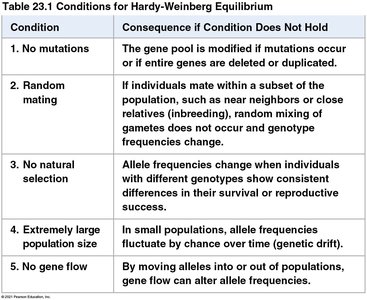
For a population to remain in Hardy-Weinberg equilibrium (no evolution), five conditions must be met:
Condition | Consequence if Condition Does Not Hold |
|---|---|
No mutations | Gene pool is modified if mutations occur or if genes are deleted/duplicated. |
Random mating | Nonrandom mating changes genotype frequencies. |
No natural selection | Allele frequencies change if genotypes differ in survival/reproduction. |
Large population size | Small populations experience genetic drift. |
No gene flow | Gene flow alters allele frequencies. |
Mechanisms of Evolutionary Change
Natural Selection
Natural selection increases the frequency of alleles that enhance survival and reproduction. It is the only mechanism that consistently leads to adaptive evolution.
Selection acts on phenotypes, but only heritable variation affects evolution.
Relative fitness measures an individual's contribution to the next generation compared to others.
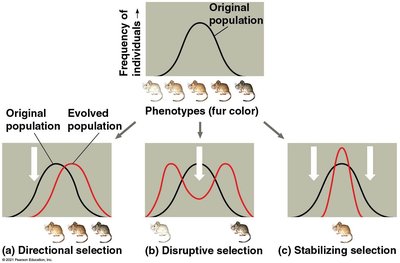
Types of Selection
Directional selection: Favors one extreme phenotype.
Disruptive selection: Favors both extremes over intermediates.
Stabilizing selection: Favors intermediate phenotypes.
Genetic Drift
Genetic drift is random fluctuation in allele frequencies, especially significant in small populations. It can lead to loss of genetic variation and fixation of harmful alleles.
Founder effect: A few individuals establish a new population with different allele frequencies.
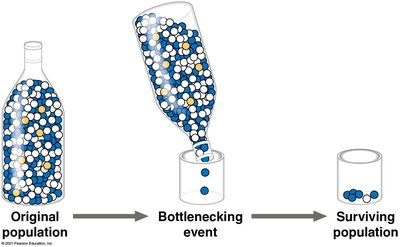
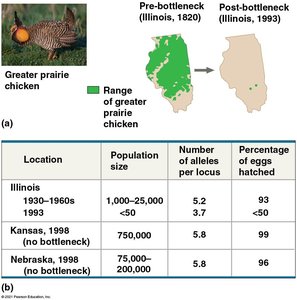
Bottleneck effect: A drastic reduction in population size alters allele frequencies.
Case Study: Greater Prairie Chicken
Population bottlenecks reduced genetic variation and hatching success in Illinois prairie chickens. Introducing individuals from other populations restored genetic diversity and improved fitness.
Gene Flow
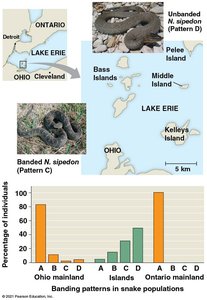
Gene flow is the movement of alleles between populations, which can reduce differences among populations and affect adaptation to local environments.
Example: Migration of banded snakes from mainland to islands maintains disadvantageous alleles in island populations.
Adaptive Evolution and Sexual Selection
Adaptive Evolution
Adaptive evolution results from natural selection increasing the frequency of beneficial alleles. It is a continuous process, as environments change over time.
Sexual Selection
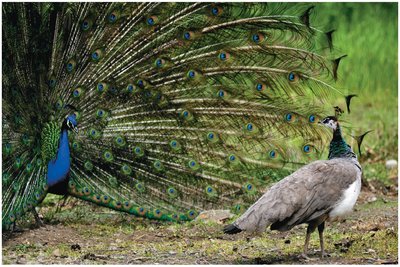
Sexual selection is a form of natural selection where individuals with certain traits are more likely to obtain mates. It can lead to sexual dimorphism (differences between sexes in traits not directly related to reproduction).
Intrasexual selection: Competition among one sex for mates (e.g., male-male competition).
Intersexual selection (mate choice): One sex (usually females) chooses mates based on specific traits.
Balancing Selection and Maintenance of Variation
Balancing Selection
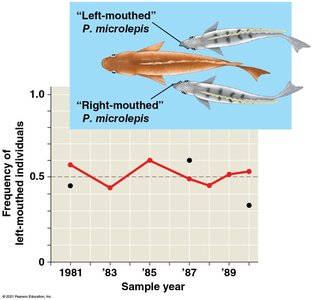
Balancing selection maintains genetic diversity in a population by preserving multiple alleles at a locus.
Frequency-dependent selection: Fitness of a phenotype depends on its frequency relative to others.
Heterozygote advantage: Heterozygotes have higher fitness than either homozygote (e.g., sickle-cell allele in malaria regions).
Limits of Natural Selection
Why Natural Selection Cannot Fashion Perfect Organisms
There are several reasons why evolution does not produce perfect organisms:
Selection can only act on existing variation.
Evolution is limited by historical constraints.
Adaptations are often compromises.
Chance, natural selection, and the environment interact in complex ways.
Additional info: These notes provide a comprehensive overview of the mechanisms driving evolution in populations, with emphasis on genetic variation, the Hardy-Weinberg principle, and the roles of selection, drift, and gene flow. Examples and diagrams reinforce key concepts for exam preparation.
