 Back
BackChapter 3: Carbon and the Molecular Diversity of Life – Study Notes
Study Guide - Smart Notes
 Tailored notes based on your materials, expanded with key definitions, examples, and context.
Carbon and the Molecular Diversity of Life
Introduction to Biomolecules
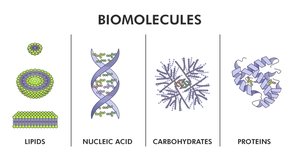
Living organisms are composed of a vast array of organic compounds, primarily built on the element carbon. The diversity and complexity of these molecules underpin the structure and function of all life forms. The four main classes of biomolecules are carbohydrates, lipids, proteins, and nucleic acids.
3.1 Carbon Atoms Can Form Diverse Molecules by Bonding to Four Other Atoms
Properties of Carbon
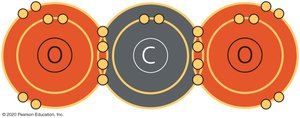
Carbon's unique ability to form four covalent bonds with a variety of atoms allows it to serve as the backbone for large, complex, and diverse molecules. This versatility is due to its four valence electrons, enabling the formation of stable covalent bonds with elements such as hydrogen, oxygen, and nitrogen, as well as with other carbon atoms.
The Tetrahedral Shape of Carbon Compounds
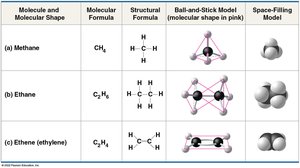
When carbon forms four single bonds, the resulting molecule adopts a tetrahedral geometry. If double bonds are present, the molecule may be planar. The shape of these molecules is crucial for their biological function.
Formation of Bonds with Carbon
Valence: The number of covalent bonds an atom can form, determined by the number of unpaired electrons in its outer shell.
Double Bonds: When two carbons are joined by a double bond, the atoms attached to those carbons are in the same plane, making the molecule flat.
Common Elements Bonded to Carbon: Hydrogen, oxygen, nitrogen, and other carbons.
Hydrocarbons: Molecules consisting only of carbon and hydrogen, often forming long chains or rings.
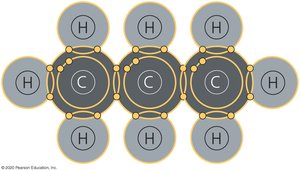
Carbon Chain Skeletons
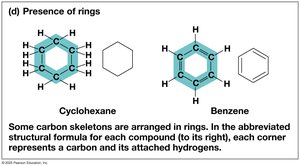
Carbon chains form the skeletons of most organic molecules. These chains can vary in:
Length
Branching
Double bond position
Presence of rings
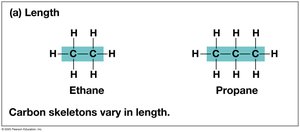
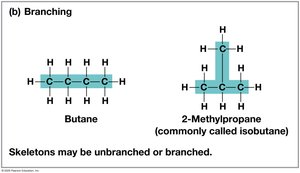
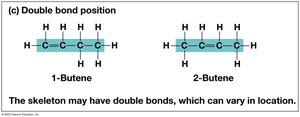
Isomers
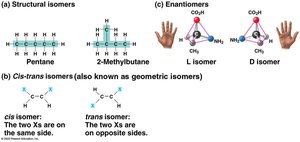
Isomers are compounds with the same molecular formula but different structures and properties. There are three main types:
Structural Isomers: Differ in the covalent arrangement of atoms.
Cis-trans Isomers (Geometric Isomers): Differ in spatial arrangement around double bonds.
Enantiomers: Mirror images of each other, often with only one form biologically active.
Functional Groups
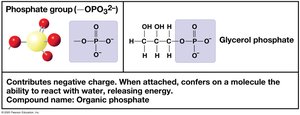
Functional groups are chemical groups attached to carbon skeletons that participate in chemical reactions and confer specific properties to molecules. Seven functional groups are especially important in biological molecules, including hydroxyl, carbonyl, carboxyl, amino, sulfhydryl, phosphate, and methyl groups.
ATP: The Energy Currency of the Cell
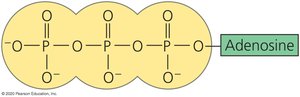
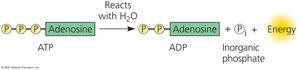
Adenosine triphosphate (ATP) is an organic molecule consisting of adenosine attached to three phosphate groups. ATP stores potential energy that can be released by hydrolysis, providing energy for cellular processes.
3.2 Macromolecules Are Polymers, Built from Monomers
Polymers and Monomers
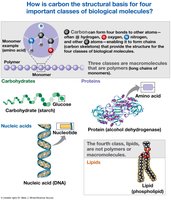
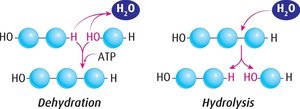
Polymers are long molecules made of repeating units called monomers. The synthesis and breakdown of polymers involve dehydration (condensation) and hydrolysis reactions, respectively. Enzymes catalyze these reactions.
Dehydration Reaction: Joins two monomers by removing a water molecule.
Hydrolysis Reaction: Breaks a bond between monomers by adding water.
Carbohydrates
Monosaccharides
Carbohydrates are sugars and polymers of sugars. The simplest are monosaccharides (e.g., glucose), which serve as major nutrients and building blocks for other molecules. Monosaccharides typically have the formula and form rings in aqueous solutions.
Disaccharides and Glycosidic Linkages
Disaccharides are formed by joining two monosaccharides via a glycosidic linkage (a covalent bond formed by a dehydration reaction). Example: sucrose (glucose + fructose).
Polysaccharides
Polysaccharides are carbohydrate polymers with storage (e.g., starch, glycogen) or structural (e.g., cellulose, chitin) roles. Their function depends on the identity of the monomers and the type of glycosidic linkages.
Starch: Storage in plants; composed of glucose monomers.
Glycogen: Storage in animals; highly branched structure.
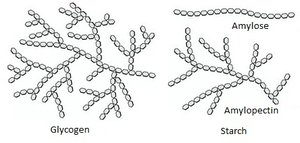
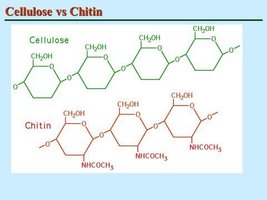
Cellulose: Structural component of plant cell walls; straight, unbranched polymer of glucose.
Chitin: Structural polysaccharide in arthropods and fungi; similar to cellulose but with nitrogen-containing groups.
Lipids
General Properties
Lipids are hydrophobic molecules that do not form true polymers. They are mainly composed of hydrocarbons and serve as energy storage, structural components, and signaling molecules.
Fats (Triacylglycerols)
Fats are constructed from glycerol and three fatty acids, forming triacylglycerol via ester linkages. Fats store more than twice as much energy as carbohydrates.
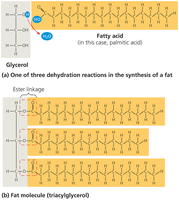
Saturated vs. Unsaturated Fatty Acids
Saturated fatty acids: No double bonds; solid at room temperature; mostly animal fats.
Unsaturated fatty acids: One or more double bonds; liquid at room temperature; mostly plant and fish fats.
Trans fats: Unsaturated fats with trans double bonds; can be artificially produced by hydrogenation.
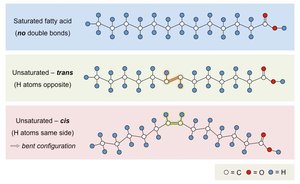
Phospholipids
Phospholipids consist of two fatty acids, a phosphate group, and glycerol. They are amphipathic, with hydrophobic tails and a hydrophilic head, and form the basis of cell membranes by self-assembling into bilayers in water.
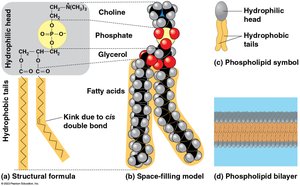
Steroids
Steroids are lipids with a carbon skeleton consisting of four fused rings. Cholesterol is a key steroid in animal cell membranes and a precursor for other steroids such as hormones.
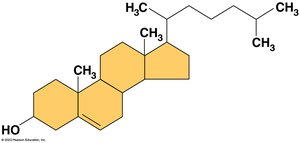
Proteins
Structure and Function
Proteins are polymers of amino acids and account for more than 50% of the dry mass of most cells. They perform a wide range of functions, including catalysis, defense, transport, communication, movement, and structural support.
Amino Acids
Amino acids are organic molecules with amino and carboxyl groups, differing in their side chains (R groups). The sequence and properties of amino acids determine protein structure and function. There are 20 standard amino acids used by cells.
Polypeptides and Protein Structure
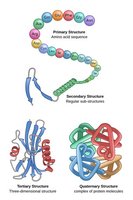
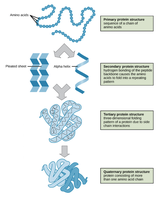
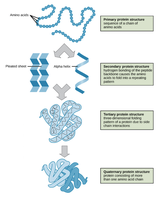
Primary structure: Unique sequence of amino acids.
Secondary structure: Coils and folds (α helix, β pleated sheet) due to hydrogen bonding.
Tertiary structure: Overall 3D shape from interactions among R groups (hydrophobic interactions, disulfide bridges, etc.).
Quaternary structure: Association of two or more polypeptides (e.g., hemoglobin).
Protein Function and Denaturation
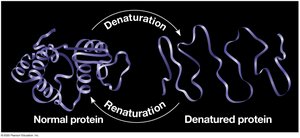
Protein function depends on its specific shape, which can be altered by changes in temperature, pH, or salt concentration. Denaturation is the loss of native structure, rendering the protein inactive. Sometimes, denaturation is reversible.
Nucleic Acids
DNA and RNA
Nucleic acids store, transmit, and help express hereditary information. The two main types are deoxyribonucleic acid (DNA) and ribonucleic acid (RNA). Genes are made of DNA, which directs the synthesis of RNA and, ultimately, proteins (the central dogma: DNA → RNA → Protein).
Nucleotide Structure
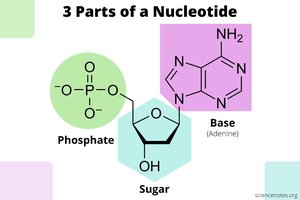
Nucleotides are the monomers of nucleic acids, each consisting of a nitrogenous base, a pentose sugar, and one or more phosphate groups. The nitrogenous bases are classified as pyrimidines (C, T, U) and purines (A, G).
Nucleotide Polymers
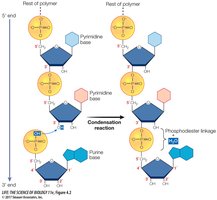
Nucleotides are joined by phosphodiester linkages to form the sugar-phosphate backbone of DNA and RNA. DNA is typically double-stranded, forming a double helix with complementary base pairing (A-T, G-C), while RNA is usually single-stranded.
Genomics and Proteomics
Overview
Genomics is the study of whole sets of genes and their interactions, while proteomics focuses on large sets of proteins. Bioinformatics uses computational tools to analyze biological data, such as genome sequences. These fields have revolutionized our understanding of biology and evolution.
DNA and Proteins as Tape Measures of Evolution
The linear sequences of nucleotides in DNA are inherited and can be compared to assess evolutionary relationships among organisms. Closely related species have more similar DNA sequences than distantly related ones, providing a molecular basis for evolutionary studies.
