 Back
BackChapter 3: Carbon and the Molecular Diversity of Life - Study Notes
Study Guide - Smart Notes
 Tailored notes based on your materials, expanded with key definitions, examples, and context.
Carbon and the Molecular Diversity of Life
Overview: Carbon Compounds and Life
Living organisms are composed primarily of chemicals based on the element carbon. Carbon's unique properties allow it to form large, complex, and varied molecules, making it the foundation of organic chemistry and biological macromolecules. - Organic compounds are molecules containing carbon. - Four main classes of biological molecules: carbohydrates, lipids, proteins, and nucleic acids. - The first three classes can form macromolecules, which are large molecules built from smaller units.
What Properties Make Carbon the Basis of All Life?
Carbon's versatility arises from its electron configuration, which allows it to form four covalent bonds with a variety of atoms. This enables the creation of diverse molecular structures. - Valence is the number of covalent bonds an atom can form. - Carbon's valence of 4 allows for complex bonding patterns. 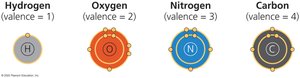
Molecular Diversity Arising from Variation in Carbon Skeletons
The skeletons of organic molecules are formed by carbon chains, which can vary in length, branching, double bond position, and ring formation. This diversity is fundamental to the complexity of biological molecules. - Carbon skeletons can be straight, branched, or arranged in rings. - Double bonds can vary in position, affecting molecular properties. 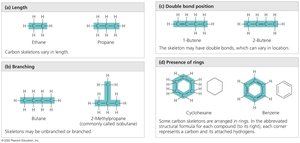
The Chemical Groups Most Important to Life
Chemical groups, known as functional groups, replace hydrogens on the carbon skeleton and are directly involved in chemical reactions. Each functional group has characteristic properties and reactivity. - Seven key functional groups: hydroxyl, carbonyl, carboxyl, amino, sulfhydryl, phosphate, and methyl. 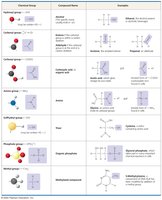
Macromolecules: Polymers and Monomers
Macromolecules Are Polymers, Built from Monomers
Macromolecules are polymers, long chains of repeating units called monomers. Some monomers also have independent biological functions. - Polymer: a long molecule made of repeating monomers. - Monomer: a small molecule that can join with others to form a polymer.
The Synthesis and Breakdown of Polymers
Cells synthesize and degrade polymers using dehydration and hydrolysis reactions, facilitated by enzymes. - Dehydration reaction: joins two monomers by removing a water molecule. - Hydrolysis: breaks a polymer into monomers by adding water. 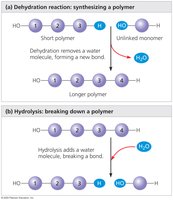
The Diversity of Polymers
The variety of polymers in cells arises from a small set of monomers, leading to immense molecular diversity within and between species.
Carbohydrates: Fuel and Building Material
Carbohydrates
Carbohydrates include sugars and their polymers. The simplest carbohydrates are monosaccharides, which serve as energy sources and building blocks. - Monosaccharides: simple sugars, usually multiples of CH2O. - Polysaccharides: polymers of sugars with storage or structural roles.
Sugars: Monosaccharides and Disaccharides
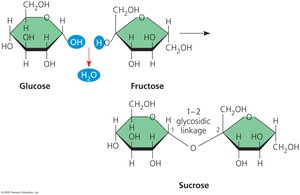
Monosaccharides are classified by the number of carbons and the position of the carbonyl group. In aqueous solutions, many sugars form rings. - Glucose (C6H12O6) is the most common monosaccharide. - Disaccharide: formed by joining two monosaccharides via a glycosidic linkage. 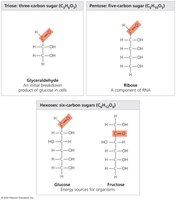
Polysaccharides: Storage and Structural Roles
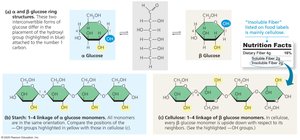
Polysaccharides serve as storage (starch in plants, glycogen in animals) and structural (cellulose in plants, chitin in arthropods and fungi) molecules. - Starch: storage polysaccharide in plants, composed of glucose monomers. - Glycogen: storage polysaccharide in animals, stored in liver and muscle. - Cellulose: structural polysaccharide in plant cell walls, differs from starch in glycosidic linkage. - Chitin: structural polysaccharide in arthropod exoskeletons and fungal cell walls. 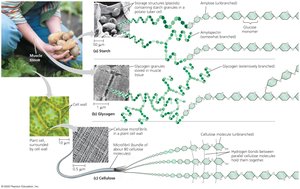
Lipids: Energy Storage and Membrane Structure
Lipids
Lipids are hydrophobic molecules, including fats, phospholipids, and steroids. They serve as energy storage, membrane structure, and signaling molecules.
Fats
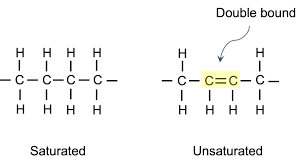
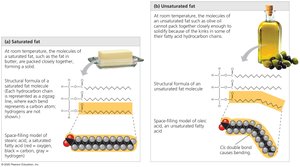
Fats are composed of three fatty acids joined to glycerol by ester linkages, forming triglycerides. - Saturated fatty acids: no double bonds, solid at room temperature. - Unsaturated fatty acids: one or more double bonds, liquid at room temperature. 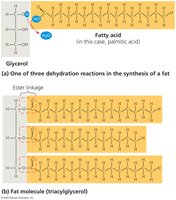
Phospholipids
Phospholipids have two fatty acid tails (hydrophobic) and a phosphate group (hydrophilic head) attached to glycerol. They form bilayers in cell membranes. 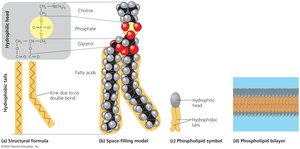
Steroids
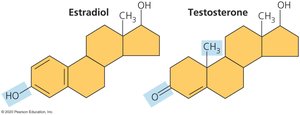
Steroids are lipids with a carbon skeleton of four fused rings. Cholesterol is a key steroid in animal cell membranes. 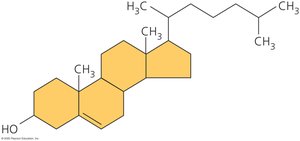
Proteins: Structure and Function
Proteins Include a Diversity of Structures, Resulting in a Wide Range of Functions
Proteins are polymers of amino acids and perform numerous functions, including catalysis, defense, storage, transport, communication, movement, and structural support. 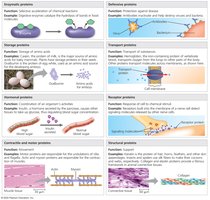
Amino Acid Monomers
Amino acids have carboxyl and amino groups, and differ by their side chains (R groups). There are 20 amino acids in proteins. 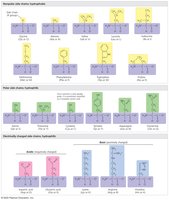
Polypeptides (Amino Acid Polymers)
Amino acids are linked by peptide bonds to form polypeptides, which have a unique sequence and directionality (N-terminus to C-terminus). 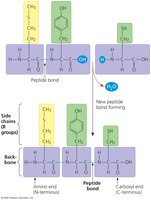
Protein Structure and Function
Protein function depends on its three-dimensional structure, which is determined by the sequence of amino acids and environmental conditions. - Four levels of protein structure: primary (sequence), secondary (coils and folds), tertiary (overall shape), quaternary (multiple polypeptides). 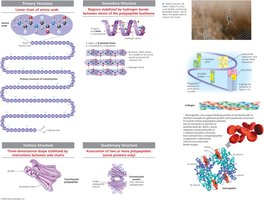
Sickle-Cell Disease: A Change in Primary Structure
A single amino acid substitution can alter protein structure and function, as seen in sickle-cell disease affecting hemoglobin. 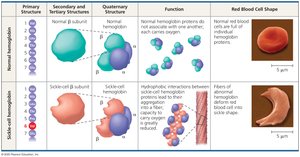
What Determines Protein Structure?
Protein structure is influenced by amino acid sequence and environmental factors such as pH, salt concentration, and temperature. Denaturation is the loss of native structure, rendering the protein inactive. 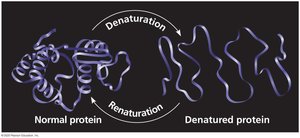
Nucleic Acids: Hereditary Information
Nucleic Acids Store, Transmit, and Help Express Hereditary Information
Nucleic acids (DNA and RNA) are polymers of nucleotides and are responsible for storing and transmitting genetic information. - Gene expression: DNA → RNA → Protein 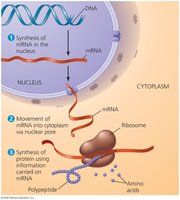
The Components of Nucleic Acids
Nucleotides consist of a nitrogenous base, a pentose sugar, and one or more phosphate groups. - Two families of nitrogenous bases: pyrimidines (single ring: C, T, U) and purines (double ring: A, G). - DNA contains deoxyribose; RNA contains ribose. 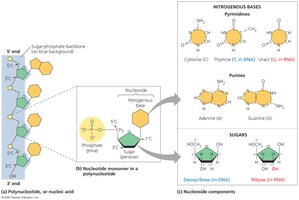
Nucleotide Polymers
Nucleotides are joined by phosphodiester linkages, forming a sugar-phosphate backbone. DNA and RNA have directionality (5' to 3' ends).
The Structures of DNA and RNA Molecules
DNA is a double helix with antiparallel strands and complementary base pairing (A-T, G-C). RNA is usually single-stranded, with A-U pairing. 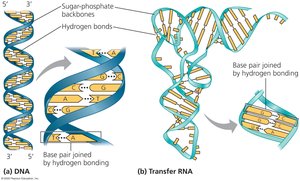
Additional info:
- The diversity and complexity of biological macromolecules arise from the versatility of carbon and the specific chemical properties of functional groups. - Understanding the structure and function of carbohydrates, lipids, proteins, and nucleic acids is fundamental to molecular biology and biochemistry.
