 Back
BackChapter 3: Water and Life – Key Concepts and Properties
Study Guide - Smart Notes
 Tailored notes based on your materials, expanded with key definitions, examples, and context.
Water and Life
Polar Covalent Bonds and Hydrogen Bonding in Water
Water’s unique properties arise from its molecular structure and the interactions between its molecules. The polarity of water molecules leads to hydrogen bonding, which is fundamental to many of water’s behaviors.
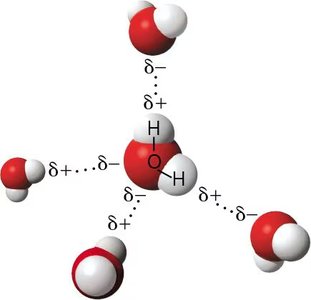
Polar Molecule: Water (H2O) has a bent shape, with oxygen being more electronegative than hydrogen, resulting in partial negative (δ−) and partial positive (δ+) charges.
Hydrogen Bond: A weak bond formed when the partially positive hydrogen of one water molecule is attracted to the partially negative oxygen of another.
Significance: Hydrogen bonding is responsible for water’s cohesion, surface tension, and many other emergent properties.
Comparison: A hydrogen bond is not a covalent bond; it is an intermolecular force, whereas a polar covalent bond is an intramolecular bond within a water molecule.
Example: The attraction between water molecules in liquid water is due to hydrogen bonds.
Emergent Properties of Water
Hydrogen bonding gives rise to four key properties of water that are essential for life on Earth.
Cohesion: Water molecules stick together, aiding the transport of water against gravity in plants.
Surface Tension: The measure of how difficult it is to stretch or break the surface of a liquid; water’s is unusually high.
High Specific Heat: Water can absorb or release large amounts of heat with only a slight change in its own temperature. This property stabilizes ocean and organism temperatures.
Heat of Vaporization & Evaporative Cooling: Water requires significant energy to vaporize, and as it evaporates, it cools surfaces (e.g., sweating in animals).
Ice Floats: Solid water (ice) is less dense than liquid water due to hydrogen bonds forming a crystalline structure, allowing aquatic life to survive under ice.
Versatile Solvent: Water dissolves many substances due to its polarity, making it an excellent medium for chemical reactions in cells.
Hydrophilic vs. Hydrophobic: Hydrophilic substances have an affinity for water; hydrophobic substances do not mix with water.
Solution: A homogeneous mixture of two or more substances; water is often the solvent in biological solutions.
Molarity (M): The number of moles of solute per liter of solution, used to express concentration.
Mole: A unit representing 6.022 × 10²³ molecules; the mass of one mole in grams equals the molecular mass in daltons.
Example: Salt (NaCl) dissolves in water as the polar water molecules surround and separate the ions.
Additional info: The emergent properties of water are crucial for the existence and evolution of life, both on Earth and potentially on other planets.
Acidic and Basic Conditions and Their Effects on Living Organisms
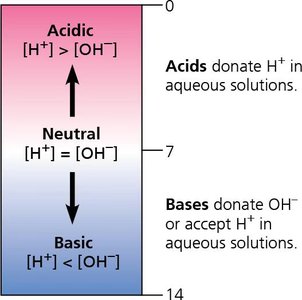
The balance of hydrogen ions (H+) and hydroxide ions (OH−) in aqueous solutions determines acidity or basicity, which is vital for biological processes.
Water Ionization: Water can transfer an H+ to another water molecule, forming hydronium (H3O+) and hydroxide (OH−).
pH Scale: Measures the concentration of H+ ions; defined as .
Acids: Substances that increase H+ concentration in solution.
Bases: Substances that reduce H+ concentration, often by donating OH− or accepting H+.
Buffers: Mixtures of weak acids and bases that resist changes in pH by reversibly binding H+.
Example: The bicarbonate buffer system in blood maintains pH homeostasis.
Environmental Impact: Ocean Acidification
Human activities, such as burning fossil fuels, increase atmospheric CO2. Some CO2 dissolves in oceans, forming carbonic acid and lowering ocean pH—a process called ocean acidification. This threatens marine organisms that rely on calcium carbonate for their shells and skeletons.
Example: Coral reefs are at risk due to decreased calcification rates in more acidic oceans.
Additional info: If the concentration of OH− in a solution rises to 10−3 M, the concentration of H+ decreases to 10−11 M (since at 25°C), and the pH is 11.
