Back
BackChapter 3: Water and Life – Study Notes for Biology Students
Study Guide - Smart Notes
 Tailored notes based on your materials, expanded with key definitions, examples, and context.
Water and Life
Introduction to Water's Role in Biology
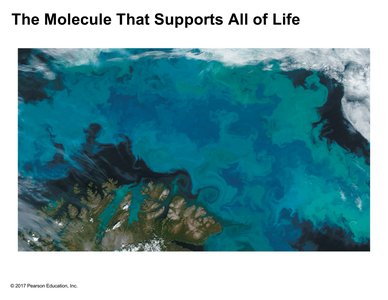
Water is a fundamental molecule that makes life possible on Earth. It covers most of the planet and composes a significant portion of living organisms. Many biochemical reactions essential for life depend on water's unique properties, which are directly related to its molecular structure.
Structure of Water Molecules
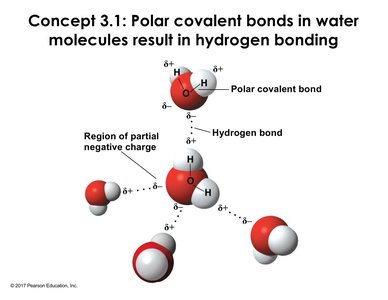
The structure of water is responsible for its special properties. Water molecules contain polar covalent bonds, resulting in partial charges: oxygen is more electronegative, creating a partial negative charge, while hydrogen atoms have partial positive charges. This polarity enables water molecules to form hydrogen bonds with each other, which are individually weak and transient but collectively strong due to their abundance.
Polar covalent bond: Unequal sharing of electrons between oxygen and hydrogen.
Hydrogen bond: Attraction between partial positive and partial negative regions of adjacent water molecules.
Emergent properties: Physical characteristics of water arising from its molecular interactions.
Emergent Properties of Water
Overview of Water's Four Emergent Properties
Water's unique structure gives rise to four emergent properties that make Earth suitable for life:
Cohesive behavior
Ability to moderate temperature
Expansion upon freezing
Versatility as a solvent
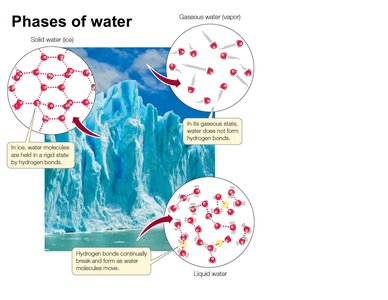
Phases of Water
Water exists in three states: solid (ice), liquid, and gas (vapor). The arrangement and movement of water molecules differ in each phase:
Solid (ice): Water molecules form a stable crystal lattice with maximum hydrogen bonding (four bonds per molecule).
Liquid: Hydrogen bonds are constantly breaking and reforming; molecules are closer together than in ice.
Gas (vapor): Molecules move rapidly with high kinetic energy; hydrogen bonds do not form.
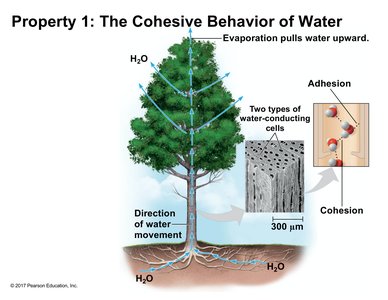
Cohesive Behavior of Water
Cohesion refers to water molecules sticking to each other via hydrogen bonds. This property enables processes such as transpiration in plants, where water moves upward from roots to leaves. Adhesion is water's ability to stick to other substances, such as cell walls in plants, facilitating directional movement.
Cohesion: Interaction between like molecules (water-water).
Adhesion: Interaction between water and other charged/polar surfaces.
Transpiration: Movement of water through plant tissues, driven by cohesion and adhesion.
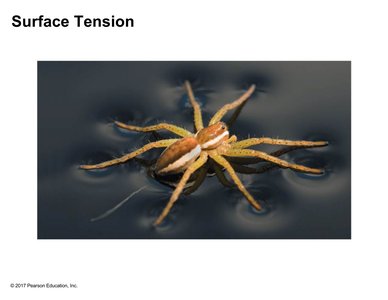
Surface Tension
Surface tension is the measure of how difficult it is to break the surface of a liquid. Cohesion produces surface tension, allowing certain insects (e.g., water striders) to walk on water and enabling water to slightly overflow a glass without spilling.
Surface tension: Caused by stronger attraction among water molecules at the surface.
Example: Water strider walking on water.
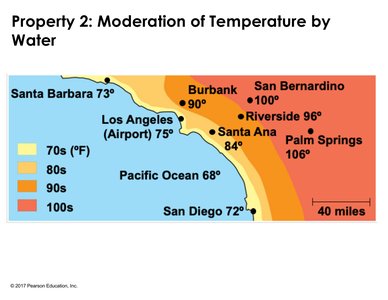
Moderation of Temperature by Water
Water can absorb and release large amounts of heat with only slight changes in its own temperature due to the energy required to break hydrogen bonds. This property is known as high specific heat, which helps minimize temperature fluctuations and maintain stable environments for organisms.
Specific heat: Amount of heat needed to change the temperature of 1 gram of a substance by 1°C.
Heat absorption: Breaks hydrogen bonds.
Heat release: Forms hydrogen bonds.
Example: Coastal regions have more moderate temperatures due to the ocean's heat absorption.
Evaporative Cooling
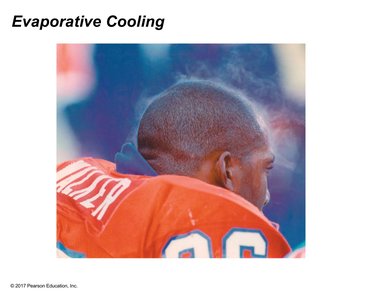
Evaporation is the transformation of water from liquid to gas, requiring energy to break hydrogen bonds. As water evaporates, it cools the surface, helping organisms regulate temperature and prevent overheating.
Heat of vaporization: Energy required to change 1 gram of water from liquid to gas.
Example: Sweating cools the body by evaporative loss of water.
Expansion Upon Freezing
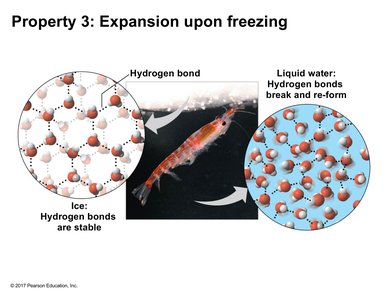
When water freezes, its molecules form a stable crystal lattice, increasing the distance between them and making ice less dense than liquid water. This property allows ice to float, insulating aquatic life below and preventing bodies of water from freezing solid.
Crystal lattice: Stable hydrogen bonds in ice.
Density: Ice is less dense than liquid water.
Example: Icebergs float; aquatic organisms survive under ice.
Water as a Universal Solvent
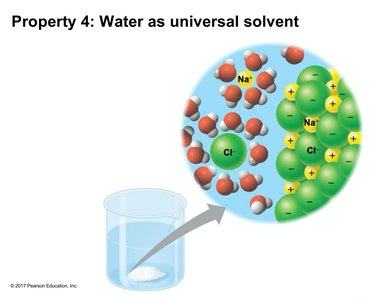
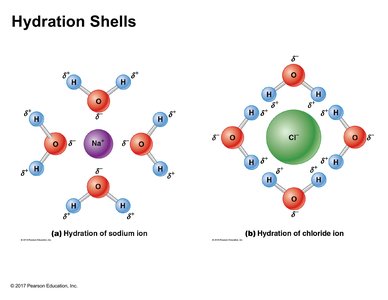
Water's polarity makes it an excellent solvent, capable of dissolving many substances. When ionic compounds (e.g., salt) dissolve, water molecules surround the ions, forming hydration shells and separating them.
Solvent: Dissolving agent (water).
Solute: Substance being dissolved (e.g., salt).
Solution: Homogeneous mixture of solute and solvent.
Aqueous solution: Solution where water is the solvent.
Hydration Shells
Water molecules orient themselves differently around positive (Na+) and negative (Cl-) ions, forming hydration shells that facilitate dissolution.
Hydration shell: Sphere of water molecules surrounding an ion.
Orientation: Partial negative oxygen faces Na+; partial positive hydrogen faces Cl-.
Dissolving Large Polar Molecules
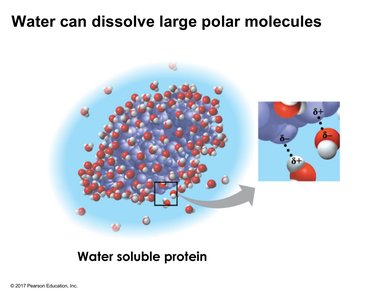
Water can also dissolve large polar molecules, such as proteins, by forming hydrogen bonds with their polar regions. Molecules with polar or ionic properties are termed hydrophilic (water-loving).
Hydrophilic: Attracted to water; can form hydrogen bonds.
Example: Water-soluble proteins and sugars.
Hydrophilic and Hydrophobic Substances
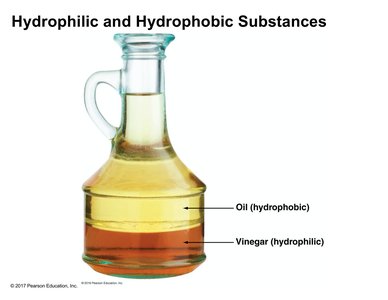
Hydrophilic substances interact with water due to their polar or ionic nature. Hydrophobic substances, such as oils, do not interact with water and tend to aggregate together, minimizing disruption of hydrogen bonding in water. This property is important in cell membrane structure and function.
Hydrophilic: Water-loving; interacts with water.
Hydrophobic: Water-fearing; does not interact with water.
Example: Oil (hydrophobic) and vinegar (hydrophilic) separation.
Solute Concentration in Aqueous Solutions
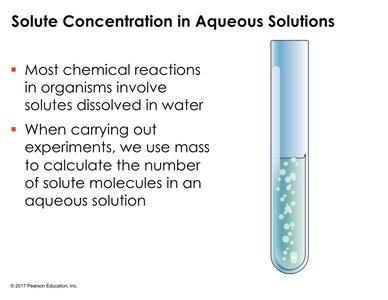
Most biological reactions occur in aqueous solutions. Solute concentration is the amount of solute dissolved per unit volume of solution, commonly measured in grams per liter. Accurate preparation of solutions is essential for experimental and physiological processes.
Solute concentration: Amount of solute per unit volume.
Example: 1 gram of salt dissolved to make 1 liter of solution.
Acidic and Basic Conditions Affect Living Organisms
Ionization of Water
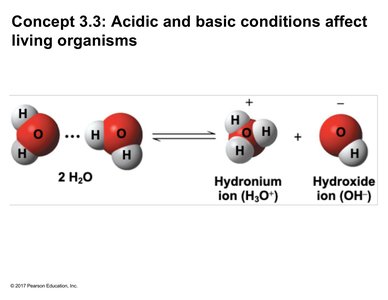
Water molecules can undergo ionization, where a hydrogen atom shifts from one molecule to another, forming a hydronium ion (H3O+) and a hydroxide ion (OH-). This process affects the acidic or basic properties of solutions.
Ionization: Formation of hydronium and hydroxide ions.
Equation:
pH Scale and Biological Relevance
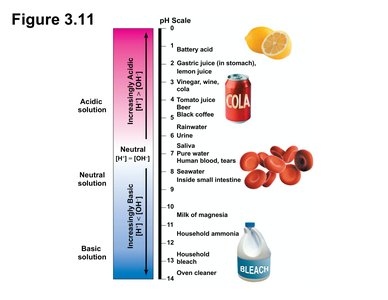
The pH scale measures the concentration of hydrogen ions in a solution, ranging from acidic (low pH) to basic (high pH). Biological processes often require a narrow pH range, and small shifts can have significant effects on molecular function, reaction rates, and solubility.
pH: Negative logarithm of hydrogen ion concentration ().
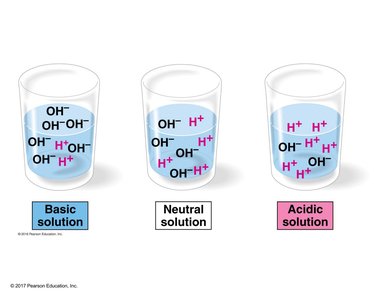
Neutral: pH 7; equal concentrations of hydronium and hydroxide ions.
Acidic: pH < 7; higher concentration of hydrogen ions.
Basic: pH > 7; lower concentration of hydrogen ions.
Buffers and pH Regulation
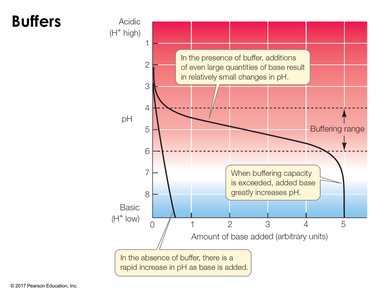
Buffers are substances that minimize changes in pH by absorbing or releasing hydrogen ions. They are essential for maintaining stable conditions in biological systems, such as blood, which must remain within a narrow pH range for proper physiological function.
Buffer: Substance that resists changes in pH.
Example: Blood buffer system maintains pH between 7.35 and 7.45.
Buffering range: The range within which a buffer can effectively resist pH changes.
Acidification of Oceans
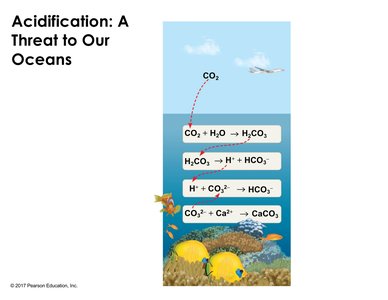
Human activities increase atmospheric CO2, which dissolves in oceans and forms carbonic acid. This acid dissociates, increasing hydrogen ion concentration and reducing carbonate ions needed for marine organisms to form calcium carbonate shells. Ocean acidification threatens calcifying species and disrupts marine ecosystems.
CO2 + H2O → H2CO3 (carbonic acid formation)
H2CO3 → H+ + HCO3- (dissociation)
H+ + CO32- → HCO3- (reduces carbonate ions)
CO32- + Ca2+ → CaCO3 (calcium carbonate formation)
Example: Impact on oysters, clams, corals, and plankton.