 Back
BackChapter 6: An Introduction to Metabolism – Study Notes
Study Guide - Smart Notes
 Tailored notes based on your materials, expanded with key definitions, examples, and context.
An Introduction to Metabolism
The Energy of Life
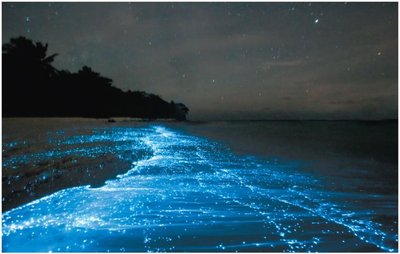
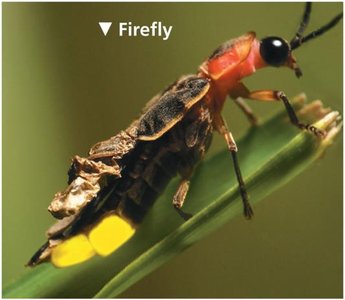
Living cells function as miniature chemical factories, carrying out thousands of reactions to sustain life. Cells extract energy from sugars through cellular respiration and use this energy to perform work. Plants and algae convert sunlight into chemical energy via photosynthesis. Some organisms, such as fireflies and phytoplankton, convert energy to light in a process called bioluminescence.
Bioenergetics and Metabolism
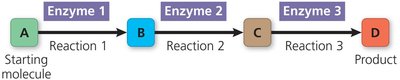
Bioenergetics is the study of how energy flows through living organisms. Metabolism refers to the sum of all chemical reactions in an organism, arising from orderly interactions between molecules. Metabolic pathways begin with a specific molecule and end with a product, with each step catalyzed by a specific enzyme.
Metabolic Pathways: Catabolic and Anabolic
Metabolic pathways are classified as either catabolic or anabolic:
Catabolic pathways: Release energy by breaking down complex molecules into simpler compounds (e.g., cellular respiration).
Anabolic pathways: Consume energy to build complex molecules from simpler ones (e.g., protein synthesis from amino acids).
Forms of Energy
Kinetic and Potential Energy
Energy is the capacity to cause change or do work. It exists in various forms:
Kinetic energy: Energy of motion. Includes thermal energy (random movement of atoms/molecules) and heat (thermal energy transfer).
Light: Can be harnessed to perform work.
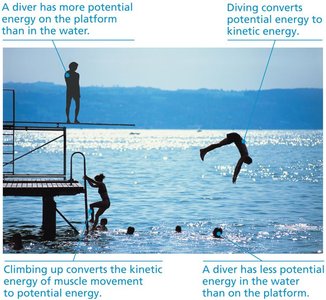
Potential energy: Energy that matter possesses due to its location or structure. Chemical energy is potential energy available for release in a chemical reaction.
Energy can be converted from one form to another.
The Laws of Energy Transformation
Thermodynamics
Thermodynamics is the study of energy transformations. In an open system, energy and matter can be transferred between the system and its surroundings. In an isolated system, exchange with the surroundings cannot occur. Organisms are open systems.
The First Law of Thermodynamics
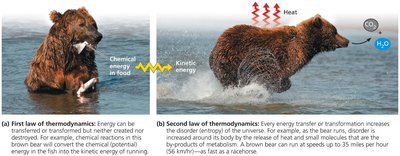
The first law of thermodynamics states that the energy of the universe is constant: energy can be transferred and transformed, but it cannot be created or destroyed. This is also known as the principle of conservation of energy.
The Second Law of Thermodynamics
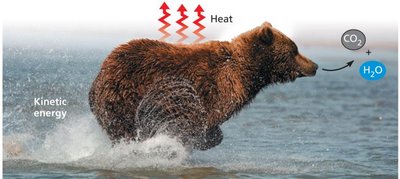
The second law of thermodynamics states that every energy transfer or transformation increases the entropy of the universe. Entropy is a measure of molecular disorder. Every transfer or transformation of energy increases entropy because some energy is lost to the surroundings as heat, which increases disorder.
Spontaneous and Nonspontaneous Processes
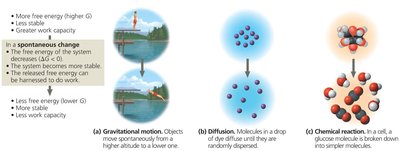
Spontaneous processes occur without energy input and must increase the entropy of the universe. Nonspontaneous processes decrease entropy and require energy input.
Biological Order and Disorder
Cells and organisms create ordered structures from less organized materials, acting as islands of low entropy in an increasingly random universe. While entropy may decrease in a system, the total entropy of the universe increases. Energy flows into ecosystems as light and exits as heat.
Free Energy, Stability, and Equilibrium
Free-Energy Change (ΔG)
Free energy is the portion of a system’s energy that can do work when temperature and pressure are uniform. The change in free energy ($\Delta G$) during a chemical reaction is the difference between the free energy of the final state and the initial state:
$\Delta G = G_{final} - G_{initial}$
Only reactions with a negative $\Delta G$ are spontaneous. At chemical equilibrium, forward and reverse reactions occur at the same rate, representing maximum stability. A process is spontaneous and can perform work only when moving toward equilibrium.
Exergonic and Endergonic Reactions
Exergonic Reactions
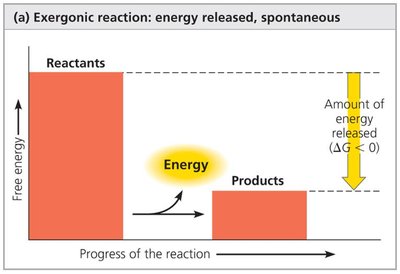
An exergonic reaction releases free energy and is spontaneous ($\Delta G$ is negative). The magnitude of $\Delta G$ represents the maximum amount of work the reaction can perform.
Endergonic Reactions
An endergonic reaction absorbs free energy from the surroundings and is nonspontaneous ($\Delta G$ is positive). The magnitude of $\Delta G$ is the quantity of energy required to drive the reaction.
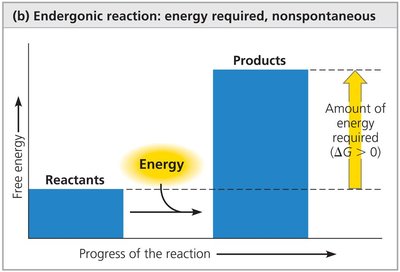
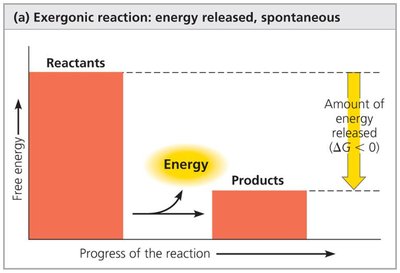
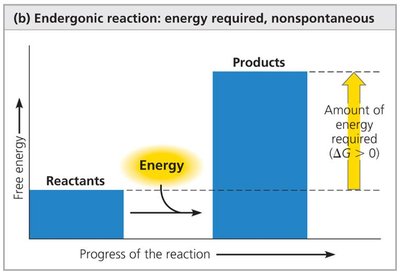
ATP and Cellular Work
ATP Powers Cellular Work
Cells perform three main kinds of work: chemical, transport, and mechanical. Energy coupling, the use of an exergonic process to drive an endergonic one, is mediated by ATP (adenosine triphosphate).
Structure and Hydrolysis of ATP
ATP consists of ribose (a sugar), adenine (a nitrogenous base), and three phosphate groups. The bonds between the phosphate groups can be broken by hydrolysis, releasing energy and producing ADP (adenosine diphosphate) and inorganic phosphate. The energy released comes from the chemical change to a state of lower free energy, not from the phosphate bonds themselves.
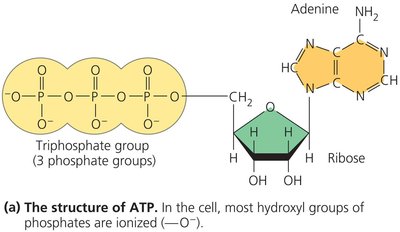
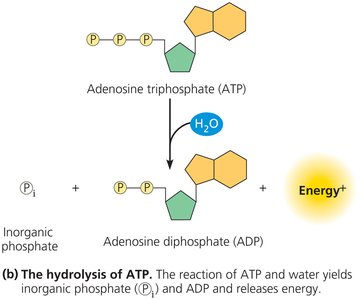
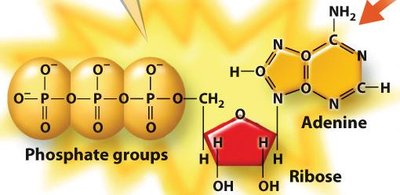
ATP Hydrolysis and Energy Coupling
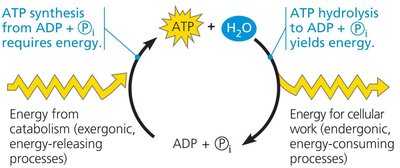
When the phosphate-phosphate bond breaks by hydrolysis, the result is ADP + Pi. The energy released by ATP hydrolysis (exergonic) is used to drive endergonic reactions.
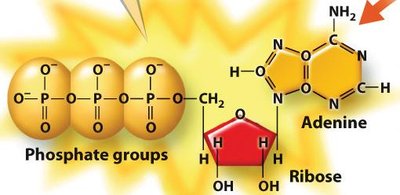
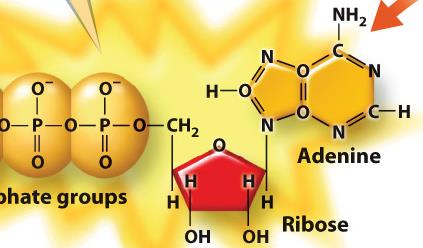

How ATP Works
ATP drives endergonic reactions by phosphorylation, transferring a phosphate group to another molecule (the recipient is a phosphorylated intermediate). Coupled reactions are overall exergonic.

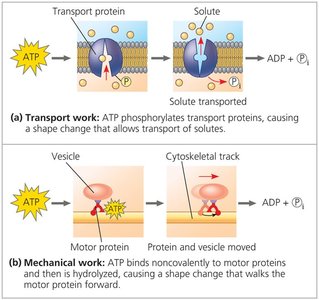
ATP in Transport and Mechanical Work
ATP hydrolysis powers transport and mechanical work by causing changes in protein shape and binding ability. This occurs via phosphorylation or noncovalent bonding between ATP and protein.
Regeneration of ATP
ATP is a renewable resource, regenerated by the addition of a phosphate group to ADP. The energy to phosphorylate ADP comes from catabolic reactions.
Enzymes and Metabolic Reactions
Enzymes as Catalysts
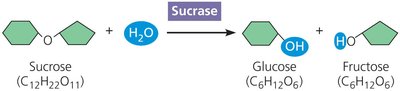
A catalyst is a chemical agent that speeds up a reaction without being consumed. An enzyme is a macromolecule (usually a protein) that acts as a catalyst. For example, sucrase catalyzes the hydrolysis of sucrose.
Activation Energy Barrier
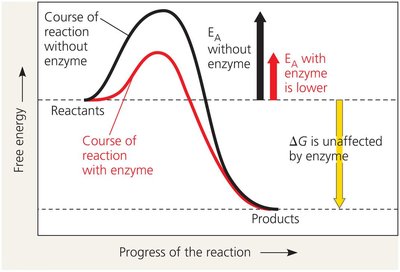
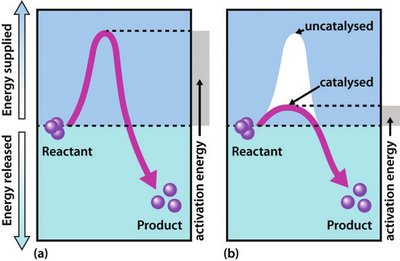
Activation energy (EA) is the energy required to start a reaction. Enzymes lower the EA barrier without being consumed, speeding up reactions that would eventually occur. Enzymes do not affect the change in free energy ($\Delta G$).


Substrate Specificity of Enzymes
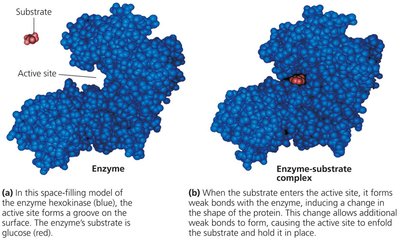
The substrate is the reactant molecule on which an enzyme acts. Enzymes bind to their substrate at the active site, forming an enzyme-substrate complex. Enzyme specificity results from the fit between the shape of the active site and the substrate. Enzymes change shape due to chemical interactions with the substrate, a phenomenon called induced fit.
Catalysis in the Enzyme’s Active Site
Substrates are held in the active site by weak interactions, such as hydrogen bonds. The active site lowers activation energy and converts substrates to products. After releasing products, the active site is available for more substrate molecules. Increasing substrate concentration can speed up the rate of enzyme catalysis, but when all enzyme molecules are saturated, reaction speed can only be increased by adding more enzyme.
Effects of Local Conditions on Enzyme Activity
An enzyme’s activity can be affected by environmental factors such as temperature and pH, as well as chemicals that specifically influence the enzyme. Each enzyme has an optimal temperature and pH at which its reaction rate is greatest.
Cofactors and Coenzymes
Cofactors are nonprotein molecules that help enzymes carry out processes difficult for amino acids. Cofactors may be inorganic (e.g., metal ions) or organic. An organic cofactor is called a coenzyme. Most vitamins act as coenzymes or as raw materials for coenzyme synthesis.
Enzyme Inhibitors
Enzyme activity is often regulated by molecules that selectively inhibit enzyme function:
Competitive inhibitors: Bind to the active site and prevent substrate binding.
Noncompetitive inhibitors: Bind to an alternate site, causing the active site to change shape and become less effective.
Reversible inhibitors bind by weak interactions; irreversible inhibitors form covalent bonds. Toxins and poisons are often irreversible enzyme inhibitors.
Regulation of Enzyme Activity
Cells regulate metabolic pathways by switching on or off genes encoding specific enzymes and by regulating the activity of enzymes once formed.
Allosteric Regulation of Enzymes
Allosteric regulation can inhibit or stimulate enzyme activity. A regulatory molecule binds to a protein at one site and affects its function at another site. Most allosterically regulated enzymes are made from two or more polypeptide subunits and oscillate between active and inactive shapes. Binding of an activator stabilizes the active shape; inhibitor binding stabilizes the inactive shape. Cooperativity occurs when binding of one substrate to the active site of one subunit locks all other subunits into the active shape, amplifying the enzyme's response.
Feedback Inhibition
Feedback inhibition occurs when the end product of a metabolic pathway shuts down the pathway, preventing the cell from wasting resources by making more product than needed.
