 Back
BackChapter 7: Photosynthesis – Using Light to Make Food (Campbell Biology, Concepts & Connections, 10th Edition)
Study Guide - Smart Notes
 Tailored notes based on your materials, expanded with key definitions, examples, and context.
Photosynthesis: Using Light to Make Food
An Introduction to Photosynthesis
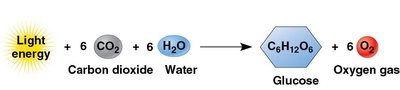
Photosynthesis is the fundamental biological process by which plants, algae, and certain bacteria convert solar energy into chemical energy, producing sugars and oxygen from carbon dioxide and water. This process sustains most life on Earth by providing food and oxygen.
Autotrophs: Organisms that produce their own food from inorganic substances. Plants are autotrophs.
Photoautotrophs: Autotrophs that use light energy to drive the synthesis of organic compounds.
Heterotrophs: Organisms that consume other organisms for energy.
Producers: Photoautotrophs that form the base of food chains.
Importance: Photosynthesis provides food and oxygen for nearly all living organisms.
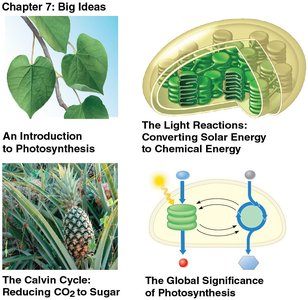
Photosynthesis Occurs in Chloroplasts in Plant Cells
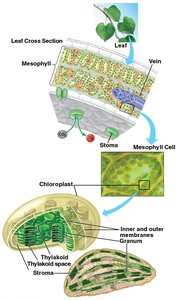
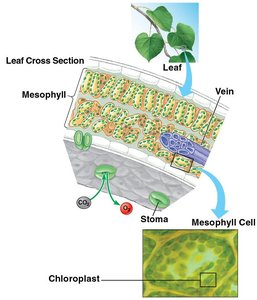
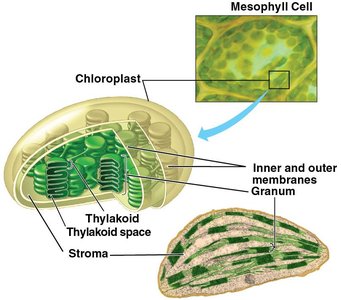
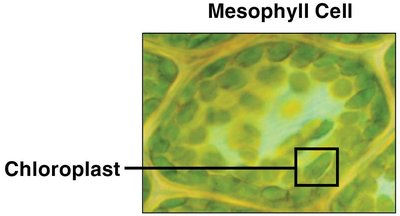
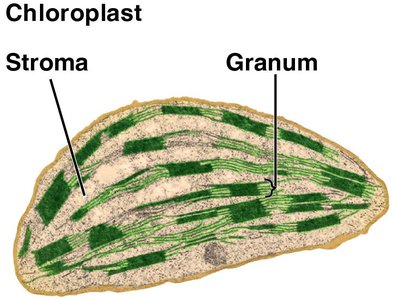
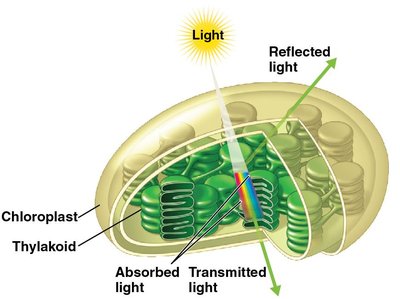
Chloroplasts are specialized organelles found in the mesophyll cells of leaves. They are the site of photosynthesis, containing the pigment chlorophyll and structures necessary for capturing light energy.
Chloroplast Structure: Surrounded by a double membrane, contains stacks of thylakoids (grana) and stroma (fluid).
Chlorophyll: The main light-absorbing pigment, essential for converting solar energy to chemical energy.
Mesophyll: The green tissue in the interior of the leaf, rich in chloroplasts.
Tracing Photosynthesis Using Isotopes
Scientists used isotopes to determine the source of oxygen released during photosynthesis. Experiments with heavy oxygen (O-18) showed that the oxygen gas produced comes from water, not carbon dioxide.
Key Experiment: Plants produced O2 containing O-18 only when supplied with labeled H2O.
Photosynthesis Equation:

Photosynthesis as a Redox Process
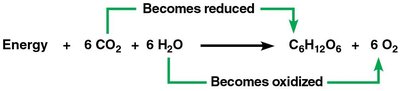
Photosynthesis involves redox (oxidation-reduction) reactions. Water is oxidized, and carbon dioxide is reduced, resulting in the formation of glucose and oxygen.
Oxidation: Loss of electrons (water is oxidized).
Reduction: Gain of electrons (carbon dioxide is reduced).
Comparison: Cellular respiration also uses redox reactions to harvest energy from glucose.
Stages of Photosynthesis: Light Reactions and Calvin Cycle
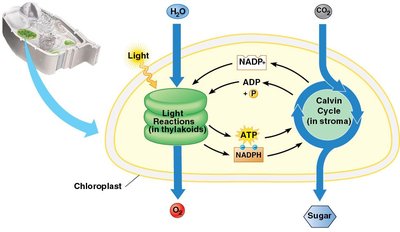
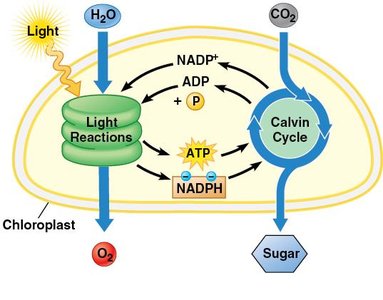
Photosynthesis occurs in two main stages: the light reactions and the Calvin cycle. These stages are linked by ATP and NADPH, which are produced in the light reactions and used in the Calvin cycle.
Light Reactions: Occur in thylakoids, produce ATP and NADPH.
Calvin Cycle: Occurs in stroma, uses ATP and NADPH to fix carbon dioxide into organic molecules.
Carbon Fixation: Incorporation of CO2 into organic compounds.
The Light Reactions: Converting Solar Energy to Chemical Energy
Visible Radiation Absorbed by Pigments Drives the Light Reactions
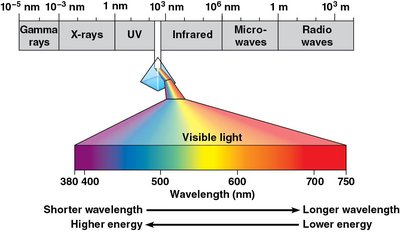
Sunlight is electromagnetic energy. Chlorophyll and other pigments absorb specific wavelengths of visible light, driving the light reactions. Carotenoids protect against excessive light.
Photon: A fixed quantity of light energy.
Wavelength: Shorter wavelengths have higher energy.
Pigments: Chlorophyll a, chlorophyll b, and carotenoids.
Photosystems Capture Solar Energy
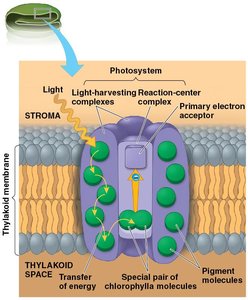
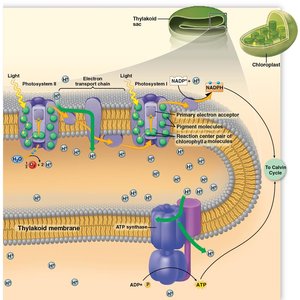
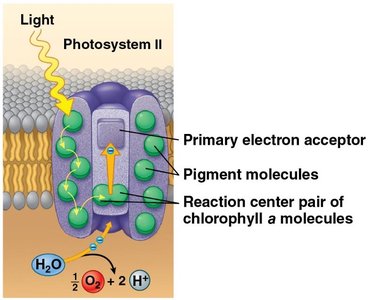
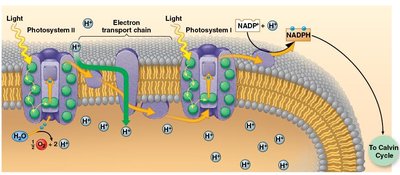
Photosystems are complexes in the thylakoid membrane that capture light energy. Each photosystem consists of light-harvesting complexes and a reaction-center complex. The primary electron acceptor receives excited electrons from chlorophyll a.
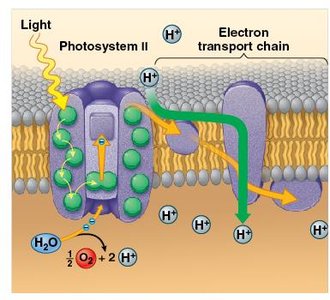
Photosystem II: First in the sequence, splits water and releases O2.
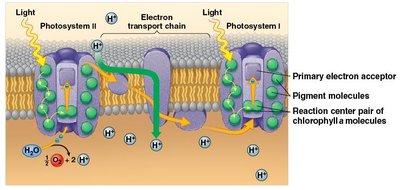
Photosystem I: Second, receives electrons and reduces NADP+ to NADPH.
Electron Transport Chain and Photophosphorylation
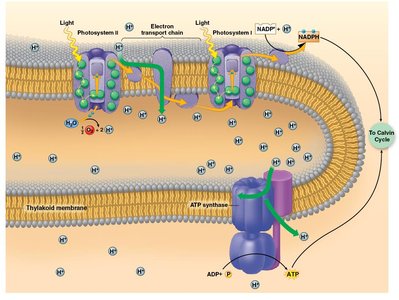
Electrons move from photosystem II to photosystem I via an electron transport chain, generating ATP and NADPH. Water is split to provide electrons, releasing oxygen. The electron transport chain pumps H+ into the thylakoid space, and the resulting gradient powers ATP synthesis via ATP synthase.
Photophosphorylation: ATP production driven by light energy.
ATP Synthase: Enzyme that synthesizes ATP as H+ flows back into the stroma.
The Calvin Cycle: Reducing CO2 to Sugar
ATP and NADPH Power Sugar Synthesis in the Calvin Cycle
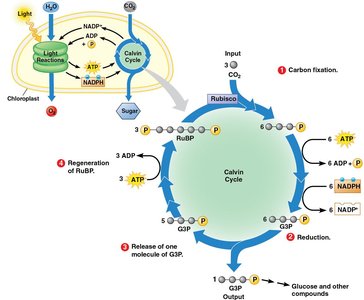
The Calvin cycle uses ATP and NADPH from the light reactions to fix carbon dioxide and produce G3P, a three-carbon sugar. The cycle consists of four main steps: carbon fixation, reduction, release of G3P, and regeneration of RuBP.
Carbon Fixation: Rubisco enzyme combines CO2 with RuBP.
Reduction: ATP and NADPH are used to convert intermediates to G3P.
Release of G3P: One G3P molecule is released per three CO2 fixed.
Regeneration of RuBP: ATP is used to regenerate RuBP from G3P.
Adaptations in Hot, Dry Climates: C3, C4, and CAM Plants
Plants have evolved different mechanisms to fix carbon in hot, dry climates. C3 plants use the Calvin cycle directly, but may undergo photorespiration when CO2 is low. C4 and CAM plants first fix CO2 into four-carbon compounds, allowing them to continue photosynthesis even when stomata are closed.
C3 Plants: Most common, susceptible to photorespiration.
C4 Plants: Fix CO2 in mesophyll cells, then transfer to bundle sheath cells for Calvin cycle.
CAM Plants: Fix CO2 at night, store it for use during the day.
The Global Significance of Photosynthesis
Photosynthesis Provides Food and O2 For Almost All Living Organisms
Photosynthesis is essential for life, providing food and oxygen. Cellular respiration in plants uses about half of the carbohydrates produced. Sugars are also used to synthesize other organic molecules and build cell walls.
Cellulose: Main component of plant cell walls, formed from glucose.
Organic Molecules: Sugars serve as precursors for proteins and lipids.
Rising Atmospheric Levels of Carbon Dioxide and Climate Change
Increasing CO2 levels affect plant growth and global climate. Scientists study these effects using laboratory and field experiments. Reducing fossil fuel use and deforestation can help moderate climate change.
Greenhouse Effect: CO2 and other gases trap heat, leading to global warming.
Climate Change: Long-term directional change in global climate.
Paris Agreement: International effort to reduce greenhouse gas emissions.
Summary Table: Comparison of Photosynthesis Stages
Stage | Location | Reactants | Products | Main Functions |
|---|---|---|---|---|
Light Reactions | Thylakoid membranes | H2O, Light | O2, ATP, NADPH | Convert solar energy to chemical energy |
Calvin Cycle | Stroma | CO2, ATP, NADPH | G3P (sugar), ADP, NADP+ | Fix carbon, synthesize sugars |
Key Terms and Definitions
Autotroph: An organism that makes its own food from inorganic substances.
Photoautotroph: An autotroph that uses light energy to synthesize organic compounds.
Heterotroph: An organism that obtains food by consuming other organisms.
Chloroplast: Organelle in plant cells where photosynthesis occurs.
Thylakoid: Membrane-bound compartment inside chloroplasts, site of light reactions.
Stroma: Fluid inside chloroplasts, site of Calvin cycle.
Photosystem: Complex of proteins and pigments that captures light energy.
ATP: Adenosine triphosphate, energy carrier molecule.
NADPH: Electron carrier produced in light reactions.
Calvin Cycle: Series of reactions that fix carbon dioxide and produce sugars.
Rubisco: Enzyme that catalyzes carbon fixation in the Calvin cycle.
Photorespiration: Process that occurs when O2 is used instead of CO2 in the Calvin cycle.
