 Back
BackChapter 8: Photosynthesis – The Process That Powers Life
Study Guide - Smart Notes
 Tailored notes based on your materials, expanded with key definitions, examples, and context.
Photosynthesis: Feeding the Biosphere
Introduction to Photosynthesis
Photosynthesis is the process by which plants, algae, some protists, and certain prokaryotes convert solar energy into chemical energy, nourishing almost the entire living world. This process occurs primarily in chloroplasts and is fundamental to life on Earth.
Autotrophs: "Self-feeders" that obtain energy and carbon from nonliving sources, producing organic molecules from CO2 and other inorganic substances. Most plants are photoautotrophs, using sunlight to synthesize organic compounds.
Heterotrophs: Organisms that obtain energy and carbon by consuming other organisms or their remains. They depend directly or indirectly on photoautotrophs for food and oxygen.
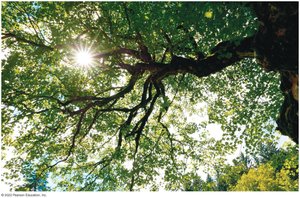
Example: Plants, algae, and cyanobacteria are primary producers, while animals, fungi, and many bacteria are heterotrophs.
Photosynthesis: Chloroplasts in Plants
Structure and Function of Chloroplasts
Chloroplasts are the organelles where photosynthesis takes place. They are mainly found in the mesophyll cells of leaves and are believed to have evolved from photosynthetic bacteria (endosymbiont theory).
Leaves are the primary site of photosynthesis in plants.
CO2 enters and O2 exits the leaf through microscopic pores called stomata.
Chloroplasts have a double membrane surrounding a dense fluid called the stroma, with internal membranes called thylakoids that may form stacks known as grana.
The green pigment chlorophyll resides in the thylakoid membranes and is responsible for capturing light energy.
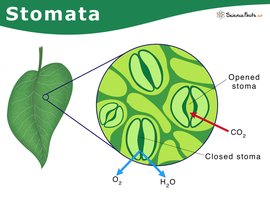
Example: Each mesophyll cell contains 30–40 chloroplasts, maximizing the plant's ability to capture sunlight.
Tracking Atoms through Photosynthesis
Photosynthesis Equation and Redox Reactions
Photosynthesis is a complex series of redox reactions that can be summarized by the following equation:
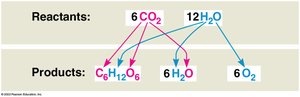
Water is oxidized to oxygen; carbon dioxide is reduced to glucose (actually, the direct product is G3P, a 3-carbon sugar).
Oxygen atoms in O2 come from water, not CO2.
Example: Experiments using the heavy isotope oxygen-18 (18O) traced the source of oxygen released during photosynthesis to water.
Photosynthesis as a Redox Process
Redox Principles in Photosynthesis
Photosynthesis reverses the direction of electron flow compared to cellular respiration. It is an endergonic process powered by light energy, where H2O is oxidized and CO2 is reduced.
OIL RIG: Oxidation Is Loss (of electrons), Reduction Is Gain (of electrons).
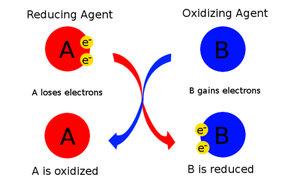
Example: In photosynthesis, water donates electrons (is oxidized), and carbon dioxide accepts electrons (is reduced).
Overview of Photosynthesis: Two Stages
Light Reactions and the Calvin Cycle
Photosynthesis consists of two main stages: the light reactions and the Calvin cycle.
Light reactions ("photo" part): Occur in the thylakoid membranes, converting solar energy into chemical energy (ATP and NADPH), and releasing O2 as a by-product.
Calvin cycle ("synthesis" part): Occurs in the stroma, using ATP and NADPH to convert CO2 into sugar via carbon fixation.

Example: The Calvin cycle produces glyceraldehyde-3-phosphate (G3P), which is used to synthesize glucose and other carbohydrates.
Sunlight and the Electromagnetic Spectrum
Nature of Light
Light is a form of electromagnetic energy, traveling in waves and consisting of particles called photons. The electromagnetic spectrum encompasses all wavelengths of electromagnetic radiation, but only visible light (380–750 nm) powers photosynthesis.
Shorter wavelengths have higher energy per photon.
Visible light is detected as colors by the human eye and is absorbed by photosynthetic pigments.
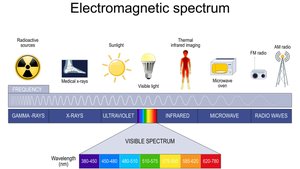
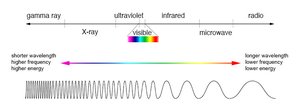
Example: Blue light (shorter wavelength) has more energy than red light (longer wavelength).
Photosynthetic Pigments and Light Absorption
Pigments and Their Roles
Pigments are substances that absorb visible light. Different pigments absorb different wavelengths, and the wavelengths not absorbed are reflected or transmitted, giving leaves their green color.
Chlorophyll a: Main pigment, absorbs violet-blue and red light.
Accessory pigments: Chlorophyll b and carotenoids broaden the spectrum and protect chlorophyll from damage.
Spectrophotometer: Instrument used to measure a pigment’s ability to absorb various wavelengths.
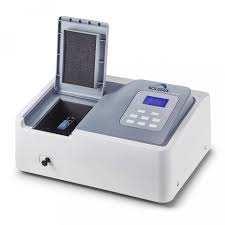
Example: Leaves appear green because chlorophyll reflects and transmits green light.
Excitation of Chlorophyll by Light
How Light Energy Is Captured
When pigments absorb light, electrons are excited to a higher energy state. As they return to the ground state, energy is released as fluorescence (light and heat).
Only absorbed light can drive photosynthesis.
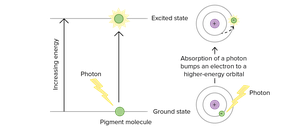
Example: Isolated chlorophyll fluoresces red when illuminated due to electron relaxation.
Photosystems: Light-Harvesting Complexes
Organization and Function
Photosystems are complexes in the thylakoid membrane consisting of a reaction-center complex surrounded by light-harvesting complexes. They facilitate the transfer of energy from photons to the reaction center, where electrons are excited and transferred to a primary electron acceptor.
Photosystem II (PS II): Functions first, best absorbs 680 nm (P680).
Photosystem I (PS I): Functions second, best absorbs 700 nm (P700).
Linear electron flow: Electrons move through both photosystems and an electron transport chain, producing ATP and NADPH.
Example: The splitting of water in PS II releases O2 as a by-product.
Steps of Linear Electron Flow
Electron Transport in Light Reactions
Light energy excites electrons in PS II, which are transferred to the primary electron acceptor. Water is split to replace these electrons, releasing O2. Electrons move down an electron transport chain, creating a proton gradient used to generate ATP. In PS I, electrons are re-excited and transferred to NADP+, forming NADPH.
ATP is produced by photophosphorylation via chemiosmosis.
NADPH carries high-energy electrons to the Calvin cycle.
Example: The proton gradient across the thylakoid membrane powers ATP synthase, similar to mitochondrial chemiosmosis.
Comparison of Chemiosmosis in Chloroplasts and Mitochondria
Similarities and Differences
Both organelles use electron transport chains to create a proton gradient and drive ATP synthesis via ATP synthase. However, mitochondria use chemical energy from food, while chloroplasts use light energy.
Mitochondria: Protons pumped into intermembrane space, ATP formed in matrix.
Chloroplasts: Protons pumped into thylakoid space, ATP formed in stroma.
Example: Both processes rely on the diffusion of protons through ATP synthase to generate ATP.
The Calvin Cycle
Phases and Key Steps
The Calvin cycle is an anabolic pathway that uses ATP and NADPH to convert CO2 into G3P. It consists of three phases: carbon fixation, reduction, and regeneration of the CO2 acceptor (RuBP).
Phase 1: Carbon fixation – CO2 combines with RuBP, catalyzed by rubisco, forming 3-phosphoglycerate.
Phase 2: Reduction – 3-phosphoglycerate is phosphorylated and reduced to G3P using ATP and NADPH.
Phase 3: Regeneration – Some G3P is used to regenerate RuBP, enabling the cycle to continue.




Example: For every three CO2 molecules fixed, one G3P exits the cycle and can be used to form glucose and other carbohydrates.
Life Depends on Photosynthesis
Importance and Applications
Photosynthesis is essential for life, providing the energy and organic molecules needed by nearly all organisms. It also produces the oxygen necessary for aerobic respiration.
Sugar produced in chloroplasts is used for energy, growth, and storage (as starch).
Photosynthesis maintains atmospheric O2 levels.
Example: Excess sugar is stored in roots, tubers, seeds, and fruits, supporting plant growth and reproduction.
Summary Table: Comparison of Photosynthesis and Cellular Respiration
Process | Location | Energy Source | Main Products | Electron Flow |
|---|---|---|---|---|
Photosynthesis | Chloroplasts | Light energy | Glucose, O2 | H2O → NADPH → Calvin cycle |
Cellular Respiration | Mitochondria | Chemical energy (glucose) | CO2, H2O, ATP | Glucose → NADH/FADH2 → O2 |
