Back
BackComprehensive Introduction to Biology: Key Concepts and Processes
Study Guide - Smart Notes
 Tailored notes based on your materials, expanded with key definitions, examples, and context.
Introduction to Biology
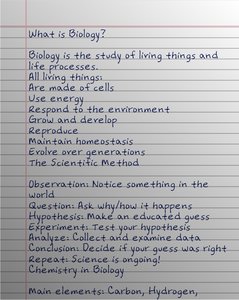
What is Biology?
Biology is the scientific study of living things and the processes that sustain life. It encompasses the structure, function, growth, origin, evolution, and distribution of living organisms.
Living things are made of cells, use energy, respond to their environment, grow, develop, reproduce, maintain homeostasis, and evolve over generations.
The scientific method is used to investigate biological questions, involving observation, hypothesis formation, experimentation, analysis, and conclusion.
The Scientific Method
Steps of the Scientific Method
Observation: Notice something in the world.
Question: Ask why or how it happens.
Hypothesis: Make an educated guess.
Experiment: Test your hypothesis.
Analyze: Collect and examine data.
Conclusion: Decide if your guess was right.
Repeat: Science is ongoing and self-correcting.
Chemistry in Biology
Main Elements and Water
Life is based on a few key elements and the unique properties of water.
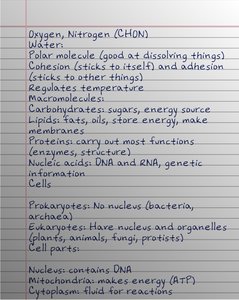
Main elements: Carbon, Hydrogen, Oxygen, Nitrogen (CHON).
Water: A polar molecule, excellent at dissolving substances.
Cohesion: Water molecules stick to each other.
Adhesion: Water molecules stick to other surfaces.
Regulates temperature: Water helps maintain stable temperatures in organisms and environments.
Biomolecules
Macromolecules and Their Functions
Carbohydrates: Sugars, energy source.
Lipids: Fats, oils; store energy, make membranes.
Proteins: Enzymes, structure, most cellular functions.
Nucleic acids: DNA and RNA, store genetic information.
Cell Components
Types of Cells
Prokaryotes: No nucleus (bacteria, archaea).
Eukaryotes: Have a nucleus and organelles (plants, animals, fungi, protists).
Cell Parts and Organelles
Nucleus: Contains DNA.
Mitochondria: Makes energy (ATP).
Cytoplasm: Fluid for reactions.
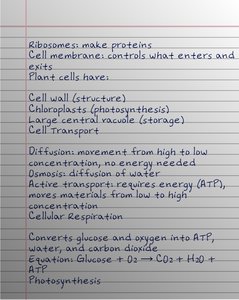
Ribosomes: Make proteins.
Cell membrane: Controls what enters and exits the cell.
Plant Cell Special Structures
Cell wall: Structure and support.
Chloroplasts: Site of photosynthesis.
Large central vacuole: Storage of water and nutrients.
The Membrane and Cell Transport
Types of Transport
Diffusion: Movement from high to low concentration, no energy needed.
Osmosis: Diffusion of water across a membrane.
Active transport: Requires energy (ATP), moves materials from low to high concentration.
Energy and Metabolism
Cellular Respiration
Cells convert glucose and oxygen into ATP (energy), water, and carbon dioxide.
Equation:
Photosynthesis
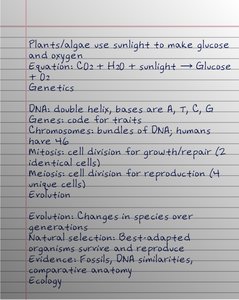
Plants and algae use sunlight to make glucose and oxygen.
Equation:
Genetics
DNA and Genes
DNA: Double helix, bases are A, T, C, G.
Genes: Code for traits.
Chromosomes: Bundles of DNA; humans have 46.
Cell Division
Mitosis: Cell division for growth and repair (2 identical cells).
Meiosis: Cell division for reproduction (4 unique cells).
Evolution
Mechanisms of Evolution
Evolution: Changes in species over generations.
Natural selection: Best-adapted organisms survive and reproduce.
Evidence: Fossils, DNA similarities, comparative anatomy.
Ecology
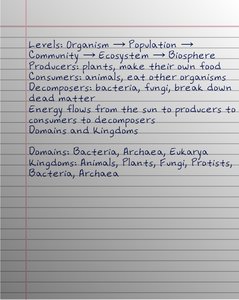
Levels of Organization
Organism → Population → Community → Ecosystem → Biosphere
Energy Flow and Roles
Producers: Plants, make their own food.
Consumers: Animals, eat other organisms.
Decomposers: Bacteria, fungi, break down dead matter.
Energy flows from the sun to producers to consumers to decomposers.
Domains and Kingdoms
Domains: Bacteria, Archaea, Eukarya.
Kingdoms: Animals, Plants, Fungi, Protists, Bacteria, Archaea.