 Back
BackComprehensive Study Notes: Meiosis, Mendelian Genetics, Chromosomal Inheritance, DNA Structure, Gene Expression, Mutations, Viruses, and Biotechnology
Study Guide - Smart Notes
 Tailored notes based on your materials, expanded with key definitions, examples, and context.
Meiosis and Sexual Reproduction
Behaviour of Chromosomes & Differences Between Meiosis I and Meiosis II
Meiosis is a specialized cell division process that produces haploid gametes, ensuring genetic diversity through mechanisms such as crossing over and independent assortment. It consists of two distinct divisions: Meiosis I (reductional) and Meiosis II (equational).
Meiosis I: Homologous chromosomes pair, align as bivalents/tetrads, and separate, reducing chromosome number from diploid (2n) to haploid (n).
Meiosis II: Sister chromatids separate, resulting in four genetically unique haploid cells.
Key events: Chromosome pairing, crossing over at chiasmata, and segregation.
Feature | Meiosis I | Meiosis II |
|---|---|---|
Main Goal | Reduce chromosome number (2n → n) | Separate sister chromatids |
Chromosome Pairing | Homologous chromosomes pair | No pairing |
Alignment at Equator | Homologous pairs (double line) | Single chromosomes (single line) |
Separation Event | Homologous chromosomes | Sister chromatids |
Genetic Variation | Crossing over, independent assortment | No new variation |
End Result | 2 haploid cells (still with sister chromatids) | 4 haploid cells (single chromatids) |
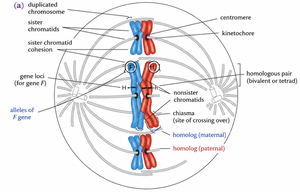
Cellular Events During Meiosis
Meiosis involves a series of stages, each with distinct chromosomal behaviors:
Interphase: Chromosomes and centrioles replicate; cell prepares for division.
Meiosis I:
Prophase I: Chromosomes condense, homologs pair (synapsis), crossing over occurs at chiasmata.
Metaphase I: Homologous pairs align randomly at the equator (independent assortment).
Anaphase I: Homologous chromosomes separate; sister chromatids remain attached.
Telophase I & Cytokinesis: Chromosomes arrive at poles; cytoplasm divides, forming two haploid cells.
Meiosis II:
Prophase II: Chromosomes re-condense; spindle forms.
Metaphase II: Chromosomes align singly at the equator.
Anaphase II: Sister chromatids separate.
Telophase II & Cytokinesis: Four genetically unique haploid gametes are produced.
Mechanisms Producing Genetic Variation
Meiosis generates genetic diversity through three main mechanisms:
Crossing Over: Exchange of genetic material between non-sister chromatids during Prophase I.
Independent Assortment: Random alignment of homologous pairs during Metaphase I; number of combinations = (n = haploid number).
Random Fertilization: Any sperm can fuse with any egg, multiplying genetic combinations.
Mendel and Genetic Inheritance
Scientific Reasons for Mendel’s Success
Mendel’s experiments with pea plants established the foundational principles of inheritance due to his choice of model organism, rigorous experimental design, and quantitative analysis.
Model organism: Pea plants with discrete traits.
Experimental design: True-breeding lines, monohybrid/dihybrid crosses, repeated trials.
Quantitative analysis: Use of ratios and hypothesis testing.
Outcomes of Monohybrid Crosses
Monohybrid crosses reveal dominant and recessive allele relationships, producing characteristic genotypic and phenotypic ratios.
Genotypic ratio: 1 AA : 2 Aa : 1 aa
Phenotypic ratio: 3 dominant : 1 recessive
Sum and Product Rules for Probability
Product Rule: Probability of independent events = multiply individual probabilities.
Sum Rule: Probability of mutually exclusive events = add individual probabilities.
Genotype vs Phenotype
Genotype: Genetic makeup (AA, Aa, aa).
Phenotype: Observable trait.
Dominant allele: Masks recessive allele in heterozygotes.
Punnett Squares: Monohybrid & Dihybrid
Monohybrid: 2x2 grid; 3:1 phenotype ratio.
Dihybrid: 4x4 grid; 9:3:3:1 phenotype ratio.
Test Cross: Purpose & Method
Purpose: Determine genotype of dominant phenotype individual.
Method: Cross with homozygous recessive; interpret offspring ratios.
Non-Mendelian Inheritance Patterns
Incomplete dominance: Blended phenotype in heterozygotes.
Codominance: Both alleles fully expressed.
Multiple alleles: More than two alleles in population (e.g., ABO blood group).
Sex-linked inheritance: Genes on sex chromosomes; distinct patterns in males and females.
Polygenic inheritance: Multiple genes contribute to trait; continuous variation.
Mendel’s Laws: Genetics & Meiosis Events
Law of Segregation: Alleles separate during gamete formation (Anaphase I).
Law of Independent Assortment: Alleles of different genes assort independently (Metaphase I).
The Chromosomal Basis of Inheritance
Sutton’s Chromosomal Theory of Inheritance
This theory connects Mendel’s laws to the physical behavior of chromosomes during meiosis, explaining inheritance patterns.
Genes are located on chromosomes.
Chromosomes occur in pairs.
Meiosis ensures segregation and independent assortment.
Genetic Linkage
Linked genes: Located close together; inherited together.
Unlinked genes: On different chromosomes; assort independently.
Homologous Recombination (Crossing Over)
Occurs during Prophase I: Homologous chromosomes exchange segments at chiasmata.
Result: Recombinant chromosomes with new allele combinations.
Chromosomal Mapping
Recombination frequency: Used to estimate gene distances (1% = 1 cM).
Genetic maps: Constructed from test crosses and offspring analysis.
Sex Determination
Chromosomal systems: XX/XY, ZZ/ZW, XX/X0, haplodiploidy, environmental.
SRY gene: Triggers male development in humans.
Karyograms
Definition: Visual arrangement of chromosomes in pairs.
Creation: Cells arrested in metaphase, stained, photographed, and arranged.
Normal human karyogram: 46 chromosomes (23 pairs).
Nondisjunction & Chromosomal Disorders
Nondisjunction: Failure to separate chromosomes; results in aneuploidy (trisomy, monosomy).
Common disorders: Down syndrome (trisomy 21), Klinefelter (XXY), Turner (X0).
X Inactivation & Mosaic Phenotypes
X inactivation: One X chromosome in females is randomly silenced (Barr body).
Mosaic phenotype: Different patches express different X chromosomes (e.g., tortoiseshell cats).
DNA Structure and Replication
Key Experiments Identifying DNA as Genetic Material
Griffith’s transformation: Demonstrated transfer of genetic material.
Avery, MacLeod & McCarty: Identified DNA as the transforming principle.
Hershey & Chase: Confirmed DNA as genetic material using bacteriophages.
Chargaff’s First Rule
A = T, G = C: Due to complementary base pairing.
Application: Used to calculate base percentages in double-stranded DNA.
Contributions to the DNA Model
Franklin & Gosling: X-ray diffraction revealed helical structure.
Watson & Crick: Proposed double helix, complementary pairing, antiparallel strands.
Structure of DNA
Nucleotides: Deoxyribose sugar, phosphate, nitrogenous base.
Double helix: Sugar-phosphate backbone, base pairs inside, constant diameter.
Chemical Forces Holding Strands Together
Phosphodiester bonds: Covalent bonds in backbone.
Hydrogen bonds: Between bases; A-T (2 bonds), G-C (3 bonds).
Hydrophobic interactions: Base stacking adds stability.
Anti-Parallel Nature & Directionality
Strands run in opposite directions: 5’→3’ and 3’→5’.
DNA synthesis: Occurs 5’→3’ only.
DNA as Hereditary Material: Semi-Conservative Replication
Each new molecule: One old strand, one new strand.
Occurs during S phase of cell cycle.
Process of DNA Replication & Enzymes
Helicase: Unwinds DNA.
SSBs: Stabilize single strands.
Topoisomerase: Relieves tension.
Primase: Synthesizes RNA primer.
DNA Polymerase III: Main builder, adds nucleotides.
DNA Polymerase I: Removes primers, replaces with DNA.
Ligase: Joins Okazaki fragments.
Leading vs Lagging Strands
Feature | Leading Strand | Lagging Strand |
|---|---|---|
Synthesis | Continuous | Discontinuous (Okazaki fragments) |
Primers | One | Multiple |
Speed | Fast | Slower |
End Replication Problem & Telomeres
Linear chromosomes: Lagging strand cannot fully replicate ends; telomeres shorten.
Telomerase: Enzyme that extends telomeres; active in germ/stem cells, reactivated in cancer.
Gene Expression and Regulation
Central Dogma of Molecular Biology
Flow: DNA → RNA → Protein
Replication, transcription, translation: Key steps in information transfer.
Genetic Code
Triplet codons: Three nucleotides code for one amino acid.
Universal, redundant, unambiguous: Features of the code.
Transcription and RNA Processing
Prokaryotes: Transcription occurs in cytoplasm; mRNA is ready for translation.
Eukaryotes: Transcription in nucleus; pre-mRNA processed (capping, tailing, splicing).
Translation and Ribosomes
Initiation, elongation, termination: Steps in protein synthesis.
Ribosomes: rRNA and protein; catalyze peptide bond formation.
Gene Regulation
Prokaryotes: Operon model; transcriptional control.
Eukaryotes: Regulation at epigenetic, transcriptional, posttranscriptional, translational, and posttranslational levels.
Chromatin remodeling, histone modification, DNA methylation: Control access to genes.
Transcription factors, enhancers, silencers: Regulate gene expression.
Alternative splicing, RNA stability: Expand protein diversity and control expression.
Mutations
Types of Mutations
Small-scale: Point mutations (silent, missense, nonsense), frameshift mutations.
Large-scale: Chromosomal deletions, duplications, inversions, translocations, aneuploidy.
Effects of Mutations
Silent: No change in protein.
Missense: One amino acid changed.
Nonsense: Premature stop codon.
Frameshift: Alters reading frame; usually nonfunctional protein.
Mutagens
Physical: Radiation.
Chemical: Carcinogens.
Biological: Viruses, transposons.
Gene Expression Changes and Cancer
Proto-oncogenes: Overexpression leads to uncontrolled growth.
Tumor suppressors: Silencing or mutation removes growth inhibition.
Epigenetic, transcriptional, posttranscriptional, posttranslational errors: Disrupt cell cycle control.
Viruses
Why Viruses Are Considered Nonliving
Not cellular: No cytoplasm, organelles, or membrane.
No independent reproduction or metabolism.
No response to stimuli or homeostasis.
Basic Features of a Virus
Genetic material: DNA or RNA (single/double stranded).
Capsid: Protein coat.
Envelope: Lipid layer in some viruses.
Viral Replication
Attachment, entry, uncoating, replication, assembly, release: Steps in viral life cycle.
Lytic cycle: Host cell destroyed; rapid infection.
Lysogenic cycle: Viral DNA integrates; dormant phase.
Retroviruses
Reverse transcriptase: Converts RNA to DNA; integrates into host genome.
Example: HIV.
Significance of Viruses
Disease: Major human illnesses.
Evolution: Drive genetic diversity.
Ecology: Regulate populations.
Biotechnology: Used in gene therapy, research, vaccine development.
Biotechnology and Genomics
DNA/RNA Extraction
Cell lysis, debris removal, precipitation, purification: Steps to isolate nucleic acids.
cDNA vs Genomic DNA
Feature | Genomic DNA | cDNA |
|---|---|---|
Source | Nucleus/chromosomes | mRNA (cytoplasm) |
Content | Genes + non-coding DNA + introns | Exons only |
Size | Large | Smaller |
Expression | Same in all cells | Varies by cell type |
Use | Study genome, mutations | Protein production, gene expression |
Key Techniques
Gel electrophoresis: Separates DNA/RNA/proteins by size and charge.
PCR: Amplifies specific DNA sequences.
CRISPR-Cas9: Precise gene editing.
Cloning
Molecular cloning: Copies genes or produces proteins.
Reproductive cloning: Produces genetically identical organisms.
Restriction Enzymes & Recombinant Plasmids
Restriction enzymes: Cut DNA at specific sequences; create sticky or blunt ends.
Recombinant plasmids: Combine foreign gene with plasmid vector.
Vectors
Features: Origin of replication, selectable marker, multiple cloning site, promoter.
Biotechnology Uses
Medicine: Protein production, vaccines, gene therapy, diagnostics.
Agriculture: Pest/herbicide resistance, nutritional enhancement, improved yield.
Genomics & Maps
Genomics: Study of entire genomes.
Genetic maps: Based on recombination frequency.
Physical maps: Based on DNA sequence or fragment size.
DNA Fingerprinting
Principle: Unique DNA patterns from non-coding repeats.
Use: Forensics, paternity, ancestry.
Chain Termination DNA Sequencing (Sanger Method)
Uses ddNTPs: Terminate DNA chains; fluorescent labeling for sequence determination.
Pharmacogenomics
Personalized medicine: Drug response based on genome.
Polygenic Traits
Controlled by multiple genes: Continuous variation; influenced by environment.
