 Back
BackDescent with Modification: A Darwinian View of Life (Chapter 22 Study Notes)
Study Guide - Smart Notes
 Tailored notes based on your materials, expanded with key definitions, examples, and context.
Descent with Modification: A Darwinian View of Life
Introduction to Evolutionary Biology
Evolutionary biology explores how species change over time, accumulate differences from their ancestors, and adapt to various environments. The concept of descent with modification—first articulated by Charles Darwin—explains both the unity and diversity of life on Earth.
Historical Perspectives on Evolution
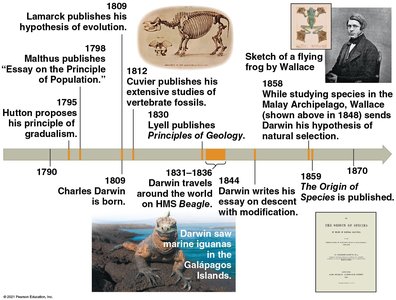
Aristotle (384–322 BCE): Proposed the scala naturae, a scale of increasing complexity, viewing species as fixed and unchanging.
Carolus Linnaeus (1707–1778): Developed a nested classification system and the binomial nomenclature for naming species (e.g., Homo sapiens).
Georges Cuvier (1769–1832): Founded paleontology, noting that fossils in older strata differ from those in newer layers, suggesting extinction and appearance of new species.
James Hutton and Charles Lyell: Proposed that geological features form gradually, implying an ancient Earth.
Jean-Baptiste de Lamarck: Suggested evolution via use and disuse of traits and inheritance of acquired characteristics (not supported by modern evidence).
Darwin’s Voyage and Observations
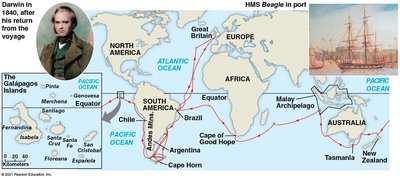
Charles Darwin’s journey on the HMS Beagle (1831–1836) provided critical observations that led to the theory of evolution by natural selection. He collected specimens, observed geological changes, and studied unique species, especially on the Galápagos Islands.
Noted similarities between fossils and living species in the same region.
Observed that Galápagos species resembled those from the South American mainland but had unique adaptations.
Descent with Modification and the Tree of Life
Darwin proposed that all organisms are related by descent from a common ancestor. Over time, populations accumulate modifications that help them adapt to their environments, resulting in the diversity of life.
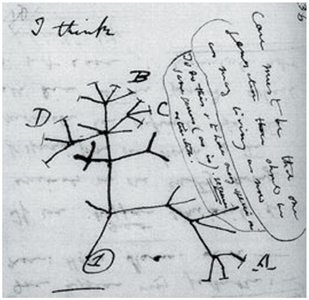
Evolution is both a pattern (observable changes in species over time) and a process (mechanisms such as natural selection).
Branching and extinction events explain morphological gaps between groups.
Mechanisms of Evolution: Natural Selection
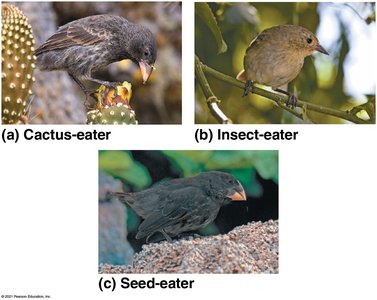
Natural selection is the process by which individuals with advantageous heritable traits survive and reproduce more successfully, leading to the accumulation of favorable traits in the population.
Observation 1: Members of a population vary in their inherited traits.
Observation 2: All species can produce more offspring than the environment can support.
Inference 1: Individuals with traits that enhance survival and reproduction leave more offspring.
Inference 2: Favorable traits increase in frequency over generations.
Artificial Selection
Humans have modified species through artificial selection, breeding individuals with desired traits. This process demonstrates the power of selection to shape organisms.
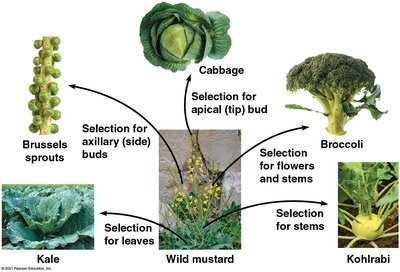
Key Features of Natural Selection
Only populations evolve; individuals do not.
Natural selection acts on heritable variation already present in the population.
Environmental changes can shift which traits are favorable, potentially leading to new species.
Evidence for Evolution
Multiple lines of evidence support the theory of evolution:
Direct observations: Evolution of drug-resistant bacteria and changes in beak size in soapberry bugs.
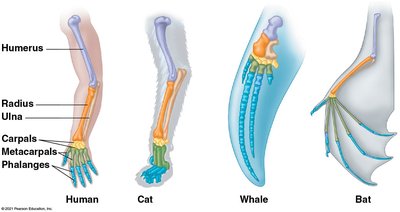
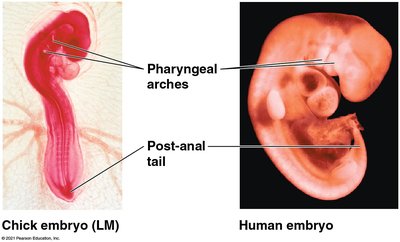
Homology: Similarities in structure due to common ancestry, including anatomical, embryological, and molecular homologies.
Fossil record: Documents extinction, origin of new groups, and transitions within groups.
Biogeography: Geographic distribution of species explained by continental drift and historical events.
Homology
Homologous structures are anatomical features that are similar due to shared ancestry but may serve different functions in modern species.
Comparative embryology reveals similarities in early development (e.g., pharyngeal arches, post-anal tail).
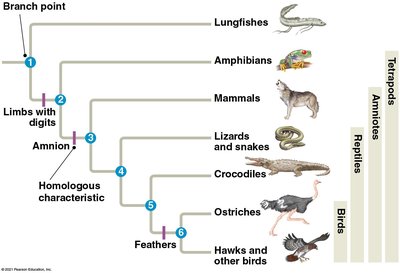
Evolutionary Trees
Evolutionary trees (phylogenies) illustrate hypotheses about relationships among species, based on shared derived characteristics.
Convergent Evolution
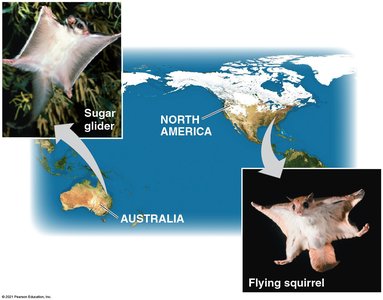
Convergent evolution describes the independent evolution of similar features in distantly related groups due to adaptation to similar environments. These features are called analogous traits.
The Fossil Record
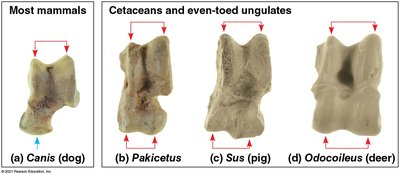
The fossil record provides evidence for the extinction of species, the origin of new groups, and evolutionary transitions (e.g., land to sea in cetaceans).
Biogeography
Biogeography studies the geographic distribution of species. Continental drift and the breakup of Pangea explain similarities and differences among species on different continents.
Scientific Theory and Ongoing Research
Darwin’s theory of evolution by natural selection is a unifying scientific theory, integrating observations from many fields and generating new research questions. Ongoing discoveries continue to expand our understanding of evolutionary processes.
