 Back
BackDNA and Its Role in Heredity: Structure, Replication, and Repair
Study Guide - Smart Notes
 Tailored notes based on your materials, expanded with key definitions, examples, and context.
DNA and Its Role in Heredity
Key Concepts Overview
This chapter explores the discovery, structure, replication, and repair mechanisms of DNA, as well as its significance in heredity and medical applications. Understanding these concepts is fundamental to molecular biology and genetics.
DNA as Genetic Material
Structure of DNA
Semiconservative Replication
DNA Repair Mechanisms
Polymerase Chain Reaction (PCR)
Experiments Revealed the Function of DNA as Genetic Material
Historical Evidence and Key Experiments
Early experiments established DNA as the molecule responsible for heredity. Chromosomes were known to contain DNA and proteins, but evidence was needed to confirm DNA's role.
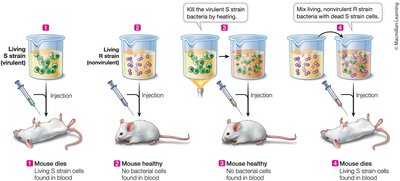
Griffith's Transformation Experiment: Demonstrated that a substance from dead virulent bacteria could transform nonvirulent bacteria, making them virulent.
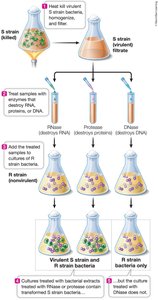
Avery, MacLeod, and McCarty: Showed that DNA, not protein or RNA, was the transforming principle.
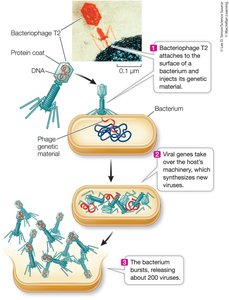
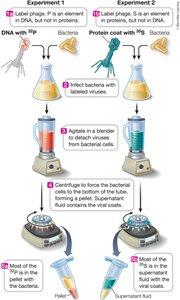
Hershey-Chase Experiment: Used bacteriophage viruses labeled with radioactive isotopes to show that DNA, not protein, enters bacteria and directs viral replication.
Example: The transformation of Streptococcus pneumoniae strains in mice demonstrated the heritable nature of DNA.
DNA Has a Structure That Suits Its Function
Chemical Composition and Evidence
DNA is a polymer of nucleotides, each containing a sugar, phosphate, and a nitrogenous base. The bases are classified as purines (adenine, guanine) and pyrimidines (cytosine, thymine).
Chargaff's Rule: The amount of purines equals the amount of pyrimidines in DNA, but the ratio of A+T to G+C varies among species.
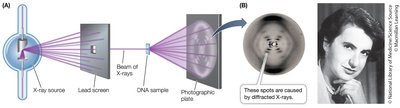
X-ray Diffraction: Crystallography by Rosalind Franklin revealed the helical structure of DNA.
Double Helix Model
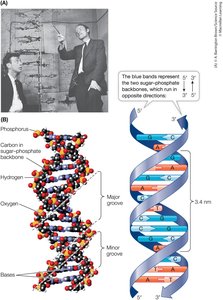
Watson and Crick built the double helix model, pairing purines with pyrimidines to maintain uniform width. The strands are antiparallel and held together by hydrogen bonds between complementary bases.
Key Features: Double-stranded, right-handed helix, antiparallel strands, complementary base pairing, major and minor grooves.
Backbone: Sugar-phosphate backbone on the outside, bases on the inside.
Major and Minor Grooves
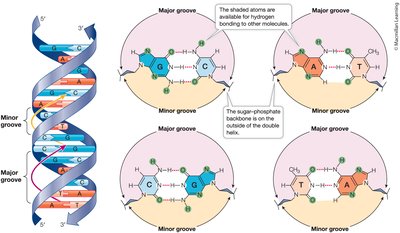
The double helix exposes the outer edges of base pairs in grooves, allowing protein-DNA interactions essential for gene regulation.
Functional Significance
Information Storage: Millions of nucleotides encode genetic information.
Mutation Susceptibility: Changes in base sequence can lead to mutations.
Replication: Complementary base pairing enables precise replication.
Expression: DNA sequences determine protein sequences, which define phenotypes.
DNA Is Replicated Semiconservatively
Models of Replication
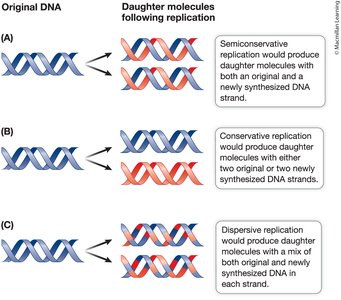
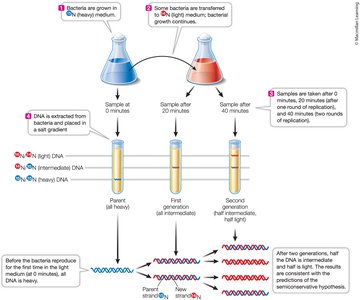
DNA replication was shown to be semiconservative, meaning each new molecule contains one old and one new strand. Other models (conservative, dispersive) were disproven by the Meselson-Stahl experiment.
Semiconservative: Each parent strand serves as a template.
Conservative: Original molecule remains intact.
Dispersive: Fragments of old and new DNA are mixed.
Steps in DNA Replication
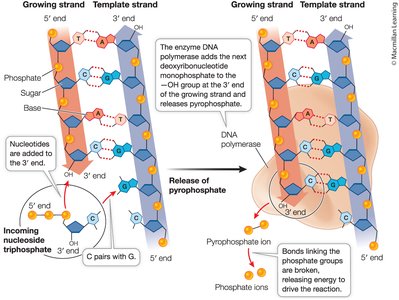
Initiation: Double helix unwinds at the origin of replication.
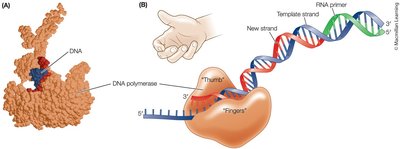
Elongation: DNA polymerase adds nucleotides to the 3' end, forming phosphodiester bonds.
Termination: Replication ends when all regions are copied.
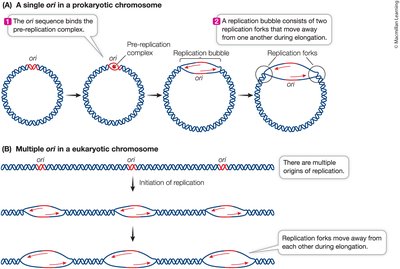
Origins of Replication
Prokaryotes have a single origin, while eukaryotes have multiple origins to ensure timely replication of large chromosomes.
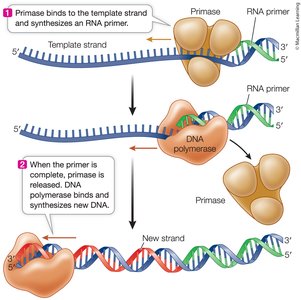
Primer Requirement
DNA polymerase requires a short RNA primer synthesized by primase to begin replication.
DNA Polymerase Structure and Function
DNA polymerase is a large enzyme with distinct regions for substrate binding and base recognition.
Replication Complex and Fork
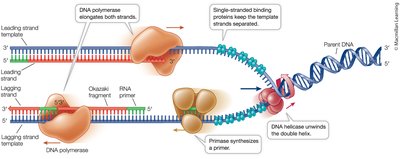
Multiple proteins collaborate at the replication fork, including helicase (unwinds DNA) and single-strand binding proteins (stabilize unwound strands).
Leading and Lagging Strands
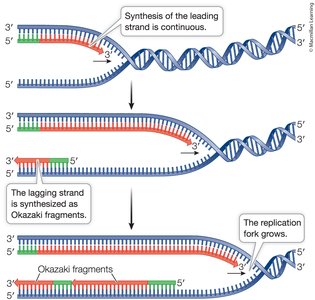
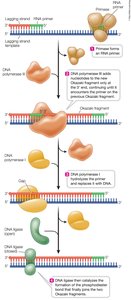
Replication is continuous on the leading strand and discontinuous on the lagging strand, which forms Okazaki fragments.
DNA Ligase and Sliding Clamp
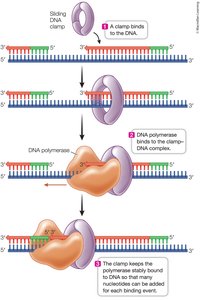
DNA ligase joins Okazaki fragments, and a sliding clamp increases polymerase efficiency by stabilizing the enzyme-DNA complex.
Telomeres and Telomerase
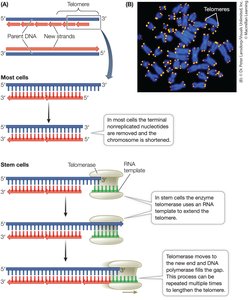
Telomeres are repetitive sequences at chromosome ends. Telomerase extends telomeres in stem cells and cancer cells, preventing chromosome shortening.
Errors in DNA Can Be Repaired
DNA Repair Mechanisms
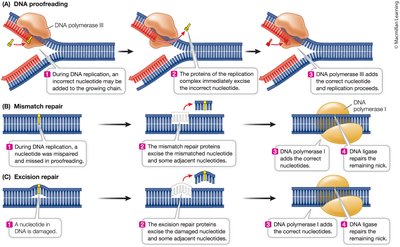
Cells employ multiple mechanisms to correct errors and damage in DNA:
Proofreading: DNA polymerase removes mismatched bases during replication.
Mismatch Repair: Proteins scan newly replicated DNA for errors and correct mismatches.
Excision Repair: Damaged bases are excised and replaced by DNA polymerase.
Targeting DNA Replication in Cancer Therapy
Cisplatin Mechanism
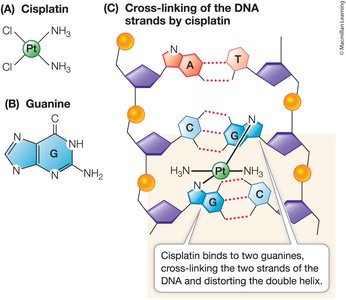
Cisplatin is a chemotherapy drug that cross-links DNA strands, preventing replication and inducing cell death. It is effective against rapidly dividing cancer cells.
Cisplatin Structure: Contains platinum bonded to chlorines and amino groups.
Action: Chlorines are displaced by guanine nitrogen atoms, forming covalent bonds and cross-linking DNA.
Result: DNA replication is blocked, leading to apoptosis.
Summary Table: DNA Replication Models
Model | Description | Experimental Evidence |
|---|---|---|
Semiconservative | Each new DNA molecule contains one old and one new strand | Meselson-Stahl experiment |
Conservative | Original DNA molecule remains intact; new molecule is entirely new | Disproved by Meselson-Stahl |
Dispersive | Fragments of old and new DNA are mixed in each strand | Disproved by Meselson-Stahl |
Key Terms and Definitions
DNA (Deoxyribonucleic Acid): The molecule that carries genetic information in cells.
Nucleotide: The building block of DNA, consisting of a sugar, phosphate, and base.
Replication Fork: The site where DNA unwinds and replication occurs.
Okazaki Fragment: Short DNA segments synthesized on the lagging strand.
Telomere: Repetitive DNA sequence at chromosome ends.
Telomerase: Enzyme that extends telomeres.
Cisplatin: Chemotherapy drug that cross-links DNA.
Equations and Formulas
Phosphodiester Bond Formation:
Chargaff's Rule:
Telomere Repeat Sequence (Human):
Additional info:
DNA repair mechanisms are crucial for maintaining genetic stability and preventing diseases such as cancer.
Telomerase activity is a hallmark of cancer cells, enabling unlimited division.
