 Back
BackDNA and the Gene: Synthesis and Repair – Study Notes
Study Guide - Smart Notes
 Tailored notes based on your materials, expanded with key definitions, examples, and context.
DNA and the Gene: Synthesis and Repair
Testing Early Hypotheses about DNA Synthesis
Understanding how DNA replicates was a foundational question in molecular biology. Three main models were proposed:
Semiconservative replication: Parental DNA strands separate and each serves as a template for a new daughter strand. Each daughter DNA molecule consists of one old and one new strand.
Conservative replication: The parental DNA molecule serves as a template for an entirely new molecule, so one daughter has both old strands and the other has both new strands.
Dispersive replication: The parental DNA is cut into pieces, and each daughter molecule contains interspersed segments of old and new DNA.
Example: The Meselson–Stahl experiment provided evidence for the semiconservative model by using isotopic labeling to distinguish old and new DNA strands.
A Model for DNA Synthesis
DNA Polymerase and the Direction of Synthesis
DNA polymerase is the enzyme responsible for catalyzing DNA synthesis. Several types exist, but all share key properties:
Directionality: DNA polymerases can only add deoxyribonucleotides to the 3' end of a growing DNA chain, so synthesis always proceeds in the 5' to 3' direction.
Monomers: The building blocks are deoxyribonucleoside triphosphates (dNTPs), which have high potential energy due to their three phosphate groups. Hydrolysis of these phosphates makes the formation of phosphodiester bonds exergonic.
Equation:
$\text{(dNMP)}_n + \text{dNTP} \rightarrow \text{(dNMP)}_{n+1} + \text{PP}_i$
Origin of Replication and Replication Bubbles
DNA replication begins at specific sequences called origins of replication:
Bacteria typically have a single origin, forming one replication bubble.
Eukaryotic chromosomes have multiple origins, forming many replication bubbles.
Each bubble has two replication forks, and synthesis is bidirectional.
Opening and Stabilizing the DNA Helix
Several proteins are required to open and stabilize the DNA double helix:
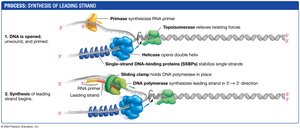
DNA helicase: Breaks hydrogen bonds between DNA strands, separating them.
Single-strand DNA-binding proteins (SSBPs): Bind to separated strands to prevent them from re-annealing.
Topoisomerase: Relieves tension caused by unwinding by cutting and rejoining DNA downstream of the replication fork.
Leading Strand Synthesis
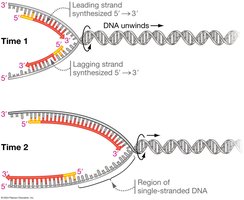
The antiparallel structure of DNA means that synthesis occurs differently on each strand:
DNA polymerase cannot start synthesis de novo; it requires a primer with a free 3' end.
Primase (an RNA polymerase) synthesizes a short RNA primer complementary to the DNA template.
DNA polymerase then adds dNTPs to the primer's 3' end, synthesizing the leading strand continuously toward the replication fork (5' to 3').
Lagging Strand Synthesis
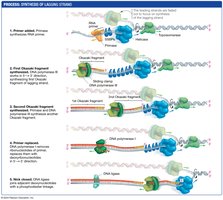
The lagging strand is synthesized discontinuously, away from the replication fork:
Primase synthesizes new RNA primers as the fork opens.
DNA polymerase synthesizes short DNA fragments (Okazaki fragments) from each primer.
Fragments are later joined into a continuous strand by DNA ligase.
Proteins Required for DNA Synthesis in Bacteria
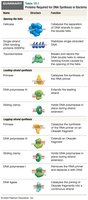
The following table summarizes the main proteins involved in bacterial DNA replication:
Enzyme/Protein | Function |
|---|---|
Helicase | Catalyzes the separation of DNA strands to open the double helix |
Single-strand DNA-binding proteins (SSBPs) | Stabilize single-stranded DNA |
Topoisomerase | Relieves twisting forces caused by the opening of the helix |
Primase | Synthesizes RNA primer |
DNA polymerase III | Extends the leading strand and Okazaki fragments |
Sliding clamp | Holds DNA polymerase in place during strand extension |
DNA polymerase I | Removes RNA primer and replaces it with DNA |
DNA ligase | Joins Okazaki fragments into a continuous strand |
The Replisome
The replisome is a large macromolecular complex containing all the enzymes required for DNA synthesis at the replication fork. It is dynamic, and recent research suggests that the process is more flexible and variable than previously thought.
Replicating the Ends of Linear Chromosomes
The End Replication Problem and Telomeres
Linear chromosomes in eukaryotes have ends called telomeres. Replicating these ends poses a problem:
The leading strand can be synthesized to the end, but the lagging strand cannot be completed because there is no primer for the final segment.
This leaves a single-stranded overhang, which is eventually degraded, causing chromosomes to shorten with each cell division.
Telomeres consist of short, repeating, non-coding DNA sequences.
Telomerase and Chromosome Maintenance
Telomerase is an enzyme that extends telomeres using an RNA template it carries:
It binds to the overhang and adds short DNA repeats, allowing normal DNA polymerase to finish replication.
Telomerase is active in gametes and stem cells, but not in most somatic cells.
Telomere length limits the number of cell divisions; when telomeres become too short, cells stop dividing.
Most cancer cells reactivate telomerase, enabling unlimited division.
Correcting Mistakes in DNA Synthesis
DNA Polymerase Proofreading
DNA polymerase has proofreading ability:
It checks the shape of newly added bases and removes mismatches using its exonuclease activity.
This reduces the error rate to about one mistake per 107 bases.
Mismatch Repair
Sometimes, mismatches escape proofreading. Mismatch repair enzymes correct these errors after DNA synthesis:
They recognize the mismatch, remove a section of the newly synthesized strand, and fill in the correct bases.
Repairing Damaged DNA
DNA can be damaged by environmental factors such as UV light and chemicals:
UV light can cause thymine dimers, which create kinks in the DNA and block replication.
The nucleotide excision repair system recognizes distortions, removes the damaged section, and fills in the gap using the undamaged strand as a template. DNA ligase seals the repaired strand.
Example: Nucleotide excision repair is crucial for preventing mutations that can lead to diseases such as cancer.
