 Back
BackDNA Polymerases: Structure, Function, and Mechanism
Study Guide - Smart Notes
 Tailored notes based on your materials, expanded with key definitions, examples, and context.
DNA Polymerases
Overview of DNA Polymerases
DNA polymerases are essential enzymes responsible for synthesizing new DNA strands during the process of DNA replication. They ensure the accurate copying of genetic information from one generation to the next. Multiple types of DNA polymerases exist within organisms, each with specialized roles in DNA replication and repair.
Definition: DNA polymerases are enzymes that catalyze the addition of nucleotides to a growing DNA strand, using a template strand as a guide.
Directionality: New DNA strands are always synthesized in the 5' to 3' direction, meaning nucleotides are added to the free 3' hydroxyl (OH) group of the growing strand.
Types: Organisms contain several types of DNA polymerases, each with slightly different functions (e.g., DNA Polymerase I, II, III in prokaryotes).

DNA Polymerase Requirements
For DNA polymerases to function, certain requirements must be met. These requirements ensure that DNA synthesis proceeds accurately and efficiently.
Template Strand: The original (parental) DNA strand serves as a template, guiding the sequence of the new strand by complementary base pairing.
Primer: A short RNA molecule, known as a primer, provides a starting point for DNA polymerase. The primer is synthesized by the enzyme primase.
Enzyme Primase: Primase synthesizes the RNA primer, which is later replaced by DNA to complete the new strand.
Conversion of Primer: The RNA primer is eventually removed and replaced with DNA nucleotides to form a continuous DNA strand.
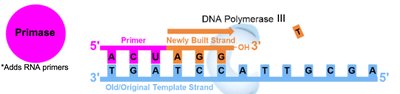
Mechanism of DNA Synthesis
DNA polymerases add nucleotides to the 3' end of the primer, synthesizing the new strand in the 5' to 3' direction. The enzyme reads the template strand and incorporates complementary nucleotides (A with T, G with C).
Base Pairing: Adenine (A) pairs with Thymine (T), and Guanine (G) pairs with Cytosine (C).
Elongation: DNA polymerase catalyzes the formation of phosphodiester bonds between nucleotides, extending the DNA chain.
Equation for DNA Synthesis:
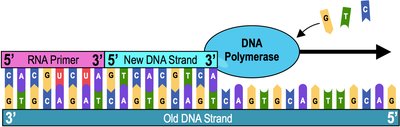
Directionality of DNA Polymerase Activity
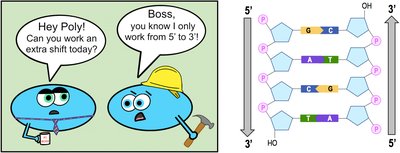
DNA polymerases can only add nucleotides in the 5' to 3' direction. This property is crucial for understanding the mechanism of DNA replication and the synthesis of leading and lagging strands.
5' to 3' Synthesis: DNA polymerase moves along the template strand in the 3' to 5' direction, synthesizing the new strand in the 5' to 3' direction.
Replication Fork: At the replication fork, one strand (leading) is synthesized continuously, while the other (lagging) is synthesized in short fragments (Okazaki fragments).
Practice: Determining the Complementary DNA Sequence
Given a DNA sequence, the complementary strand can be determined using base pairing rules:
Example: If the sequence of the 5'-3' strand is AATGCTAC, the complementary sequence is:
Original Strand (5'→3') | Complementary Strand (3'→5') |
|---|---|
A A T G C T A C | T T A C G A T G |
Correct Answer: 3'-TTACGATG-5'
Summary Table: Key Features of DNA Polymerases
Feature | Description |
|---|---|
Direction of Synthesis | 5' to 3' only |
Template Requirement | Requires a DNA template strand |
Primer Requirement | Requires an RNA primer synthesized by primase |
Main Prokaryotic Enzyme | DNA Polymerase III |
Primer Removal | RNA primer is replaced by DNA |
Additional info: DNA polymerases also possess proofreading activity, which helps maintain the fidelity of DNA replication by removing incorrectly paired nucleotides.
