 Back
BackDNA Replication and Repair: Chapter 17 Study Notes
Study Guide - Smart Notes
 Tailored notes based on your materials, expanded with key definitions, examples, and context.
DNA Replication and Repair
Overview of DNA Functions
DNA is the molecular blueprint for life, governing cellular processes through three essential mechanisms: replication, transcription, and translation. Replication ensures that each new cell receives an identical copy of DNA during cell division, while transcription and translation are involved in protein synthesis (covered in later chapters).
Replication: Copying DNA prior to cell division (S-phase of Interphase).
Transcription: Producing a working copy (RNA) of a gene that can leave the nucleus.
Translation: Synthesizing proteins as directed by the gene's instructions.
DNA Replication: Key Concepts
DNA replication is a highly regulated process that ensures genetic continuity. It is described as semi-conservative, meaning each new DNA molecule contains one original strand and one newly synthesized strand.
Purpose: To duplicate the entire DNA set before cell division, ensuring both daughter cells inherit identical genetic material.
Timing: Occurs during the S-phase of Interphase, prior to mitosis.
Result: Two identical DNA molecules, each composed of half original and half new nucleotides.
Step 1: DNA Unwinds
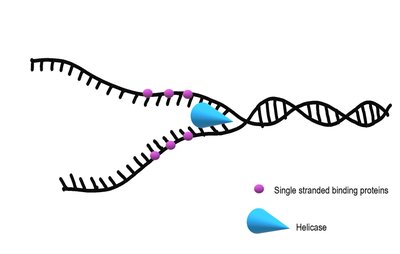
The first step in replication involves unwinding the double helix. The enzyme helicase breaks the hydrogen bonds between nucleotide pairs, separating the two strands. Single stranded binding proteins stabilize the separated strands, preventing them from re-annealing.
Helicase: Unzips the DNA at multiple locations.
Single stranded binding proteins: Bind to the separated strands to keep them apart.
Step 2: Formation of Replication Bubbles
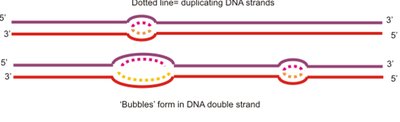
Replication does not occur along the entire DNA molecule at once. Instead, multiple replication bubbles form simultaneously at different locations, allowing for efficient duplication.
Replication bubbles: Regions where DNA strands are separated and replication is actively occurring.
Multiple helicase enzymes: Create several bubbles along the DNA strand.
Step 3: Complimentary Base Pairing
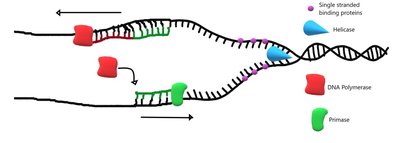
New nucleotides are added to each template strand through the action of specific enzymes. Primase inserts an RNA primer to mark the starting point, and DNA polymerase binds at the primer, facilitating the addition of complementary nucleotides.
Primase: Adds RNA primer to initiate replication.
DNA Polymerase: Adds new nucleotides (A-T, C-G pairing) to the template strand.
Directionality: Replication proceeds in opposite directions on the two strands.
Step 3: Leading and Lagging Strands
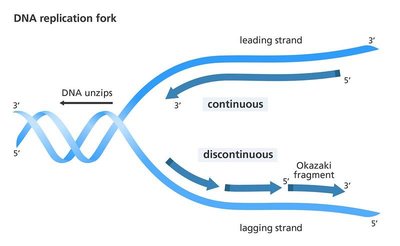
DNA replication occurs differently on the two strands due to their antiparallel orientation. The leading strand is synthesized continuously, while the lagging strand is synthesized in short fragments called Okazaki fragments.
Leading strand (3' to 5'): Synthesized continuously in the direction of helicase movement.
Lagging strand (5' to 3'): Synthesized discontinuously in short segments (Okazaki fragments).
Okazaki fragments: Short DNA segments on the lagging strand, later joined by ligase.
Step 4: Finishing Replication
To complete DNA replication, the enzyme ligase seals the gaps between Okazaki fragments, repairing the sugar-phosphate backbone. The DNA strands then recoil into their double helix structure.
Ligase: Connects Okazaki fragments and repairs the backbone.
Result: Two identical DNA molecules, each with one original and one new strand.
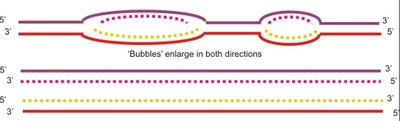
At the End of S-Phase
After replication, two identical daughter DNA molecules are formed. Each consists of half original and half new DNA. The process takes approximately 7–8 hours.
Outcome: Genetic continuity between parent and daughter cells.
Efficiency: Multiple replication bubbles speed up the process.
Mutations: Causes and Consequences
Errors can occur during replication, leading to mutations. These may be caused by biological, chemical, or physical factors. While some mutations are harmful, others contribute to genetic diversity.
Biological exposures: Viruses such as HPV.
Chemical substances: Pesticides, household chemicals.
Physical substances: Radiation, heat.
Consequences: Can affect cell function, replication, or be passed to new cells.
DNA Repair Mechanisms
The cell has specialized enzymes to detect and repair mutations, especially during the G2 phase. These mechanisms are efficient if the damage is not too severe.
"READ" enzymes: Recognize mismatched base pairs.
"CUT" enzymes: Remove incorrect nucleotides.
"REPLACE" enzymes: Insert correct nucleotides.
Timing: Most active between replication and mitosis.
Summary Table: Key Enzymes in DNA Replication
Enzyme | Function |
|---|---|
Helicase | Unwinds and separates DNA strands |
Single stranded binding proteins | Stabilize separated DNA strands |
Primase | Adds RNA primer to initiate replication |
DNA Polymerase | Adds new nucleotides to template strand |
Ligase | Joins Okazaki fragments and repairs backbone |
Key Formula: Complimentary Base Pairing
Base pairing follows strict rules:
Adenine (A) pairs with Thymine (T)
Cytosine (C) pairs with Guanine (G)
General formula for base pairing:
Additional info:
DNA replication is fundamental to cell reproduction and genetic inheritance. The semi-conservative model ensures genetic stability, while repair mechanisms maintain DNA integrity. Mutations, though often harmful, are a source of genetic variation and evolution.
