 Back
BackEarly Earth and the Origins of Life: Geologic Time and the Evolution of Life
Study Guide - Smart Notes
 Tailored notes based on your materials, expanded with key definitions, examples, and context.
Early Earth and the Origins of Life
Formation of Earth and Pre-Origin of Life
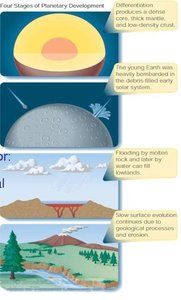
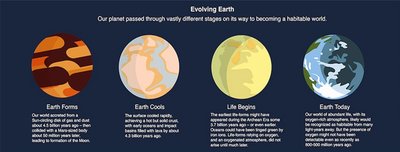
The Earth formed approximately 4.5 billion years ago through the accretion of matter in the early solar system. The planet underwent a period of intense bombardment by asteroids, which made it inhospitable to life for several hundred million years. As the bombardment subsided, Earth's surface cooled, heavy elements sank to form the core, and lighter elements formed the crust. Flooding by rain created the first oceans, and geological processes such as plate tectonics and erosion began to shape the planet's surface.
Heavy Bombardment: Asteroids and comets frequently impacted the early Earth, contributing to its heat and volatile inventory.
Formation of Oceans: Water vapor condensed as the planet cooled, leading to the formation of oceans.
Surface Evolution: Wind, water erosion, and tectonic activity continually reshaped the Earth's crust.
Geologic Time Scales
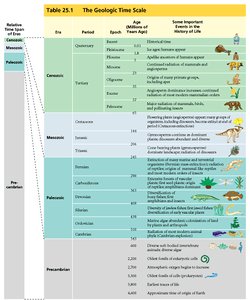
Geologic time is divided into hierarchical units: eons, eras, periods, and epochs. These divisions help paleobiologists and geologists organize Earth's history and the evolution of life.
Era: Spans hundreds of millions of years and contains two or more periods.
Period: Lasts tens of millions of years.
Epoch: Lasts several million years.
Precambrian Time
Origin of Life and Early Evolution
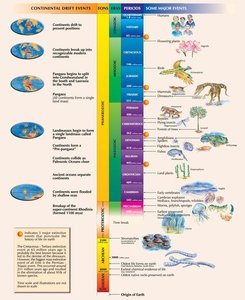
Life is believed to have originated around 3.8 billion years ago. The oldest known fossils are prokaryotes (about 3.5 billion years old), which were simple, single-celled organisms. The rise of photosynthetic cyanobacteria around 2.7 billion years ago led to the accumulation of atmospheric oxygen, a pivotal event known as the Great Oxygenation Event. Eukaryotes (cells with nuclei) appeared around 2.2 billion years ago, and multicellular life such as algae and soft-bodied invertebrates emerged approximately 600 million years ago.
Prokaryotes: The earliest life forms, lacking a nucleus.
Cyanobacteria: Photosynthetic bacteria responsible for oxygenating the atmosphere.
Eukaryotes: More complex cells with internal organelles.
Paleozoic Era
Cambrian Period (541–485.4 million years ago)
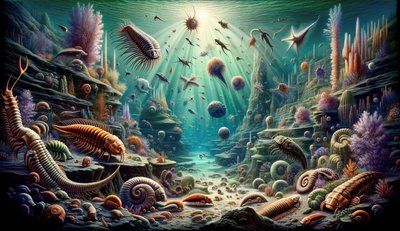
The Cambrian Period is marked by the "Cambrian Explosion," a rapid diversification of animal life. Most major animal phyla appeared during this time, and complex ecosystems developed in the oceans.
Cambrian Explosion: Sudden increase in diversity and complexity of animal life.
Marine Ecosystems: Trilobites, brachiopods, and other invertebrates dominated.
Ordovician Period (485.5–443.8 million years ago)
The Ordovician saw increased marine diversity and the first colonization of land by plants. The period ended with a major mass extinction, likely caused by volcanic activity and climate change.
Marine Diversification: Expansion of invertebrate groups.
Land Plants: Early non-vascular plants began to colonize land.
Mass Extinction: The second largest extinction event in Earth's history.
Silurian Period (443.8–419.2 million years ago)
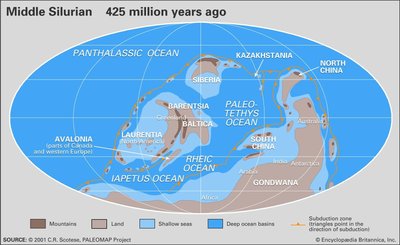
The Silurian Period was characterized by the development of the ozone layer, which stabilized the climate and allowed for rapid recovery in biodiversity. Insects and jawed fish appeared during this time.
Ozone Layer: Provided protection from UV radiation, enabling terrestrial life.
Insects and Fish: First appearance of these groups.
Devonian Period (419.2–358.9 million years ago)
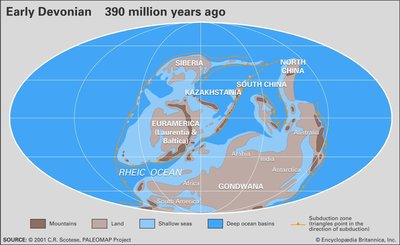
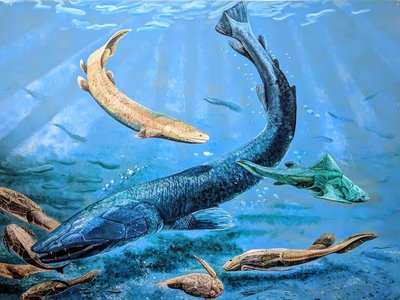
The Devonian is known as the "Age of Fishes" due to the diversification of fish. The first forests and seeded plants appeared, and the earliest tetrapods (ancestors of land vertebrates) evolved. The period ended with a significant mass extinction.
First Forests: Development of vascular plants and complex terrestrial ecosystems.
Tetrapods: Evolution of vertebrates capable of living on land.
Mass Extinction: Possibly caused by glaciation, meteorites, or atmospheric changes.
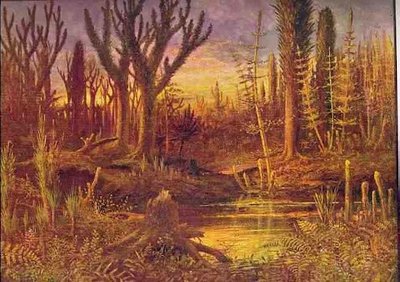
Carboniferous Period (358.9–298.9 million years ago)
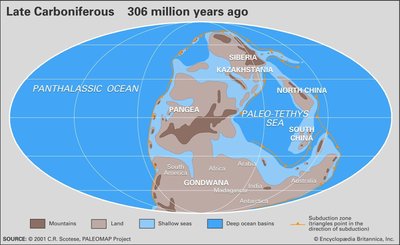
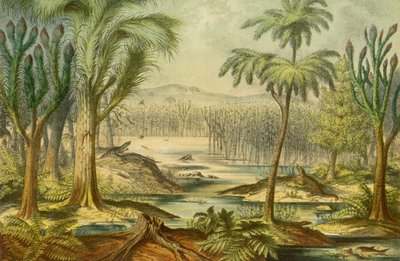
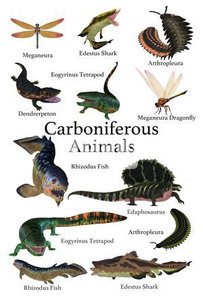
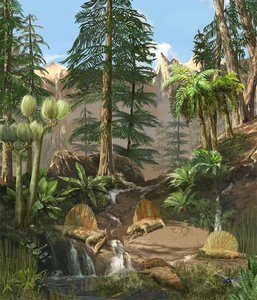
The Carboniferous was marked by warm climates, high oxygen and carbon dioxide levels, and the proliferation of swampy forests. This period saw the rise of amphibians, the ancestors of reptiles, birds, and mammals, and the formation of extensive coal deposits. The supercontinent Pangea began to form, altering ocean currents and climate.
Swampy Forests: Dominated by giant ferns and horsetails.
Coal Formation: Plant material accumulated and was buried, forming coal.
Amphibians and Early Reptiles: Diversification of vertebrate life on land.
Permian Period (298.9–251.9 million years ago)
The Permian Period saw the assembly of the supercontinent Pangea, leading to extreme climates and the dominance of reptiles. The period ended with the largest mass extinction in Earth's history, likely caused by massive volcanic eruptions and resulting environmental changes.
Pangea: Supercontinent formation altered global climate and habitats.
Reptile Dominance: Reptiles replaced amphibians as the dominant land animals.
Mass Extinction: Up to 96% of species went extinct due to volcanic activity and climate change.
Geologic Time Scale Summary Table
Era | Period | Epoch | Major Events |
|---|---|---|---|
Paleozoic | Cambrian | --- | Cambrian explosion; diversification of animal life |
Paleozoic | Ordovician | --- | Marine diversification; first land plants; mass extinction |
Paleozoic | Silurian | --- | Ozone layer forms; insects and fish appear |
Paleozoic | Devonian | --- | First forests; tetrapods; "Age of Fishes"; mass extinction |
Paleozoic | Carboniferous | --- | Swampy forests; coal formation; amphibians and reptiles |
Paleozoic | Permian | --- | Pangea forms; reptile dominance; largest mass extinction |
Dating the History of Life
Fossil Evidence and Radiometric Dating
Fossils embedded in rock layers provide evidence for the timing of evolutionary events. Radiometric dating uses the decay of radioactive isotopes to determine the age of rocks and fossils. The half-life of an isotope is the time required for half of the original amount to decay.
Isotopes: Atoms of the same element with different numbers of neutrons.
Radioactive Decay: Unstable isotopes lose particles or energy to become stable.
Half-Life: The time it takes for half of a radioactive isotope to decay.
Radiometric Dating: Determines the age of rocks and fossils by measuring parent and daughter isotopes.
Key Equations:
Radioactive decay:
Half-life:
Common isotopes used include:
Carbon-14: Half-life of 5,730 years; used for dating recent fossils (up to ~70,000 years).
Potassium-40: Half-life of 1.3 billion years; used for dating ancient rocks.
Uranium-238: Half-life of 4.5 billion years; used for dating the oldest rocks.
Other Dating Methods
Racemization: The conversion of L-amino acids to D-amino acids in fossils occurs at a known rate, providing another dating method.
Magnetic Polarity: Earth's magnetic field reverses over time, and the orientation of magnetic minerals in rocks can be used to date geological events.
Summary
The history of life on Earth is recorded in the geologic time scale, which is divided into eons, eras, periods, and epochs. Major evolutionary events, such as the origin of life, the Cambrian explosion, and mass extinctions, are tied to these divisions. Radiometric dating and fossil evidence allow scientists to reconstruct the timeline of life's evolution and the environmental changes that shaped it.
