 Back
Back8.2 Ecological Succession: Disturbance, Community Change, and Restoration
Study Guide - Smart Notes
 Tailored notes based on your materials, expanded with key definitions, examples, and context.
Succession
Disturbance and Its Role in Succession
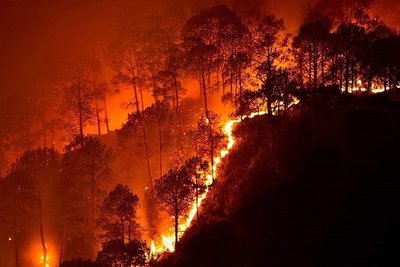
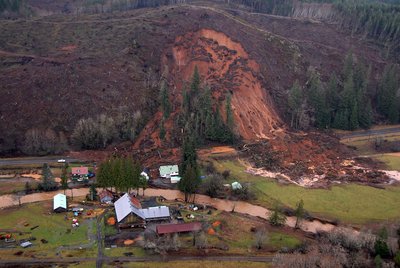
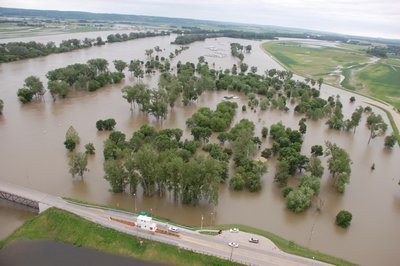
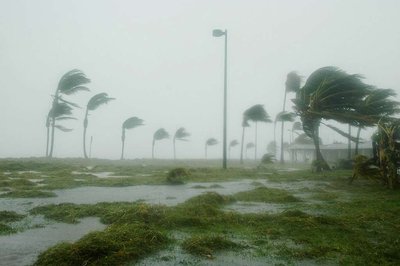
Disturbance is a fundamental concept in ecology, referring to abiotic events that kill or remove individuals in a community, thereby creating space for other organisms to grow or multiply. Disturbances initiate ecological succession and shape community structure.
Definition: An abiotic event (such as fire, storm, flood, or mudslide) that disrupts a community.
Examples: Forest fires, storms, flooding, mudslides.
Definition and Process of Succession
Succession is the process of change in a community following a disturbance or the creation of new substrate. It involves a series of stages leading to a hypothetical equilibrium state known as the climax community.
Succession: The sequential change in species composition and community structure over time after disturbance.
Climax Community: A stable, equilibrium state where change occurs rarely, if at all.
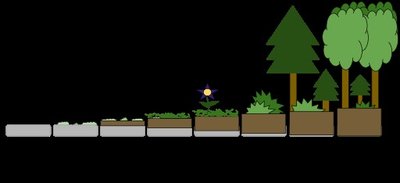
Types of Succession
Primary Succession
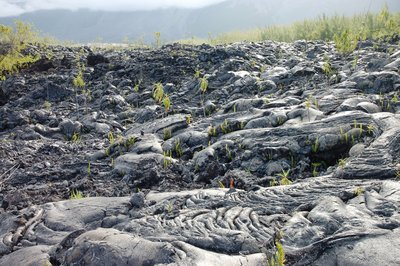
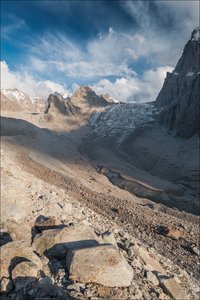
Primary succession occurs after severe disturbances where all living organisms and soil are destroyed or absent. It begins on bare substrate, such as after lava flows, glacier retreats, or landslides.
Characteristics: No soil or living organisms present initially.
Examples: Lava flows, glacier retreat, landslides.
Secondary Succession
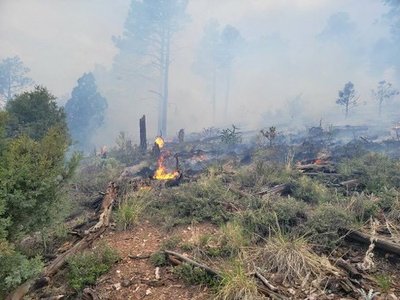
Secondary succession occurs after less severe disturbances where soil and some living organisms remain. It is common after events like fires, windstorms, or lightning strikes.
Characteristics: Soil and some organisms are still present.
Examples: Fires, trees downed by wind, lightning strikes.
Comparison Table: Primary vs. Secondary Succession
Feature | Primary Succession | Secondary Succession |
|---|---|---|
Initial Condition | Bare substrate, no soil | Soil present |
Organisms Present | None | Some survive |
Examples | Lava, glacier retreat | Fire, windstorm |
Successional Stages
Pioneer and Climax Communities
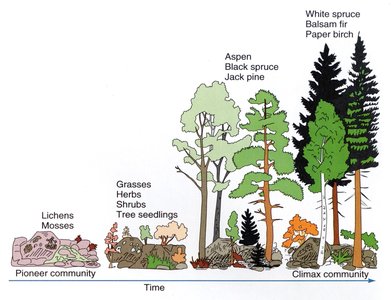
Succession involves a transition from pioneer communities to climax communities. Pioneer species are the first to colonize disturbed areas, while climax species dominate in late succession.
Pioneer Community: First to establish after disturbance; tolerant of harsh conditions; often short-lived and reproduce rapidly.
Climax Community: Late successional stage; species live longer and grow more slowly.
r-selected species: Rapid reproduction, short lifespan, typical of pioneers.
K-selected species: Slow growth, long lifespan, typical of climax species.
Historical Concepts of Succession
Space for Time Substitution
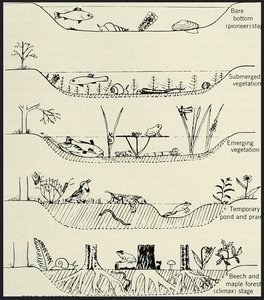
Henry Cowles studied Lake Michigan dune succession, using spatial variation to infer temporal changes in communities.
Space for Time Substitution: Observing different sites to represent different successional stages.
Clements' Superorganism and Climax Concept
Frederic Clements proposed that plant communities act as a "superorganism" with a life cycle ending in a stable climax stage.
Superorganism Concept: Community develops as a unit, reaching a stable climax.
Gleason's Individualistic Succession
Henry Gleason argued that each community is shaped by environmental conditions acting on individual species, leading to unique assemblages.
Individualistic Concept: Community composition varies based on individual species' responses to environment.
Elton and the Role of Animals
Charles Elton emphasized that both organisms (including animals) and the environment shape succession. Animals influence vegetation through activities such as eating, digging, trampling, and destroying plants.
Animal Influence: Animals can modify successional trajectories by affecting plant communities.
Models of Succession
Facilitation, Inhibition, and Tolerance Models
Connell and Slatyer (1977) described three models of succession, each explaining how early species affect later colonizers.
Facilitation: Early species modify the environment to aid colonization by later species.
Inhibition: Early species hinder colonization by later species.
Tolerance: Early species do not affect later species; later species tolerate pioneers and eventually dominate.
All these interactions can occur during succession, varying by species and time.
Modern Understanding of Succession
Variability and Climax Community Limitations
Succession varies greatly depending on location and community. The climax community is not always the best or most diverse; some species only exist in early-successional stages, and ecosystem services may be lower in climax stages. Climax communities themselves can change over time.
Intermediate Disturbance Hypothesis
The Intermediate Disturbance Hypothesis (Connell 1978) states that community diversity is greatest at intermediate levels of disturbance.
Low disturbance: Dominance by few species.
High disturbance: Only disturbance-tolerant species survive.
Intermediate disturbance: Highest diversity.
Alternative Stable States and Hysteresis
Succession can lead to different climax states, known as alternative stable states. Hysteresis describes situations where restoring original conditions does not result in recovery, meaning the path back is not the same as the path out.
Alternative Stable States: Multiple stable ecosystems can exist under similar conditions.
Hysteresis: Recovery does not follow the same trajectory as disturbance.
Succession and Restoration Ecology
Framework Species Method for Tropical Forest Restoration
The Framework Species Method involves planting a mix of pioneer, intermediate, and climax species to restore tropical forests. This approach attracts seed dispersers and pollinators, creates canopy cover to inhibit weeds, and facilitates seedling colonization, thereby increasing biodiversity and carbon storage.
Species Selection: Use a variety of species to mimic natural succession.
Biodiversity: Promotes ecosystem resilience and function.
Carbon Storage: Enhances climate mitigation.
Applying Succession Concepts to Restoration
Ecological concepts of succession are applied to restoration efforts to guide the recovery of disturbed ecosystems and promote resilience.
Resilience: The ability of an ecosystem to recover after disturbance.
Restoration: Using successional principles to restore ecosystem structure and function.
Summary Table: Succession Concepts
Concept | Description |
|---|---|
Disturbance | Abiotic event disrupting community |
Primary Succession | Starts on bare substrate, no soil |
Secondary Succession | Soil and some organisms present |
Pioneer Community | First colonizers, r-selected |
Climax Community | Stable, K-selected species |
Facilitation | Early species aid later colonizers |
Inhibition | Early species hinder later colonizers |
Tolerance | Later species tolerate pioneers |
Alternative Stable States | Multiple stable communities possible |
Hysteresis | Recovery path differs from disturbance path |
