 Back
Back8.2 Ecological Succession: Disturbance, Recovery, and Community Dynamics
Study Guide - Smart Notes
 Tailored notes based on your materials, expanded with key definitions, examples, and context.
Succession and Disturbance in Ecological Communities
What is a Disturbance?
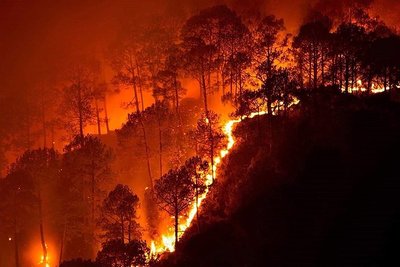
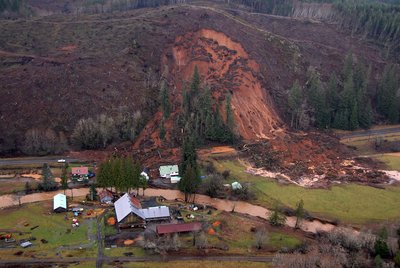
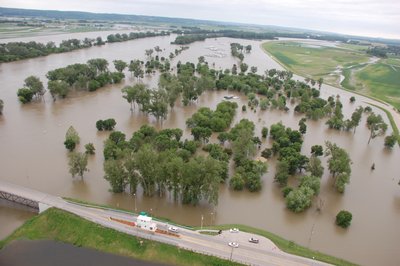
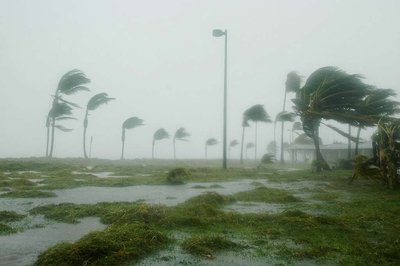
Disturbance refers to an abiotic event that kills or removes individuals in a community, thereby creating space for other organisms to grow or multiply. Disturbances are a key driver of ecological succession and can vary in intensity and frequency.
Examples of disturbances: Forest fires, storms, flooding, mudslides.
Disturbances can be natural or anthropogenic (human-caused).
Succession: Definition and Overview
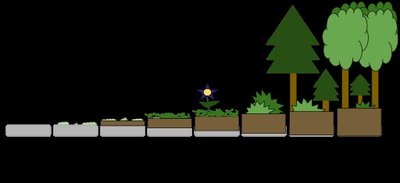
Succession is the process of change in the species structure of an ecological community over time, especially following a disturbance or the creation of new substrate. Succession leads to a series of community changes, which may culminate in a relatively stable climax community.
Climax community: A hypothetical equilibrium state where community change occurs rarely, if at all.
Types of Succession
Primary Succession
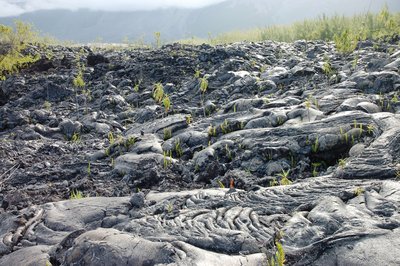
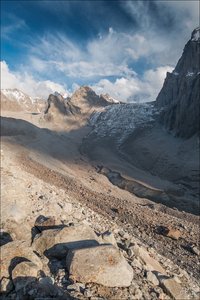
Primary succession occurs after a severe disturbance that removes all living organisms and often the soil itself. It begins on newly exposed surfaces where no soil exists.
Examples: Lava flows, retreating glaciers, landslides that remove all soil and vegetation.
Secondary Succession
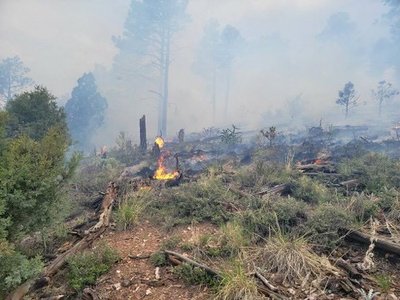
Secondary succession occurs after a less severe disturbance where some living organisms and soil remain intact. It is typically faster than primary succession because the substrate already contains organic matter and seed banks.
Examples: Forest fires, windthrow (trees downed by wind), areas cleared by humans but with soil remaining.
Comparison of Primary and Secondary Succession
Feature | Primary Succession | Secondary Succession |
|---|---|---|
Initial Condition | No soil, no organisms | Soil and some organisms present |
Examples | Lava flows, glacier retreats | Fire, windthrow, abandoned fields |
Speed | Slow | Faster |
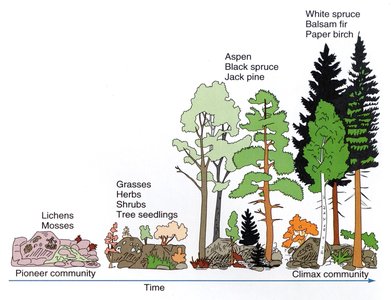
Successional Stages and Community Change
Pioneer and Climax Communities
Succession involves a sequence of communities:
Pioneer community: The first organisms to colonize a disturbed area. They are tolerant of harsh conditions, reproduce rapidly, and are often short-lived (r-selected species).
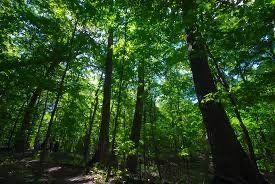
Climax community: The final, stable community in succession. Composed of species that are long-lived and grow slowly (K-selected species).
Historical Perspectives on Succession
Space for Time Substitution
Ecologists often study succession by examining different sites that represent various stages of succession, substituting space for time. This approach was pioneered by Henry Cowles in his studies of Lake Michigan sand dunes.
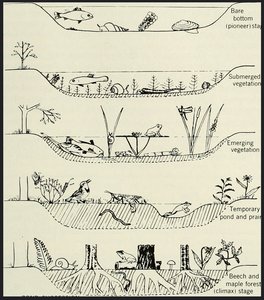
Major Succession Theories
Clements' Superorganism Concept: Frederic Clements (1916) proposed that plant communities act as a 'superorganism' with a predictable life cycle ending in a stable climax community.
Gleason's Individualistic Concept: Henry Gleason (1917) argued that communities are the result of individual species responding independently to environmental conditions, leading to less predictable outcomes.
Elton's View: Charles Elton (1926) emphasized the role of both plants and animals in shaping succession, noting that animals can influence vegetation through feeding, digging, and trampling.
Models of Succession
Three Models of Succession (Connell and Slatyer, 1977)
Facilitation: Early species modify the environment in ways that benefit later species, making colonization easier.
Inhibition: Early species hinder the establishment of later species by monopolizing resources or altering conditions unfavorably.
Tolerance: Early species do not affect later species; later species are more tolerant of environmental conditions and eventually dominate.
All three models can operate simultaneously or sequentially in different communities or at different times.
Modern Understanding of Succession
Succession varies greatly depending on location, disturbance type, and community composition.
Climax communities are not always the most diverse or productive; some species only exist in early successional stages.
Climax communities can change over time due to ongoing disturbances or environmental changes.
Intermediate Disturbance Hypothesis
This hypothesis states that community diversity is greatest at intermediate levels of disturbance. Too little disturbance allows competitive exclusion, while too much prevents establishment of many species.
Alternative Stable States and Hysteresis
Alternative stable states: Multiple stable community types can exist under similar environmental conditions.
Hysteresis: Returning to original conditions does not always restore the original community; the path of recovery may differ from the path of degradation.
Succession and Ecological Restoration
Framework Species Method
This method involves planting a mix of pioneer, intermediate, and climax species to accelerate forest restoration. Key species are chosen to attract seed dispersers and pollinators, create canopy cover, and inhibit weeds, thereby increasing biodiversity and carbon storage.
Succession concepts are applied to restoration ecology to guide the recovery of degraded ecosystems.
Summary Table: Key Concepts in Succession
Concept | Description | Example |
|---|---|---|
Disturbance | Event that removes organisms or alters resources | Fire, flood, landslide |
Primary Succession | Starts on bare substrate, no soil | Lava flow, glacier retreat |
Secondary Succession | Soil and some organisms remain | Forest fire, abandoned field |
Pioneer Species | First colonizers, r-selected | Lichens, mosses |
Climax Community | Stable, late-successional, K-selected | Mature forest |
Facilitation | Early species help later species | Nitrogen-fixing plants |
Inhibition | Early species hinder later species | Allelopathic plants |
Tolerance | Later species tolerate conditions | Shade-tolerant trees |
