 Back
BackEnzyme Activity and Inhibition: Temperature, pH, and Regulatory Mechanisms
Study Guide - Smart Notes
 Tailored notes based on your materials, expanded with key definitions, examples, and context.
Enzyme Activity: Effects of Temperature and pH
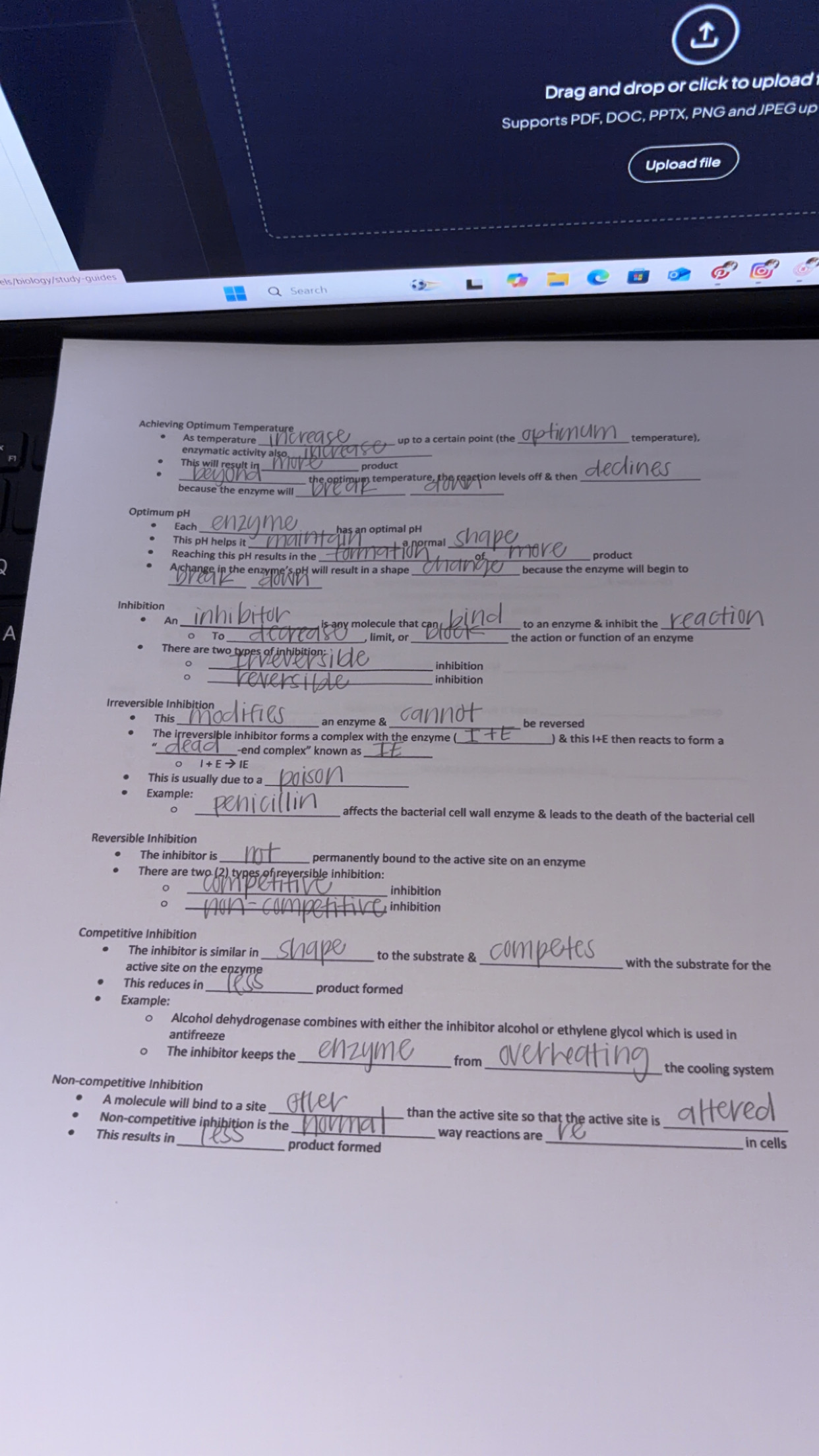
Achieving Optimum Temperature
Enzymes function most efficiently at a specific temperature, known as the optimum temperature. Changes in temperature can significantly affect the rate of enzymatic reactions.
Increasing temperature up to the optimum point increases enzymatic activity, resulting in more product formation.
Beyond the optimum temperature, the reaction rate levels off and then declines because the enzyme begins to denature.
Denaturation refers to the loss of the enzyme's three-dimensional structure, rendering it inactive.
Optimum pH
Each enzyme has an optimal pH at which it maintains its normal shape and activity. Deviations from this pH can affect enzyme function.
Maintaining optimal pH helps preserve the enzyme's conformation (shape).
Changes in pH result in a shape change of the enzyme, leading to decreased activity and less product formation.
Extreme pH values can cause denaturation, similar to temperature effects.
Enzyme Inhibition
General Concepts
An inhibitor is any molecule that can bind to an enzyme and inhibit its reaction. Inhibitors limit or block the action or function of an enzyme.
There are two main types of inhibition: irreversible and reversible.
Irreversible Inhibition
Irreversible inhibitors permanently modify an enzyme, preventing its function and making the inhibition non-reversible.
The inhibitor forms a complex with the enzyme (E + I → EI), which then reacts to form a dead-end complex (EI*).
This is usually caused by a poison or toxic substance.
Example: Penicillin affects the bacterial cell wall enzyme, leading to bacterial cell death.
Reversible Inhibition
Reversible inhibitors are not permanently bound to the enzyme and can dissociate, allowing the enzyme to regain activity.
Two types of reversible inhibition: competitive and non-competitive.
Competitive Inhibition
Competitive inhibitors resemble the substrate in shape and compete for the active site on the enzyme.
This competition reduces the amount of product formed.
Example: Alcohol dehydrogenase can bind either alcohol or ethylene glycol (antifreeze), reducing enzyme activity.
The inhibitor can prevent the enzyme from overheating the cooling system.
Non-competitive Inhibition
Non-competitive inhibitors bind to a site other than the active site, causing a change in the enzyme's shape and function.
This results in the active site being altered, so the substrate cannot bind effectively.
Non-competitive inhibition is the normal way reactions are regulated in cells.
This results in less product formed.
Summary Table: Types of Enzyme Inhibition
Type | Binding Site | Effect on Enzyme | Reversibility | Example |
|---|---|---|---|---|
Irreversible | Active site or other critical site | Permanent modification | No | Penicillin |
Competitive | Active site | Competes with substrate | Yes | Alcohol dehydrogenase |
Non-competitive | Other site (allosteric) | Alters enzyme shape | Yes | Cellular regulation |
Key Terms and Concepts
Enzyme: A protein that catalyzes biochemical reactions.
Substrate: The molecule upon which an enzyme acts.
Active site: The region of the enzyme where substrate binding and catalysis occur.
Inhibitor: A molecule that decreases enzyme activity.
Denaturation: Loss of enzyme structure and function due to extreme conditions.
Equations
Enzyme-substrate reaction:
Irreversible inhibition:
Competitive inhibition: and
Non-competitive inhibition: (binding at allosteric site)
Additional info: Academic context was added to clarify mechanisms, terminology, and examples for exam preparation.
