Back
BackBio 100 LEC Chapter 8 Modules 4-5
Study Guide - Smart Notes
 Tailored notes based on your materials, expanded with key definitions, examples, and context.
Bio 100 LEC Chapter 8
Enzymes and Metabolic Reactions
Enzyme Function and Catalysis
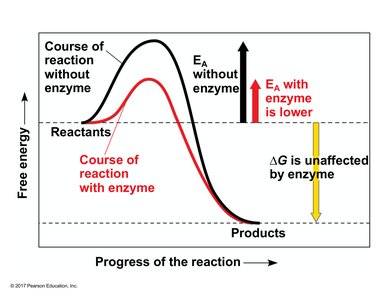
Enzymes are biological catalysts that accelerate metabolic reactions by lowering the activation energy required for those reactions. They are typically proteins and are essential for sustaining life by enabling biochemical processes to occur efficiently at physiological temperatures.
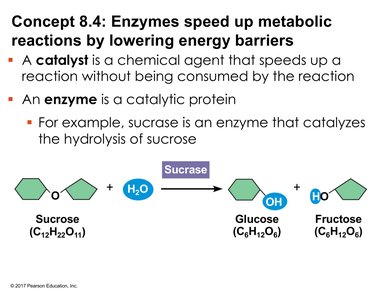
Catalyst: A chemical agent that increases the rate of a reaction without being consumed in the process.
Enzyme: A catalytic protein that facilitates specific biochemical reactions.
Example: Sucrase catalyzes the hydrolysis of sucrose into glucose and fructose.
Activation Energy and Reaction Progress
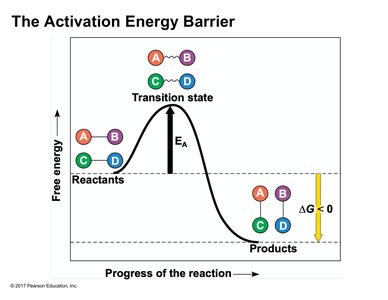
Every chemical reaction requires an initial input of energy, known as activation energy (EA), to proceed. Enzymes lower this energy barrier, allowing more reactant molecules to reach the transition state and be converted into products.
Activation Energy (EA): The energy required to initiate a reaction.
Transition State: A high-energy intermediate state during the reaction.
Free Energy Change (ΔG): The difference in energy between reactants and products; enzymes do not alter ΔG.
Classification and Structure of Enzymes
Enzyme Classes
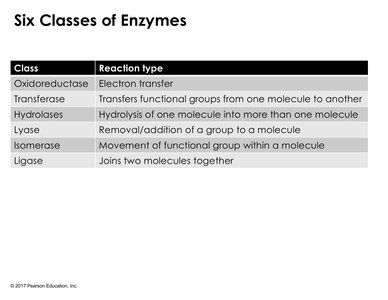
Enzymes are classified based on the type of reaction they catalyze. Each class contains enzymes with specific functions and mechanisms.
Class | Reaction type |
|---|---|
Oxidoreductase | Electron transfer |
Transferase | Transfers functional groups from one molecule to another |
Hydrolase | Hydrolysis of one molecule into more than one molecule |
Lyase | Removal/addition of a group to a molecule |
Isomerase | Movement of functional group within a molecule |
Ligase | Joins two molecules together |
Enzyme Structure and Active Site
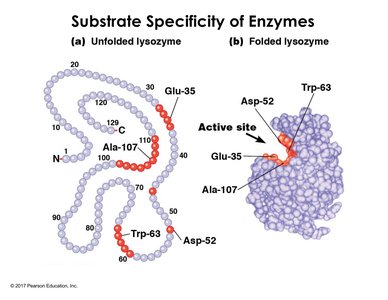
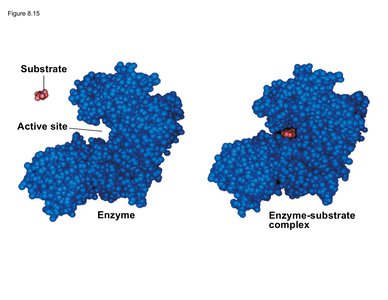
The three-dimensional structure of an enzyme determines its specificity. The active site is a region where substrate molecules bind and undergo a chemical reaction. The folding of the polypeptide brings together amino acid residues that form the active site, allowing for substrate recognition and catalysis.
Substrate Specificity: Enzymes are highly specific, often acting on a single substrate or a group of closely related substrates.
Active Site Formation: Proper folding is essential for the active site to form and function.
Mechanism of Enzyme Action
Enzyme-Substrate Interaction
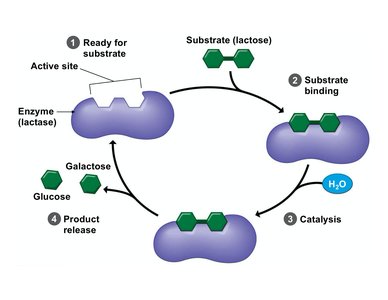
Enzyme action involves several steps: substrate binding, catalysis, and product release. The enzyme-substrate complex (ES complex) is a transient association that facilitates the conversion of substrate to product.
Step 1: Enzyme is ready for substrate binding at the active site.
Step 2: Substrate binds, often through weak interactions (hydrogen bonds, ionic bonds).
Step 3: Catalysis occurs, converting substrate to product.
Step 4: Product is released, and the enzyme is free to catalyze another reaction.
Enzyme Saturation and Kinetics
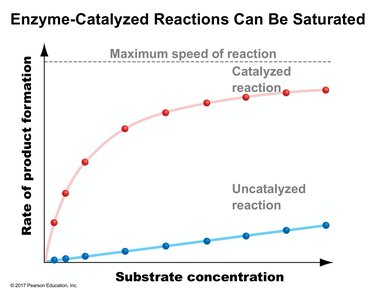
As substrate concentration increases, the rate of product formation rises until the enzyme becomes saturated. At saturation, all active sites are occupied, and the reaction rate reaches its maximum (Vmax).
Vmax: Maximum rate of reaction when the enzyme is fully saturated with substrate.
Michaelis-Menten Kinetics: Describes the relationship between substrate concentration and reaction rate.
Factors Affecting Enzyme Activity
Temperature and pH
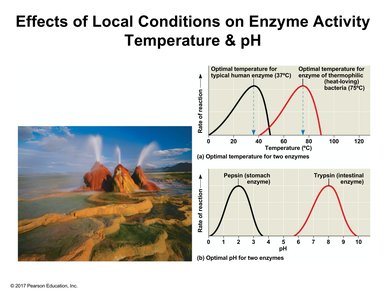
Enzyme activity is influenced by environmental conditions such as temperature and pH. Each enzyme has an optimal temperature and pH at which it functions most efficiently. Deviations from these optima can lead to decreased activity or denaturation.
Optimal Temperature: Human enzymes typically function best at 37°C; thermophilic enzymes have higher optima.
Optimal pH: Varies by enzyme location (e.g., pepsin in the stomach at pH 2, trypsin in the intestine at pH 8).
Cofactors and Coenzymes
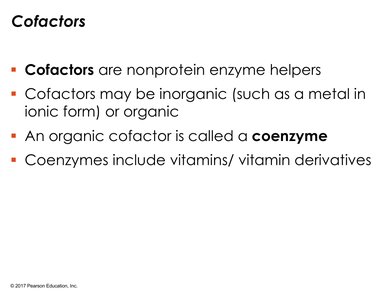
Some enzymes require non-protein helpers called cofactors for activity. Cofactors can be inorganic (e.g., metal ions) or organic (coenzymes, often derived from vitamins).
Cofactor: Non-protein molecule required for enzyme activity.
Coenzyme: Organic cofactor, often derived from vitamins.
Enzyme Inhibition
Types of Inhibition
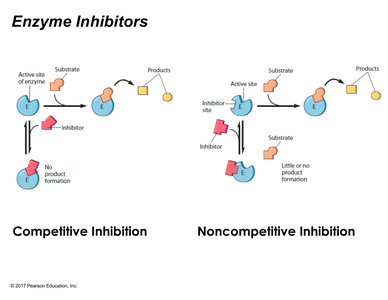
Enzyme inhibitors are molecules that decrease or abolish enzyme activity. Inhibition can be reversible or irreversible, and reversible inhibition can be competitive or noncompetitive.
Competitive Inhibition: Inhibitor competes with substrate for the active site; can be overcome by increasing substrate concentration.
Noncompetitive Inhibition: Inhibitor binds to a site other than the active site (allosteric site), altering enzyme conformation and reducing activity; cannot be overcome by increasing substrate concentration.
Regulation of Enzyme Activity
Allosteric Regulation
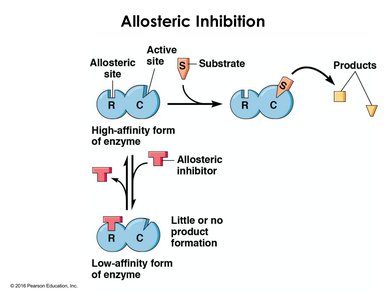
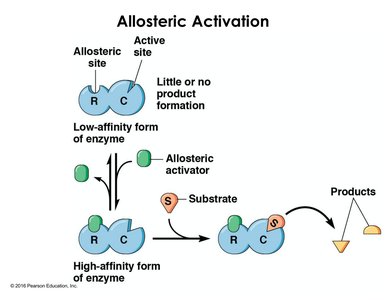
Allosteric regulation involves the binding of regulatory molecules at sites other than the active site, causing conformational changes that affect enzyme activity. Allosteric inhibitors decrease activity, while allosteric activators increase it. Many allosteric enzymes are multi-subunit proteins.
Allosteric Site: Regulatory site distinct from the active site.
Allosteric Inhibitor: Stabilizes the low-affinity (inactive) form of the enzyme.
Allosteric Activator: Stabilizes the high-affinity (active) form of the enzyme.
Cooperativity
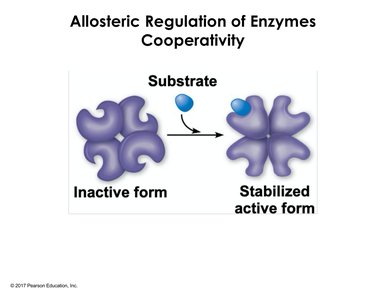
Cooperativity is a form of allosteric regulation where substrate binding to one active site affects the affinity of other active sites within a multi-subunit enzyme. Positive cooperativity increases affinity, while negative cooperativity decreases it.
Example: Hemoglobin exhibits positive cooperativity in oxygen binding.
Feedback Inhibition
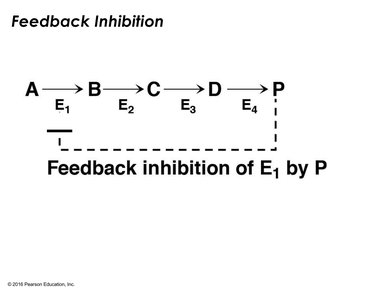
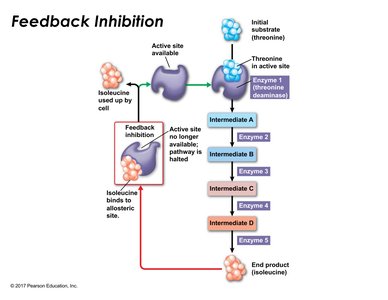
Feedback inhibition is a regulatory mechanism in which the end product of a metabolic pathway inhibits an upstream enzyme, preventing overproduction of the product and conserving resources.
Example: Isoleucine biosynthesis from threonine is regulated by feedback inhibition; isoleucine inhibits threonine deaminase when its concentration is sufficient.
Covalent Modification
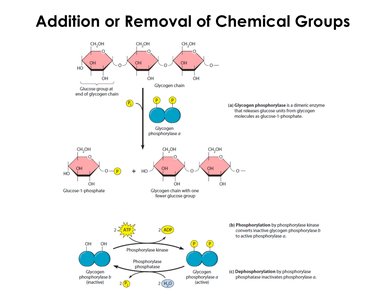
Enzyme activity can be regulated by covalent addition or removal of chemical groups, such as phosphorylation. This modification can activate or inactivate enzymes, allowing for rapid and reversible regulation of metabolic pathways.
Phosphorylation: Addition of a phosphate group, often activating the enzyme.
Dephosphorylation: Removal of a phosphate group, often inactivating the enzyme.
Compartmentalization
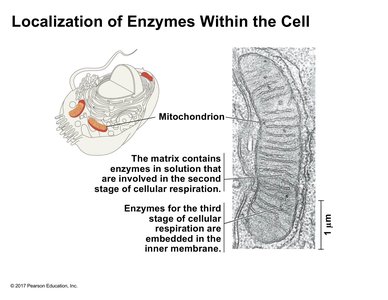
In eukaryotic cells, enzymes and metabolic pathways are often compartmentalized within specific organelles. This spatial separation allows for regulation and efficiency of metabolic processes.
Example: Enzymes for cellular respiration are localized in the mitochondria.
Enzyme Activity and Human Physiology
Clinical Application: Blood Pressure Regulation
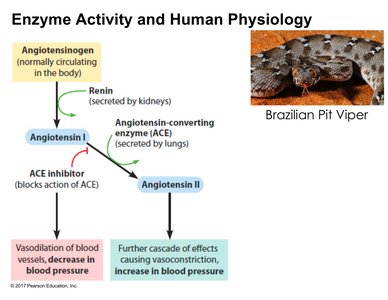
Enzyme activity is crucial in physiological processes such as blood pressure regulation. The renin-angiotensin system involves several enzymes, and inhibitors of these enzymes are used as drugs to treat hypertension.
Renin: Released by kidneys, converts angiotensinogen to angiotensin I.
Angiotensin-Converting Enzyme (ACE): Converts angiotensin I to angiotensin II, leading to vasoconstriction and increased blood pressure.
ACE Inhibitors: Block ACE, resulting in vasodilation and decreased blood pressure; used clinically to treat hypertension.