Back
BackEvolution, Diversity, and Classification of Life: Study Notes
Study Guide - Smart Notes
 Tailored notes based on your materials, expanded with key definitions, examples, and context.
How Populations Evolve
Taxonomy and Classification
Taxonomy is the branch of biology concerned with identifying, naming, and classifying species. The Linnaean system, developed by Carolus Linnaeus, uses a hierarchical classification and a binomial method for naming species. This system organizes living organisms into increasingly broad categories, from species up to domain.
Species: The most specific level, e.g., Panthera pardus.
Genus: Groups closely related species, e.g., Panthera.
Family, Order, Class, Phylum, Kingdom, Domain: Successively broader groupings.
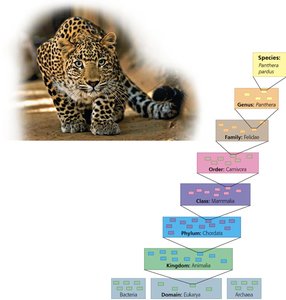
Explaining Diversity: Darwin and Evolution
Charles Darwin's On the Origin of Species (1859) introduced the concept of evolution as descent with modification. Natural selection is the mechanism for evolutionary change, resulting in adaptations. Artificial selection, or selective breeding, is a human-driven process that promotes desirable traits.
Natural Selection: Traits that enhance survival and reproduction become more common.
Artificial Selection: Humans select traits in domesticated species.
Evolution: Refers to generation-to-generation changes in populations.
Evidence of Evolution
Multiple lines of evidence support evolution:
Fossil Record: Shows historical changes in organisms.
Homologies: Similarities due to common ancestry, including genetic language and homologous genes.
Vestigial Structures: Remnants of features that served functions in ancestors.
Evolutionary Trees: Illustrate patterns of descent and branching sequences.
Natural Selection: Mechanism and Population Dynamics
Natural selection operates when resources are limited and populations grow faster than can be supported. Only some offspring survive, and those with adaptive traits reproduce more successfully.
Population: Group of organisms of the same species, living in the same area.
Heritability: Transmission of traits from parent to offspring.
Relative Fitness: Contribution to the gene pool of the next generation.
Artificial vs Natural Selection
Artificial Selection: Selective breeding for desirable traits; variation and heritability are key.
Natural Selection: Impacts heritable traits only; populations evolve, not individuals.
Sexual Selection
Sexual selection is a form of natural selection where traits that increase mating success become more common. Sexual dimorphism refers to differences in appearance between males and females not directly related to reproduction or survival.
Gene Pool and Hardy-Weinberg Principle
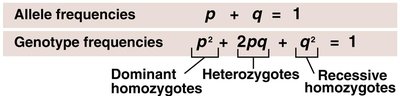
The gene pool includes all copies of every allele at every locus in a population. The Hardy-Weinberg formula calculates genotype frequencies from allele frequencies.
Allele frequencies:
Genotype frequencies:
Genetic Variation
Genetic variation arises from mutations and sexual reproduction. Only heritable genetic variation is relevant to natural selection.
Mutation: Ultimate source of genetic variation; may generate new alleles.
Sexual Reproduction: Creates fresh assortments of alleles through independent orientation, crossing over, and random fertilization.

Main Causes of Evolutionary Change
Natural Selection: Promotes adaptation.
Genetic Drift: Change due to chance; includes bottleneck and founder effects.
Gene Flow: Genetic exchange between populations.
Outcomes of Natural Selection
Directional Selection: Favors one extreme phenotype.
Disruptive Selection: Favors two or more contrasting phenotypes.
Stabilizing Selection: Favors intermediate phenotypes.
How Biological Diversity Evolves
Species Concepts and Reproductive Barriers
The biological species concept defines species as groups of populations that can interbreed and produce fertile offspring. Reproductive barriers prevent mating or fertilization between species.
Prezygotic Barriers: Time-based, habitat, behavioral, mechanical, gametic isolation.
Postzygotic Barriers: Reduced hybrid viability, reduced hybrid fertility, hybrid breakdown.
Mechanisms of Speciation
Allopatric Speciation: Geographic barrier isolates populations, blocking gene flow.
Sympatric Speciation: Reproductive isolation without geographic separation; includes polyploidy, habitat complexity, and sexual selection.

Macroevolution and Mass Extinctions
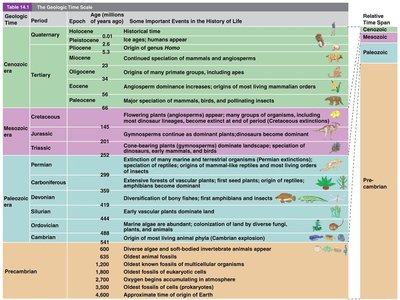
Macroevolution refers to evolutionary change above the species level, including the origin of key adaptations and the impact of mass extinctions. The geologic time scale divides Earth's history into periods, with radiometric dating based on radioactive decay.
Mechanisms of Macroevolution
Change in Developmental Rate: Alters timing of events.
Homeotic Genes: Master control genes.
Exaptations: Features evolved for one function, used for another (e.g., feathers for insulation, then flight).
Complex Structures: Evolve in small steps.
Classifying the Diversity of Life
Taxonomy and Systematics
Taxonomy is the naming and classification of species. Systematics includes taxonomy and focuses on classifying organisms and determining their evolutionary relationships. Phylogenetic trees depict hypotheses about evolutionary history and reflect hierarchical classification.

Phylogeny and Homology
Phylogeny is the evolutionary history of species. Homologous structures provide information for phylogenetic relationships. Convergent evolution results in analogous adaptations.

Cladistics
Cladistics groups organisms by common ancestry. A clade includes an ancestral species and its descendants, forming a distinct branch on the evolutionary tree.

The Evolution of Microbial Life
Major Episodes in the History of Life
Key events in the history of life include the origin of Earth, the appearance of prokaryotes, eukaryotes, multicellular organisms, and the colonization of land by plants and fungi.
Major Episode | Millions of Years Ago |
|---|---|
Origin of Earth | 4,600 |
Oldest prokaryotic fossils | 3,500 |
Beginning of atmospheric accumulation of O2 | 2,700 |
Oldest eukaryotic fossils | 1,800 |
Oldest fossils of multicellular organisms | 1,200 |
Fossils of large, diverse multicellular organisms | 600 |
Plants and fungi colonize land | 500 |

Prokaryotes: Structure and Diversity
Prokaryotes include bacteria and archaea. They lack nuclei and membrane-enclosed organelles, and most have cell walls. Common shapes are cocci, bacilli, and spiral. Prokaryotes are unicellular but may form groups.

Biofilms and Symbiosis
Prokaryotes may form biofilms, which are organized colonies attached to surfaces. Biofilms have medical implications and can be symbiotic with plants and animals.
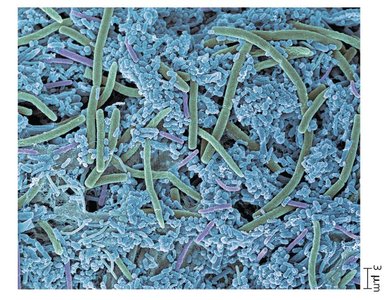
Prokaryote Reproduction
Prokaryotes reproduce by binary fission, leading to rapid accumulation of mutations. Endospores are protective cells produced under unfavorable conditions.
Ecological Impact of Prokaryotes
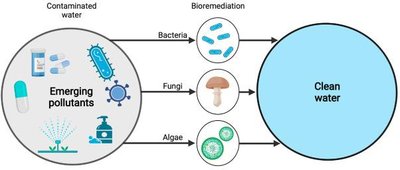
Prokaryotes recycle chemical elements, break down organic waste, and are used in bioremediation to remove pollutants from water, air, or soil.
Archaea: Extremophiles
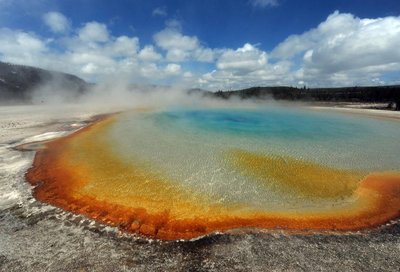
Archaea can survive in extreme environments, such as hot springs, deep-ocean vents, and highly saline habitats.
Pathogens
Some prokaryotes are pathogens, causing disease. Exotoxins are proteins secreted by bacteria, while endotoxins are components of bacterial outer membranes.
Eukarya: Protists and Their Diversity
Origins of Protists
Protists are ancestral to all other eukaryotes. Most are unicellular, and their history involves symbiosis between prokaryotes.

Protist Nutrition
Protists are diverse in their nutritional strategies:
Autotrophs: Produce food by photosynthesis (includes algae).
Heterotrophs: Acquire food from other organisms, including bacteria and other protists.
Parasites: Derive nutrition from living hosts.
Protozoan Diversity
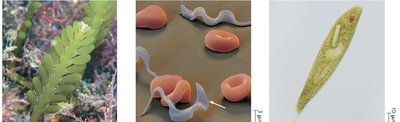
Protozoans live by ingesting food and thrive in aquatic environments. They include flagellates, amoebas, apicomplexans, and ciliates.
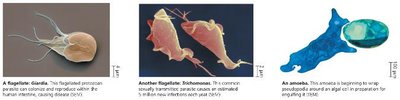
Flagellates: Move by flagella; examples include Giardia and Trichomonas.
Amoebas: Move by pseudopodia.
Apicomplexans: Parasitic, with specialized structures for penetrating host cells; examples include Plasmodium and Toxoplasma.
Ciliates: Move and feed using cilia; example is Paramecium.
Slime Molds
Slime molds are multicellular protists related to amoebas. They feed on dead plant material and can produce spores under stress.
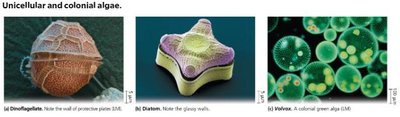
Unicellular and Colonial Algae
Algae and cyanobacteria perform photosynthesis and support food chains in aquatic ecosystems. Groups include dinoflagellates, diatoms, and green algae.
Seaweeds
Seaweeds are large, multicellular marine algae. They are classified by pigment type: green, red, and brown algae (kelp).