 Back
BackExam 1 Review: Biology Concepts and Cell Structure Guidance
Study Guide - Smart Notes
 Tailored notes based on your materials, expanded with key definitions, examples, and context.
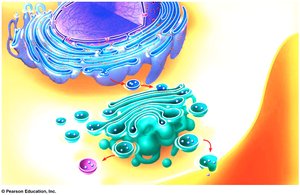
Q17. Label the following organelles: Golgi Body, Rough ER, Nucleus, Vesicle.
Background
Topic: Cell Structure and Function
This question tests your ability to identify and label major eukaryotic cell organelles, which are essential for cellular processes such as protein synthesis, modification, and transport.
Key Terms:
Golgi Body (Golgi Apparatus): Modifies, sorts, and packages proteins and lipids for secretion or delivery to other organelles.
Rough ER (Endoplasmic Reticulum): Studded with ribosomes; site of protein synthesis for proteins destined for membranes or export.
Nucleus: Contains the cell's genetic material (DNA); controls cellular activities.
Vesicle: Small membrane-bound sacs that transport materials within the cell.
Step-by-Step Guidance
Examine the provided cell diagram and identify the organelles based on their structure and location.
Look for the large, central structure surrounded by a double membrane—this is typically the nucleus.
Find the organelle with stacked, flattened sacs and vesicles nearby—this is the Golgi Body.
Identify the network of membranes with ribosomes attached—this is the Rough ER.
Locate the small, round structures involved in transport—these are vesicles.
Try solving on your own before revealing the answer!
Final Answer:
a. Rough ER b. Nucleus c. Golgi Body d. Vesicle
The diagram shows the nucleus (purple), rough ER (blue with dots), Golgi body (turquoise stacks), and vesicles (small circles).
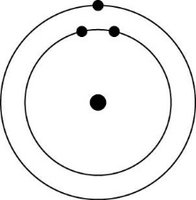
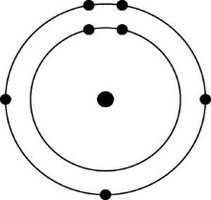
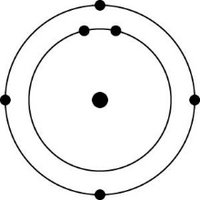
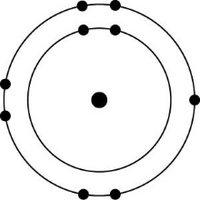
Q25. Which one of the atoms shown would be most likely to form a cation with a charge of +1?
Background
Topic: Atomic Structure and Ion Formation
This question tests your understanding of how atoms form ions, specifically cations, based on their electron configuration.
Key Terms:
Cation: A positively charged ion formed when an atom loses one or more electrons.
Electron Shell: The arrangement of electrons around the nucleus; atoms with one electron in their outer shell tend to lose it to achieve stability.
Step-by-Step Guidance
Examine each atom's electron configuration in the provided diagrams.
Identify which atom has a single electron in its outermost shell—this atom is most likely to lose that electron and form a +1 cation.
Recall that elements in Group 1 of the periodic table (like sodium) typically form +1 cations.
Compare the diagrams to the typical electron configuration of Group 1 elements.
Try solving on your own before revealing the answer!
Final Answer:
The atom with a single electron in its outermost shell (typically diagram A) is most likely to form a cation with a charge of +1.
This is because it can easily lose that electron to achieve a stable electron configuration.
Q36. A nitrogen atom has an atomic number of 7, with an atomic mass of 15.
Background
Topic: Atomic Structure and Chemical Bonding
This question tests your ability to determine the number of protons, neutrons, and possible bonds based on atomic number and mass.
Key Terms and Formulas:
Atomic Number: Number of protons in the nucleus.
Atomic Mass: Sum of protons and neutrons.
Electron Distribution: Determines bonding capacity.
Step-by-Step Guidance
Recall that the atomic number (7) tells you the number of protons.
Calculate the number of neutrons:
Determine the number of electrons (same as protons for a neutral atom).
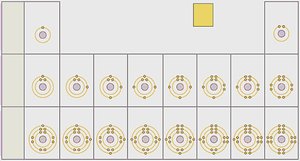
Use the electron distribution diagram to find out how many electrons are in the outer shell (valence electrons).
Based on the number of valence electrons, deduce how many bonds nitrogen can form.
Try solving on your own before revealing the answer!
Final Answer:
a) 7 protons b) 8 neutrons c) Nitrogen can form 3 bonds (it has 5 valence electrons and needs 3 more to fill its shell).
The electron distribution diagram shows 5 electrons in the outer shell, so nitrogen typically forms three covalent bonds.
