 Back
BackExchange and Transport in Animals: Osmoregulation, Excretion, and Gas Exchange
Study Guide - Smart Notes
 Tailored notes based on your materials, expanded with key definitions, examples, and context.
Exchange and Transport in Animals
Overview of Animal Exchange and Transport
Animals must acquire nutrients, exchange gases, and remove wastes to maintain homeostasis. These processes involve specialized organ systems that facilitate the movement of substances into, within, and out of the body.
Digestive System: Responsible for food processing and nutrient absorption.
Circulatory System: Transports nutrients, gases, and wastes throughout the body.
Excretory System: Removes metabolic wastes and regulates water and solute balance.
Respiratory System: Facilitates gas exchange (O2 in, CO2 out).
Osmoregulation and Excretion
Osmoregulation
Osmoregulation is the process by which animals regulate the balance of water and solutes (such as salts and ions) in their bodies. This is essential for maintaining cellular function and overall homeostasis.
Osmosis: The passive movement of water across a semipermeable membrane from areas of high water concentration (low solute) to low water concentration (high solute).
Osmolarity: The total concentration of solutes in a solution.
Isoosmotic: Equal solute concentration on both sides of a membrane; no net water movement.
Hypoosmotic (Hypotonic): Lower solute concentration outside; water moves into the cell or organism.
Hyperosmotic (Hypertonic): Higher solute concentration outside; water moves out of the cell or organism.
Osmoregulatory Strategies:
Osmoconformers: Animals that are isoosmotic with their environment (e.g., many marine invertebrates). They expend less energy regulating osmolarity.
Osmoregulators: Animals that maintain internal osmolarity independent of the environment (e.g., freshwater animals, mammals). This process is energy-intensive.
Example: Freshwater fish must actively excrete water and retain salts, while marine fish must excrete salts and retain water.
Nitrogenous Waste
The breakdown of proteins and nucleic acids produces nitrogenous wastes, which must be excreted to prevent toxicity. The form of nitrogenous waste varies among animals and is influenced by habitat and evolutionary history.
Ammonia (NH3): Highly toxic, very soluble, requires large amounts of water for excretion (common in aquatic animals).
Urea: Less toxic, requires energy to produce, can be stored and excreted with less water (mammals, amphibians).
Uric Acid: Non-toxic, requires the most energy to produce, excreted as a paste with minimal water loss (birds, reptiles, insects).
Excretory System: The Nephron
The vertebrate excretory system centers on the nephron, the functional unit of the kidney. Nephrons filter blood, reabsorb useful substances, secrete wastes, and excrete urine.
Filtration: Blood pressure forces water and small solutes from the blood into the nephron tubule.
Reabsorption: Useful substances (water, glucose, amino acids) are reabsorbed into the blood via active transport.
Secretion: Additional wastes are actively transported from the blood into the nephron.
Excretion: The final filtrate (urine) is eliminated from the body.
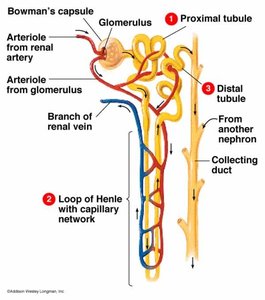
Adaptations: The length of the loop of Henle is correlated with an animal's need for water conservation. Desert mammals have long loops for maximal water reabsorption and concentrated urine, while aquatic mammals have shorter loops.
Gas Exchange and Circulation
Partial Pressure Gradients and Gas Exchange
Gas exchange in animals relies on diffusion across respiratory surfaces, driven by differences in partial pressure. Oxygen moves from areas of high to low partial pressure, as does carbon dioxide in the opposite direction.
Partial Pressure: The pressure exerted by a single gas in a mixture of gases.
Respiratory Surfaces: Thin, moist membranes (e.g., gills, lungs, skin) where gas exchange occurs.
Adaptations: Aquatic animals use gills with counter-current exchange; terrestrial animals use lungs or tracheal systems.
Example: Mammalian lungs contain millions of alveoli, where oxygen diffuses into capillaries and carbon dioxide diffuses out.
Circulatory System
The circulatory system transports gases, nutrients, and wastes throughout the body, solving the problem of large diffusion distances in complex organisms.
Arteries: Carry oxygenated blood away from the heart to body tissues.
Veins: Return deoxygenated blood from tissues to the heart.
Capillaries: Thin-walled vessels where exchange of gases, nutrients, and wastes occurs with tissues.
The respiratory and circulatory systems are closely linked, ensuring efficient gas exchange and transport throughout the body.
Plant Transport: Water and Sugar Movement
Leaf Anatomy and Gas Exchange
Leaves are the primary site of photosynthesis and gas exchange in plants. Stomata regulate the entry of CO2 and the exit of O2 and water vapor.
Stomata: Pores on the leaf surface that open and close to regulate gas and water exchange.
Transpiration: The loss of water vapor from leaves, creating a pull that draws water upward from the roots through the xylem.
Cohesion-Tension Hypothesis: Water molecules stick together (cohesion) and to the walls of xylem vessels (adhesion), allowing the transpiration pull to move water up the plant.
Translocation: The movement of sugars in the phloem, requiring active transport and moving in multiple directions to supply non-photosynthetic tissues.
Example: Water moves from roots to leaves due to evaporation at the leaf surface, while sugars produced in leaves are transported to growing tissues and storage organs.
