 Back
BackFrom DNA to Protein: Gene Expression and Mutation
Study Guide - Smart Notes
 Tailored notes based on your materials, expanded with key definitions, examples, and context.
Gene Expression: From DNA to Protein
Genes Code for Proteins
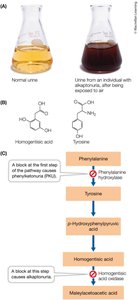
Genes are segments of DNA that encode instructions for the synthesis of proteins, which carry out most cellular functions. Early studies of genetic diseases, such as alkaptonuria and phenylketonuria (PKU), revealed that mutations in specific genes lead to the accumulation of toxic metabolic products due to nonfunctional enzymes.
Alkaptonuria: Caused by a mutation that prevents the breakdown of homogentisic acid, leading to its accumulation and darkened urine.
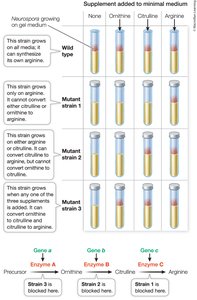
One-gene, one-enzyme hypothesis: Each gene encodes a single enzyme; later revised to one-gene, one-polypeptide, as many proteins are composed of multiple polypeptides.
Model organisms: Used in genetic studies due to ease of manipulation and rapid growth (e.g., Neurospora crassa).
Information Flows from Genes to Proteins
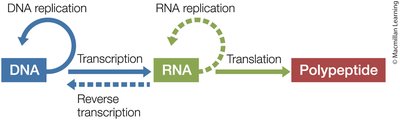
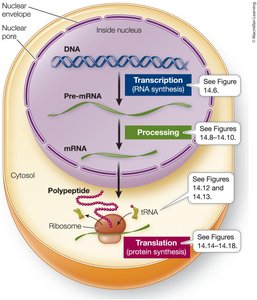
Gene expression involves two main steps: transcription and translation. The central dogma of molecular biology describes the flow of genetic information from DNA to RNA to protein.
Transcription: DNA is copied into RNA.
Translation: RNA is used as a template to synthesize proteins.
RNA types: mRNA (messenger), rRNA (ribosomal), tRNA (transfer).
Viruses: Some use RNA as genetic material; retroviruses use reverse transcription to integrate into host genomes.
DNA Is Transcribed to Produce RNA
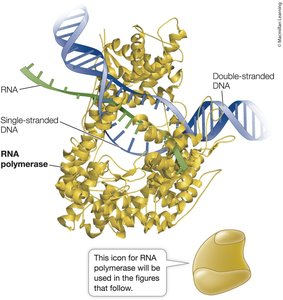
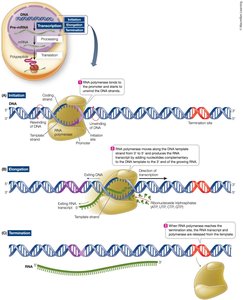
Transcription is the process by which RNA polymerase synthesizes RNA from a DNA template. The RNA produced is complementary to the template strand and similar to the coding strand.
Requirements: DNA template, ribonucleoside triphosphates (ATP, GTP, CTP, UTP), RNA polymerase.
Steps: Initiation (RNA polymerase binds promoter), Elongation (RNA synthesis), Termination (RNA detaches).
RNA polymerase: Adds nucleotides in 5′-to-3′ direction; does not require primers.
Eukaryotic Pre-mRNA Transcripts Are Processed prior to Translation
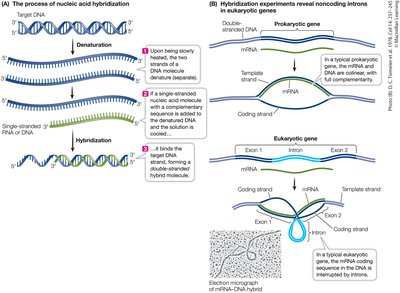
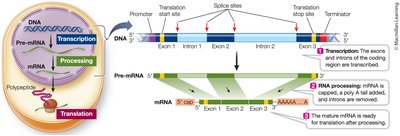
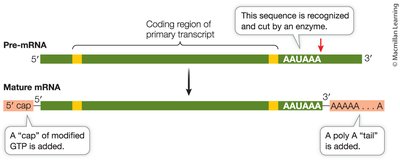
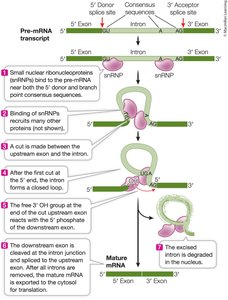
In eukaryotes, pre-mRNA undergoes several processing steps before translation. These include addition of a 5′ cap, a poly-A tail, and removal of introns via splicing.
Nucleic acid hybridization: Reveals introns (noncoding regions) in eukaryotic genes.
Splicing: Introns are removed, exons are joined to form mature mRNA.
5′ cap: Modified GTP added for ribosome binding and protection.
Poly-A tail: Added for stability and export from nucleus.
The Genetic Code Determines the Protein Sequence Encoded by an mRNA
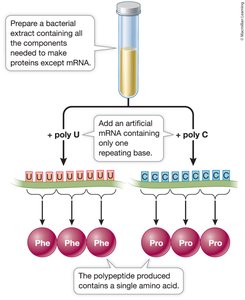
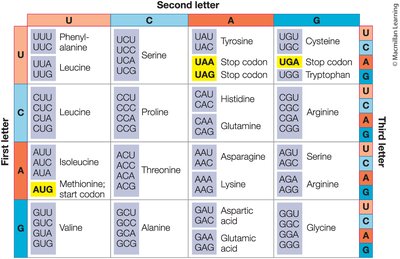
The genetic code is a set of rules by which the sequence of bases in mRNA is translated into the sequence of amino acids in a protein. Each codon (three-base sequence) specifies a particular amino acid.
Start codon: AUG (methionine).
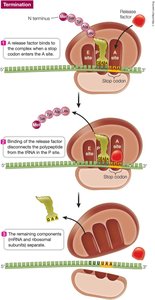
Stop codons: UAA, UAG, UGA (signal termination).
Redundancy: Most amino acids are specified by more than one codon.
Universality: The code is nearly universal across all organisms.
Translation: mRNA to Protein
The Coding Sequence in mRNA Is Translated into Proteins by Ribosomes
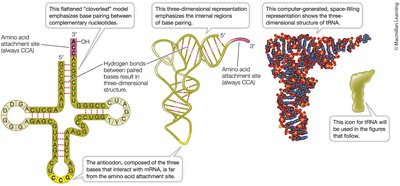
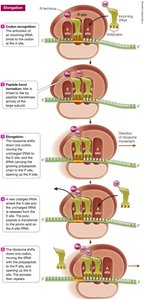
Translation is the process by which ribosomes synthesize polypeptides using mRNA as a template. tRNA molecules bring specific amino acids to the ribosome, matching codons with their anticodons.
tRNA: Binds amino acids, matches anticodon to mRNA codon, interacts with ribosome.
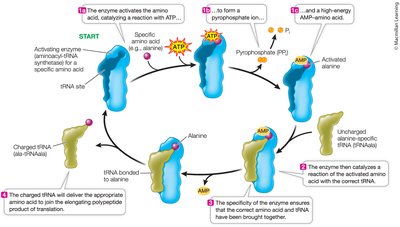
Charging: Aminoacyl-tRNA synthetases attach amino acids to tRNA using ATP.
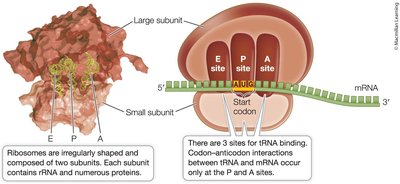
Ribosome structure: Large and small subunits; three binding sites (A, P, E).
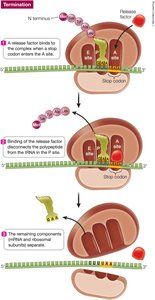
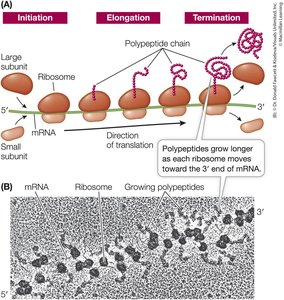
Translation steps: Initiation (assembly of complex), Elongation (peptide bond formation), Termination (release of polypeptide).
Polysomes: Multiple ribosomes translate a single mRNA simultaneously.
Polypeptide Modification and Transport
Polypeptides Can Be Modified and Transported during or after Translation
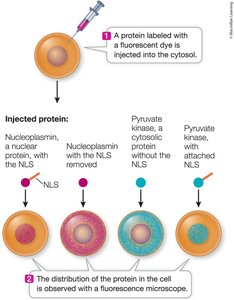
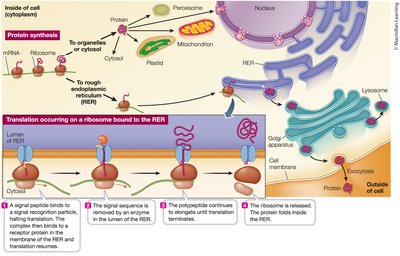
After translation, polypeptides may undergo modifications and be transported to specific cellular locations. Signal sequences direct proteins to their destinations, and posttranslational modifications alter protein function.
Signal sequences: Direct proteins to organelles (e.g., nucleus, ER).
Posttranslational modifications: Proteolysis (cutting), glycosylation (adding sugars), phosphorylation (adding phosphate groups).
Protein targeting: Proteins may remain in cytosol or be transported to organelles or secreted.
Gene Mutation and Molecular Medicine
Mutations Are Heritable Changes in DNA
Mutations are changes in the DNA sequence that can be inherited by cells or organisms. They can occur in somatic or germ line cells and have various effects on protein function.
Types: Loss of function (recessive), gain of function (dominant), conditional, reversion.
Point mutations: Substitution, insertion, or deletion of a single base pair.
Chromosomal rearrangements: Deletion, duplication, inversion, translocation.
Mutagenesis: Spontaneous (errors, tautomers) or induced (chemical, radiation).
Transposons: Mobile genetic elements that can cause mutations.
Summary Table: Types of Mutations
Type | Description | Effect |
|---|---|---|
Point Mutation | Single base substitution, insertion, or deletion | Silent, missense, nonsense, frameshift |
Chromosomal Rearrangement | Large-scale changes (deletion, duplication, inversion, translocation) | Gene disruption, dosage effects |
Transposon Insertion | Mobile element inserts into gene | Loss of function, gene duplication |
Spontaneous Mutation | Errors during replication or repair | Random, often neutral or deleterious |
Induced Mutation | Caused by mutagens (chemicals, radiation) | Varied, often deleterious |
Additional info: The notes above expand on brief points from the original slides, providing definitions, examples, and context for each concept. Images are included only when they directly reinforce the explanation of the adjacent paragraph.
