 Back
BackGene Expression: From Gene to Protein
Study Guide - Smart Notes
 Tailored notes based on your materials, expanded with key definitions, examples, and context.
Gene Expression: From Gene to Protein
Introduction to Gene Expression
Gene expression is the process by which information encoded in DNA directs the synthesis of proteins, which are essential for cellular structure and function. This process involves two main stages: transcription and translation.
The Flow of Genetic Information
One Gene–One Enzyme Hypothesis
Early experiments by Beadle and Tatum using Neurospora crassa (bread mold) demonstrated that genes act by regulating distinct chemical events, leading to the "one gene–one enzyme" hypothesis. Mutants unable to grow on minimal medium were found to lack specific enzymes in the arginine biosynthesis pathway.
Gene: A segment of DNA that codes for a functional product, usually a protein.
Enzyme: A protein that catalyzes biochemical reactions.
Mutant analysis: Helped identify the step in the pathway affected by a gene mutation.
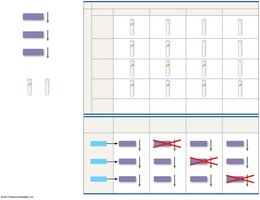
Example: Class I mutants could grow only when supplied with citrulline or arginine, indicating a block before citrulline in the pathway.
The Central Dogma of Molecular Biology
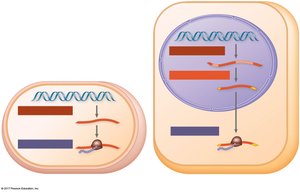
The central dogma describes the directional flow of genetic information: DNA → RNA → Protein. Transcription produces RNA from DNA, and translation synthesizes proteins using the RNA template.
Transcription: Synthesis of RNA from a DNA template.
Translation: Synthesis of a polypeptide using the information in mRNA.
Ribosome: The molecular machine that carries out translation.

Transcription: DNA-Directed Synthesis of RNA
Basic Principles of Transcription
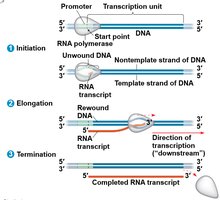
Transcription is catalyzed by RNA polymerase, which synthesizes RNA complementary to the DNA template strand. In eukaryotes, transcription occurs in the nucleus, and the resulting pre-mRNA undergoes processing before translation.
Initiation: RNA polymerase binds to the promoter region with the help of transcription factors.
Elongation: RNA polymerase moves along the DNA, synthesizing RNA in the 5' to 3' direction.
Termination: In bacteria, transcription ends at a terminator sequence; in eukaryotes, after the polyadenylation signal.
RNA Processing in Eukaryotes
Before leaving the nucleus, eukaryotic pre-mRNA is modified:
5' Cap: A modified guanine nucleotide added to the 5' end.
Poly-A Tail: 50–250 adenine nucleotides added to the 3' end.
RNA Splicing: Removal of noncoding introns and joining of coding exons.
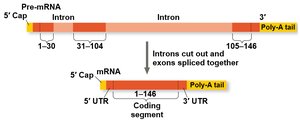
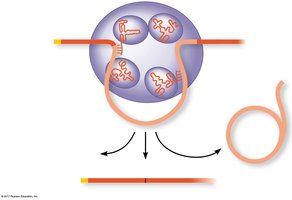
Example: Alternative RNA splicing allows a single gene to code for multiple proteins.
Translation: RNA-Directed Synthesis of a Polypeptide
The Genetic Code
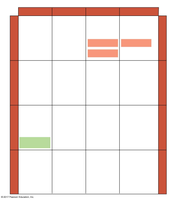
The genetic code is a set of rules by which information encoded in mRNA codons is translated into amino acids. Each codon consists of three nucleotides and specifies one amino acid or a stop signal.
There are 64 codons: 61 code for amino acids, 3 are stop codons.
The code is redundant but not ambiguous.
Codons must be read in the correct reading frame.
tRNA and the Ribosome
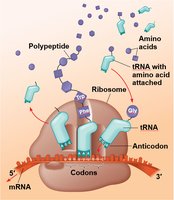
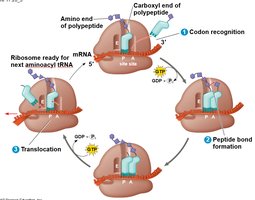
Transfer RNA (tRNA) molecules bring amino acids to the ribosome, matching their anticodon with codons on the mRNA. Aminoacyl-tRNA synthetases attach the correct amino acid to each tRNA.
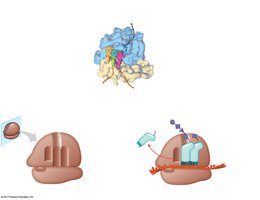
Ribosome: Composed of large and small subunits, with binding sites for tRNA (A, P, E sites).
Translation steps: Initiation, elongation, and termination.
Translation Process
Translation proceeds in three main stages:
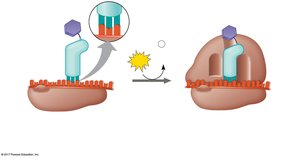
Initiation: The small ribosomal subunit binds to mRNA and the initiator tRNA; the large subunit completes the initiation complex.
Elongation: Amino acids are added one by one to the growing polypeptide chain.
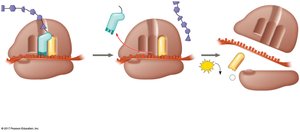
Termination: When a stop codon is reached, the polypeptide is released, and the ribosome dissociates.
Polyribosomes and Protein Targeting
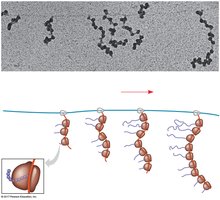
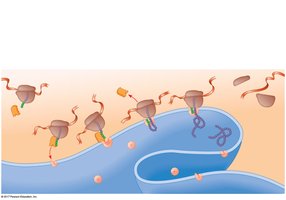
Multiple ribosomes can translate a single mRNA simultaneously, forming a polyribosome. Proteins may be targeted to specific cellular locations, such as the endoplasmic reticulum for secretion.
Mutations and Their Effects on Protein Structure
Types of Mutations
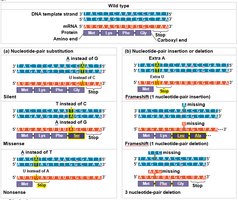
Mutations are changes in the genetic material. Point mutations affect a single nucleotide pair and can have various effects:
Silent mutation: No effect on the amino acid sequence.
Missense mutation: Changes one amino acid to another.
Nonsense mutation: Changes a codon to a stop codon, truncating the protein.
Frameshift mutation: Insertion or deletion of nucleotides alters the reading frame.
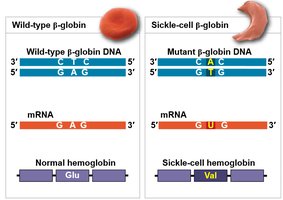
Example: Sickle-cell disease is caused by a missense mutation in the β-globin gene, resulting in abnormal hemoglobin.
