Back
BackGene Expression: From Gene to Protein (Ch. 14) – Study Notes
Study Guide - Smart Notes
 Tailored notes based on your materials, expanded with key definitions, examples, and context.
Gene Expression: From Gene to Protein
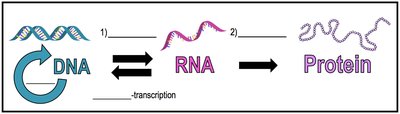
Central Dogma of Molecular Biology
The central dogma of molecular biology describes the unidirectional flow of genetic information from DNA to RNA to protein. This process is fundamental to all living organisms and explains how genetic information is expressed as cellular function.
Transcription: The process of synthesizing RNA from a DNA template.
Translation: The process of synthesizing proteins using the information encoded in mRNA.
Gene Expression: The combined process by which genotype leads to phenotype through transcription and translation.
DNA can be replicated, and in some cases, RNA can be reverse-transcribed into DNA, but information flow from nucleic acid to protein is irreversible.
Introduction to Transcription
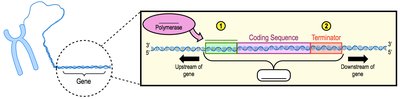
Transcription is the process by which an RNA molecule is synthesized from a DNA template within a gene. Genes are specific sequences of DNA that encode functional products, typically proteins or functional RNAs.
Promoter: A DNA sequence where transcription begins; site of RNA polymerase attachment.
Terminator: A DNA sequence where transcription ends.
RNA Polymerase: The enzyme that synthesizes RNA from the DNA template without the need for a primer.
Upstream: DNA sequences before (5' to) the start of transcription.
Downstream: DNA sequences after (3' to) the start of transcription.
Overview of Transcription
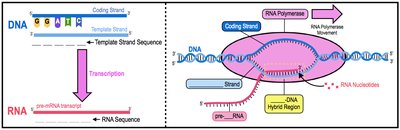
DNA consists of two strands: the coding strand and the template strand. The RNA sequence produced during transcription is complementary to the template strand and nearly identical to the coding strand, except that uracil (U) replaces thymine (T).
Coding Strand: The DNA strand with the same sequence as the RNA transcript (except T is replaced by U).
Template Strand: The DNA strand used as a template for RNA synthesis.
RNA is synthesized in the 5' to 3' direction by pairing free RNA nucleotides with the DNA template via Watson-Crick base pairing (A-U, G-C).
Steps of Transcription
Transcription occurs in three main steps: initiation, elongation, and termination.
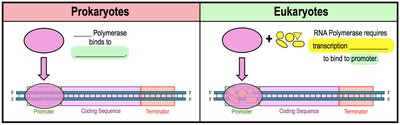
Initiation: RNA polymerase binds to the promoter and unwinds the DNA to expose the template strand. In eukaryotes, transcription factors are required for RNA polymerase to bind.
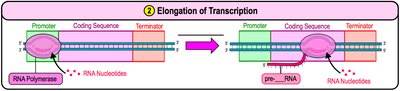
Elongation: RNA polymerase moves along the DNA, synthesizing RNA by adding nucleotides in the 5' to 3' direction.
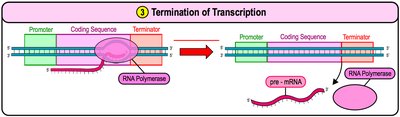
Termination: Transcription ends when RNA polymerase reaches the terminator sequence. In eukaryotes, the resulting pre-mRNA requires further processing.
Eukaryotic RNA Processing & Splicing
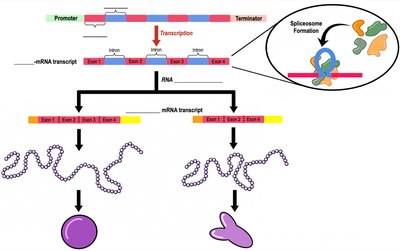
Unlike prokaryotic mRNA, eukaryotic pre-mRNA undergoes several modifications before it becomes mature mRNA ready for translation.
Pre-mRNA: The initial RNA transcript before processing.
RNA Processing: Includes addition of a 5' cap (modified guanine) and a poly-A tail (adenine nucleotides) to the 3' end.
These modifications facilitate export from the nucleus, protect mRNA from degradation, and help ribosomes attach for translation.


RNA Splicing: Removal of noncoding regions (introns) and joining of coding regions (exons) by the spliceosome. Alternative splicing allows for multiple protein products from a single gene.
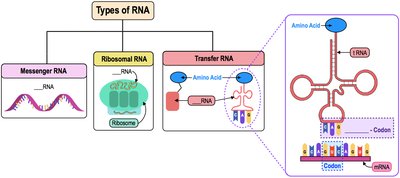
Types of RNA
Cells use several types of RNA, each with distinct functions:
Messenger RNA (mRNA): Carries genetic information from DNA to ribosomes for translation; contains codons.
Ribosomal RNA (rRNA): Structural and catalytic component of ribosomes.
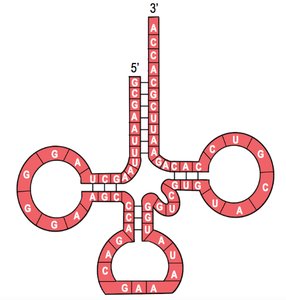
Transfer RNA (tRNA): Brings amino acids to the ribosome; contains anticodons complementary to mRNA codons.
The Genetic Code
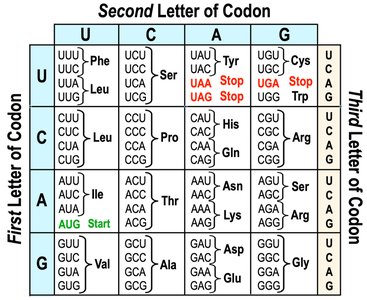
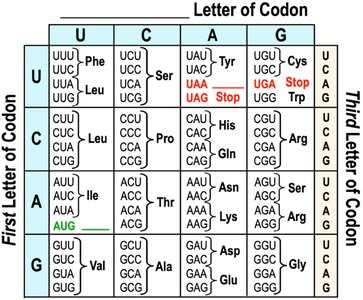
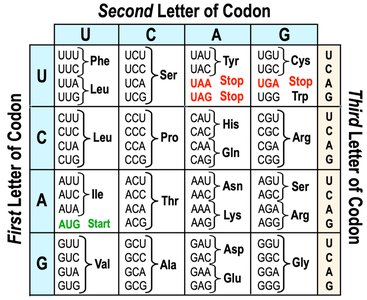
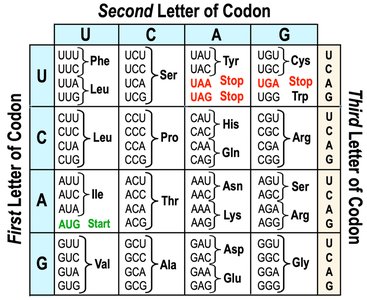
The genetic code is a set of rules by which the sequence of nucleotides in mRNA is translated into the sequence of amino acids in a protein. It is nearly universal and redundant (more than one codon can specify the same amino acid).
Each codon (three nucleotides) specifies one amino acid.
Translation begins at a start codon (AUG) and ends at a stop codon (UAA, UAG, UGA).
Introduction to Translation
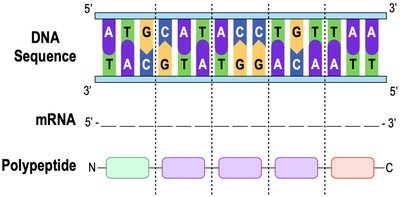
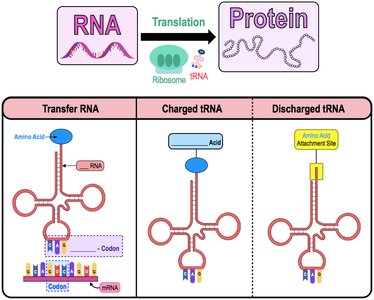
Translation is the process by which ribosomes synthesize proteins using the sequence information in mRNA. tRNA molecules bring amino acids to the ribosome, where they are joined together in the order specified by the mRNA codons.
Ribosomes: Complexes of rRNA and protein that facilitate the coupling of tRNA anticodons with mRNA codons.
tRNA: Each tRNA carries a specific amino acid and has an anticodon that pairs with the appropriate mRNA codon.
Charged tRNA: tRNA attached to its amino acid; Discharged tRNA: tRNA without an amino acid.
Ribosome Structure and tRNA Binding Sites
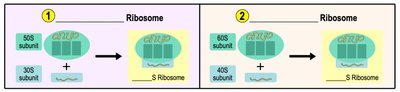
Prokaryotic ribosomes: 70S (50S large + 30S small subunits)
Eukaryotic ribosomes: 80S (60S large + 40S small subunits)
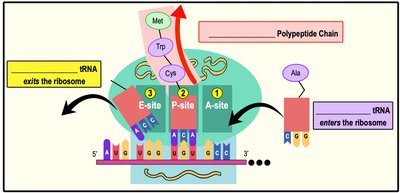
Three tRNA binding sites:
A (Aminoacyl) Site: Holds tRNA with the next amino acid.
P (Peptidyl) Site: Holds tRNA with the growing polypeptide chain.
E (Exit) Site: Where discharged tRNAs leave the ribosome.
Steps of Translation
Translation occurs in three main steps: initiation, elongation, and termination.
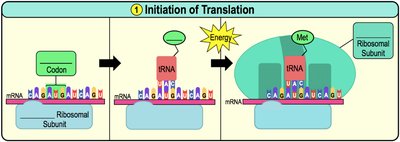
Initiation: The small ribosomal subunit binds to mRNA and a charged tRNA (carrying methionine) at the start codon (AUG). The large subunit then binds, forming the complete initiation complex.
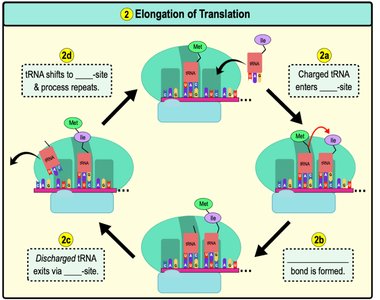
Elongation: Amino acids are added one by one to the growing polypeptide chain. The ribosome moves along the mRNA in the 5' to 3' direction, and tRNAs move through the A, P, and E sites.
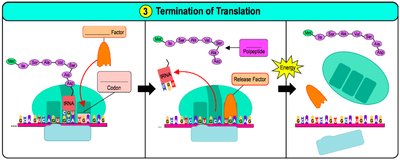
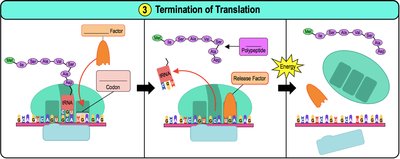
Termination: When a stop codon enters the A site, release factors bind, causing the polypeptide to be released and the translation complex to disassemble.
Post-Translational Modification
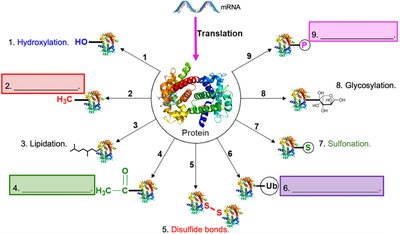
After translation, proteins often undergo covalent modifications that regulate their activity, localization, or stability. These modifications are essential for proper protein function.
Methylation
Acetylation
Ubiquitination
Phosphorylation
Glycosylation (addition of carbohydrates)
Review: Transcription vs. Translation
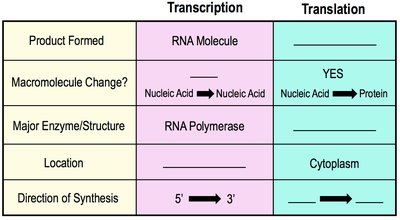
Transcription and translation are distinct but related processes in gene expression. The table below summarizes their key differences:
Transcription | Translation | |
|---|---|---|
Product Formed | RNA Molecule | Polypeptide (Protein) |
Macromolecule Change? | Nucleic Acid → Nucleic Acid | YES (Nucleic Acid → Protein) |
Major Enzyme/Structure | RNA Polymerase | Ribosome |
Location | Nucleus (Eukaryotes) | Cytoplasm |
Direction of Synthesis | 5' → 3' | N-terminus → C-terminus |
Mutations
Mutations are permanent changes in the DNA sequence. They can affect gene expression and protein function, and are a major source of genetic diversity.
Mutations can be spontaneous or induced by environmental factors (mutagens).
Types of mutations include:
Substitution: One base is replaced by another.
Insertion: Addition of one or more nucleotides.
Deletion: Removal of one or more nucleotides.
Frameshift: Insertions or deletions that alter the reading frame.
Missense: Substitution changes one amino acid.
Nonsense: Substitution creates a stop codon, terminating translation prematurely.
Silent: Substitution does not change the amino acid sequence due to redundancy in the genetic code.