 Back
BackHomeostasis and Excretory Systems in Animals
Study Guide - Smart Notes
 Tailored notes based on your materials, expanded with key definitions, examples, and context.
Maintaining Homeostasis
Introduction to Homeostasis
Homeostasis is the process by which living organisms regulate their internal environment to maintain a stable, constant condition, despite changes in the external environment. This concept, coined by Walter Cannon in 1926, is fundamental to physiology and underpins the survival of all organisms.
Dynamic Equilibrium: Homeostasis involves continuous adjustments to maintain balance at both cellular and systemic levels.
Regulated Variables: Includes pH, temperature, oxygen, ion concentrations, blood glucose, and waste products.
Control Mechanisms: Local control (paracrine/autocrine) and reflex control (nervous and endocrine systems) are key regulatory pathways.
Purpose: To maintain an optimal internal environment for cellular function and survival.
Key Players in Homeostasis
The regulation of water, ions, and organic solutes is central to homeostasis.
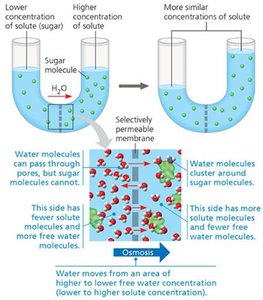
Osmosis: Water moves across semipermeable membranes from areas of low solute concentration to high solute concentration.
Solute Concentration: Low sugar concentration means more water; high sugar concentration means less water.
Regulation of Water and Salt
Animals regulate salt and water balance to maintain homeostasis, primarily through excretory systems.
Salt is actively transported, and water follows by osmosis.
Water moves from higher to lower concentration.
Excretory systems maintain water and salt balance and remove nitrogenous wastes.
Water Balance in Cells
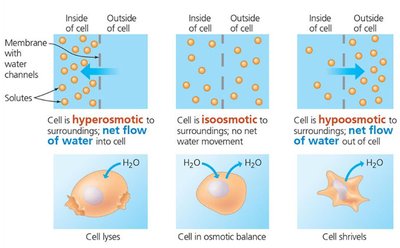
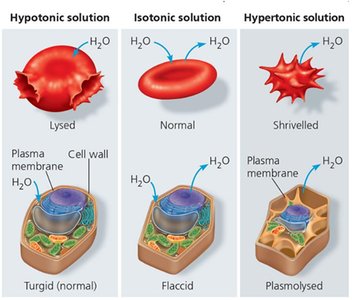
Osmolarity: Number of moles of solute per liter of solution.
Osmoregulation: Maintenance of water and solute balance regardless of environmental conditions.
Osmoconformers: Animals that are isosmotic with their environment (e.g., many marine animals).
Osmoregulators: Animals that regulate internal osmolarity (e.g., freshwater, terrestrial animals, or those moving between environments).
Osmoregulation in Fishes
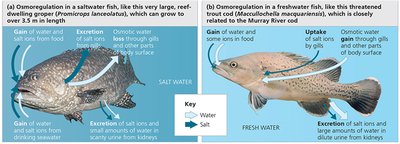
Fish exhibit different osmoregulatory strategies depending on whether they live in saltwater or freshwater environments.
Saltwater Fish: Lose water by osmosis and gain salt; must drink water and excrete salt through gills and urine.
Freshwater Fish: Gain water by osmosis and lose salt; excrete large amounts of dilute urine and actively uptake salt through gills.
Anhydrobiosis
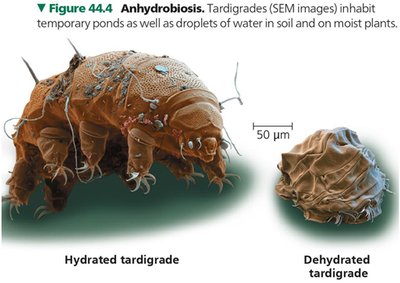
Some organisms, such as tardigrades, can survive extreme dehydration by entering a dormant state called anhydrobiosis.
Can survive with less than 2% water content.
Resume normal activity upon rehydration.
Excretory Systems and Homeostasis
Excretory Processes
Excretion is the process of removing metabolic wastes, particularly nitrogenous wastes, from the body.
Terrestrial animals lose water via urine, feces, skin, and respiratory surfaces.
Ammonia, a toxic byproduct of protein and nucleic acid metabolism, must be excreted.
Excretion impacts water balance, as wastes are dissolved in water.
Types of Nitrogenous Wastes
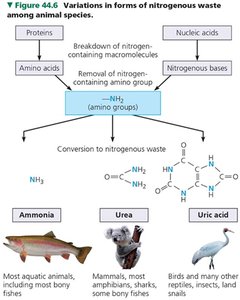
Animals excrete nitrogenous wastes in three main forms: ammonia, urea, and uric acid.
Ammonia (NH3): Highly toxic, requires large amounts of water for excretion (common in aquatic animals).
Urea: Less toxic, requires less water, produced by mammals and some fish.
Uric Acid: Least toxic, excreted as a paste, conserves water (birds, reptiles, insects).
Excretory System Structure and Function
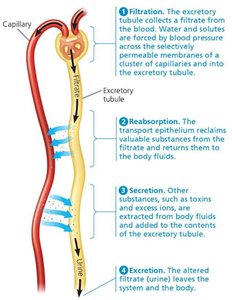
Excretory systems filter body fluids, reclaim valuable substances, and remove wastes.
Filtration: Body fluid is filtered through a selectively permeable membrane.
Reabsorption: Valuable substances are reclaimed from the filtrate.
Secretion: Additional wastes are added to the filtrate.
Excretion: The final filtrate (urine) is expelled from the body.
Types of Excretory Systems
Animals have evolved various excretory systems to suit their environments:
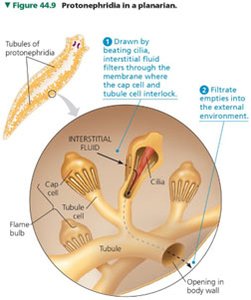
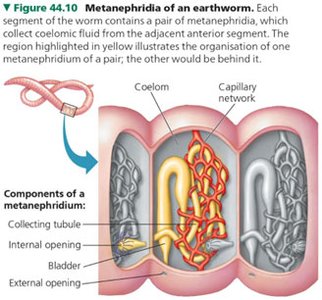
Protonephridia: Found in flatworms; network of tubules with flame bulbs that filter interstitial fluid.
Metanephridia: Found in annelids (earthworms); collect coelomic fluid and produce dilute urine.
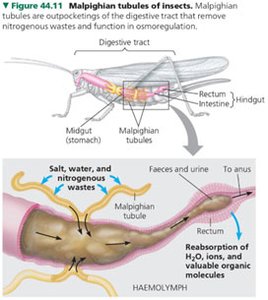
Malpighian Tubules: Found in insects; remove nitrogenous wastes from hemolymph and aid in osmoregulation.
Kidneys: Found in vertebrates; complex organs that filter blood and regulate water, salt, and waste balance.
Kidneys in Mammalian Systems
Kidney Structure and Function
Mammalian kidneys are highly specialized organs for osmoregulation and excretion.
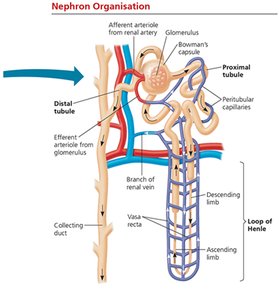
Consist of millions of nephrons, each functioning as a filtration and reabsorption unit.
Blood is filtered in the glomerulus; filtrate passes through the nephron, where water and solutes are reabsorbed or secreted as needed.
Nephron Function and Regional Specialization
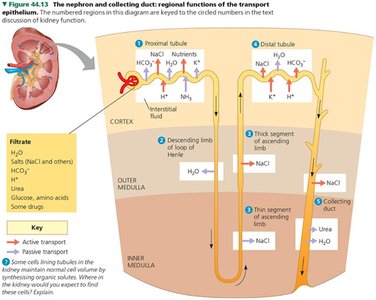
Different regions of the nephron are specialized for the reabsorption or secretion of specific substances, contributing to the formation of urine and the regulation of body fluid composition.
Proximal tubule, loop of Henle, distal tubule, and collecting duct each play distinct roles in concentrating urine and conserving water.
Kidney Function, Water Balance, and Blood Pressure
Hormonal Regulation
The kidneys regulate water balance and blood pressure through hormonal control, primarily involving antidiuretic hormone (ADH/vasopressin) and the renin-angiotensin-aldosterone system (RAAS).
ADH: Increases water reabsorption in the kidneys, reducing urine output and conserving water.
RAAS: Responds to low blood pressure by increasing sodium and water reabsorption, raising blood volume and pressure.
Clinical and Applied Aspects
Alcohol and Water Balance
Alcohol inhibits the release of ADH, leading to increased urinary water loss and dehydration.
Water Intoxication
Drinking excessive amounts of water in a short period can dilute blood sodium levels (hyponatremia), causing disorientation, respiratory distress, and potentially death.
Conn's Syndrome
Conn's syndrome is caused by adrenal cortex tumors that secrete excess aldosterone, leading to high blood pressure due to increased sodium and water retention.
Summary Table: Types of Excretory Systems
System | Organism | Main Function |
|---|---|---|
Protonephridia | Flatworms | Filtration of interstitial fluid |
Metanephridia | Annelids (earthworms) | Filtration and excretion of coelomic fluid |
Malpighian Tubules | Insects | Removal of nitrogenous wastes from hemolymph |
Kidneys | Vertebrates | Filtration of blood, osmoregulation, excretion |
Key Terms
Homeostasis: Maintenance of stable internal conditions.
Osmoregulation: Regulation of water and solute concentrations.
Excretion: Removal of metabolic wastes from the body.
Nephron: Functional unit of the kidney.
ADH (Vasopressin): Hormone that increases water reabsorption in kidneys.
RAAS: Hormonal system regulating blood pressure and fluid balance.
