Back
BackHonors Biology & Honors Study of Biology Final Exam Review Guidance
Study Guide - Smart Notes
 Tailored notes based on your materials, expanded with key definitions, examples, and context.
Q1. Compare and contrast mitosis and meiosis by completing the evolutionary factor question and the table provided.
Background
Topic: Cell Division – Mitosis vs. Meiosis
This question tests your understanding of the differences and similarities between mitosis and meiosis, two processes of cell division that are fundamental to growth, development, and reproduction in eukaryotic organisms.
Key Terms and Concepts:
Mitosis: A type of cell division that results in two genetically identical daughter cells, each with the same number of chromosomes as the parent cell.
Meiosis: A type of cell division that reduces the chromosome number by half, producing four genetically unique gametes (sperm or egg cells).
Homologous Chromosomes: Chromosome pairs, one from each parent, that are similar in shape, size, and genetic content.
Step-by-Step Guidance
List the main purpose of each process: Mitosis is for growth, repair, and asexual reproduction; meiosis is for sexual reproduction and genetic diversity.
Identify the number of cell divisions and resulting cells: Mitosis involves one division (producing two cells), while meiosis involves two divisions (producing four cells).
Compare the chromosome number in daughter cells: Mitosis produces diploid cells (same as parent), meiosis produces haploid cells (half the parent’s chromosome number).
Describe genetic variation: Mitosis results in identical cells; meiosis introduces genetic variation through crossing over and independent assortment.
Try solving on your own before revealing the answer!
Q2. Explain the role of homologous chromosomes during meiosis.
Background
Topic: Meiosis and Genetic Variation
This question focuses on the behavior of homologous chromosomes during meiosis and how this contributes to genetic diversity.
Key Terms and Concepts:
Homologous Chromosomes: Pairs of chromosomes that have the same genes but may have different alleles.
Crossing Over: The exchange of genetic material between homologous chromosomes during prophase I of meiosis.
Step-by-Step Guidance
Recall that homologous chromosomes pair up during prophase I of meiosis.
Describe how crossing over occurs between homologous chromosomes, leading to new combinations of alleles.
Explain how homologous chromosomes are separated during anaphase I, reducing chromosome number by half.
Try solving on your own before revealing the answer!
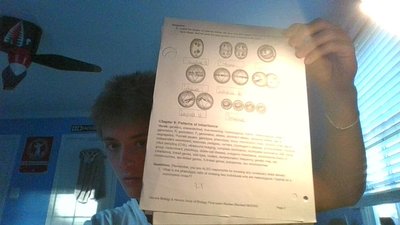
Q3. Examine the diagram and identify the stages of mitosis shown.
Background
Topic: Mitosis Stages
This question tests your ability to recognize and describe the stages of mitosis based on cell diagrams.
Key Terms and Concepts:
Prophase, Metaphase, Anaphase, Telophase: The four main stages of mitosis, each with distinct cellular events.
Step-by-Step Guidance
Observe the diagrams and note the position of chromosomes and the nuclear envelope.
Match each diagram to the correct mitosis stage based on chromosome arrangement and cell structure.
Write the name of each stage under the corresponding diagram.
Try solving on your own before revealing the answer!
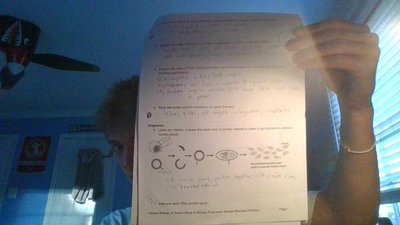
Q4. Complete the chart comparing the processes of spermatogenesis and oogenesis.
Background
Topic: Gametogenesis
This question asks you to compare the processes by which sperm and eggs are produced in animals.
Key Terms and Concepts:
Spermatogenesis: The process of sperm cell development in males.
Oogenesis: The process of egg cell development in females.
Step-by-Step Guidance
List the location where each process occurs (testes for spermatogenesis, ovaries for oogenesis).
Identify the number of functional gametes produced from one parent cell in each process.
Describe the timing and duration of each process (continuous in males, cyclical in females).
Try solving on your own before revealing the answer!
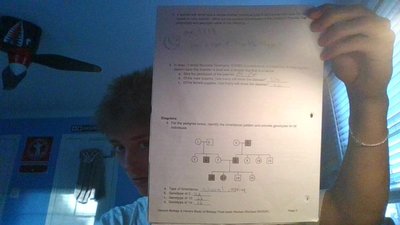
Q5. Analyze the pedigree and determine the inheritance pattern shown.
Background
Topic: Genetics – Pedigree Analysis
This question tests your ability to interpret a pedigree chart and deduce the mode of inheritance for a genetic trait.
Key Terms and Concepts:
Pedigree: A diagram showing the occurrence of phenotypes of a particular gene or organism and its ancestors.
Autosomal Dominant, Autosomal Recessive, X-linked: Common inheritance patterns to consider.
Step-by-Step Guidance
Examine the pedigree symbols and note which individuals are affected.
Determine if the trait skips generations (suggests recessive) or appears in every generation (suggests dominant).
Check if the trait is more common in one sex, which may indicate X-linked inheritance.
Try solving on your own before revealing the answer!