 Back
BackIntroduction to Biology: Themes, Organization, and the Science of Life
Study Guide - Smart Notes
 Tailored notes based on your materials, expanded with key definitions, examples, and context.
Life and the Science of Life
Biology: The Study of Life and Its Unifying Themes
Biology is the scientific study of life, revealing several unifying themes that connect all living things. These themes provide a framework for understanding the complexity and diversity of life on Earth.
Organization: Life is structured in a hierarchical manner, from molecules to the biosphere.
Information: Living organisms store, transmit, and respond to genetic information.
Energy and Matter: Life requires the transfer and transformation of energy and matter.
Interactions: Biological systems interact at all levels, from molecules to ecosystems.
Evolution: Evolution explains both the unity and diversity of life.
Theme: New Properties Emerge at Successive Levels of Biological Organization
The Hierarchical Organization of Life
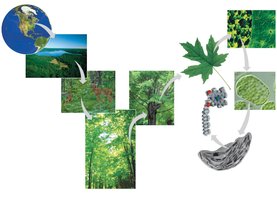
Life can be studied at various levels, each with unique properties that emerge from the interactions and arrangements of their parts. There is a strong correlation between structure and function at every level of the biological hierarchy.
Molecules → Organelles → Cells → Tissues → Organs and Organ Systems → Organisms → Populations → Communities → Ecosystems → Biosphere
Each level builds on the previous one, resulting in new properties (emergent properties).
Structure and function are closely related; for example, the shape of a bird's wing enables flight.
The Cell: An Organism’s Basic Unit of Structure and Function
Cell Theory and Types of Cells
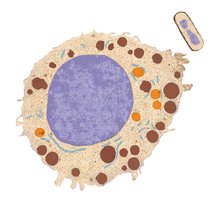
The cell is the fundamental unit of life, capable of performing all activities required for life. All cells are surrounded by a membrane that regulates the passage of materials between the cell and its environment.
Eukaryotic cells: Have membrane-enclosed organelles, including a nucleus.
Prokaryotic cells: Simpler, usually smaller, and lack a nucleus and other membrane-bound organelles.
Theme: Life’s Processes Involve the Expression and Transmission of Genetic Information
Genetic Material and Its Role
Within cells, structures called chromosomes contain genetic material in the form of DNA (deoxyribonucleic acid). DNA encodes the instructions for building and maintaining an organism, and for transmitting traits from parents to offspring.
Genes: Units of inheritance made of DNA, which direct the synthesis of proteins and influence traits.
Gene expression: The process by which information from a gene is used to synthesize a functional product, such as a protein.
Theme: Life Requires the Transfer and Transformation of Energy and Matter
Energy Flow and Chemical Cycling
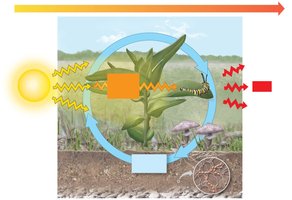
All living organisms require energy to grow, reproduce, and maintain their structures. The sun is the primary source of energy for most ecosystems. Energy flows through ecosystems, while matter cycles within them.
Photosynthesis: Plants convert light energy into chemical energy.
Cellular respiration: Organisms use chemical energy (often in the form of ATP) to perform work, releasing heat as a byproduct.
Decomposers: Break down dead organisms, returning chemicals to the soil.
Theme: From Ecosystems to Molecules, Interactions Are Important in Biological Systems
Biological Interactions and Feedback Regulation
Interactions among components of biological systems ensure the smooth integration of all parts. These interactions occur at all levels, from molecules within cells to organisms within ecosystems.
Feedback regulation: The output or product of a process regulates that process.
Negative feedback: The response reduces the initial stimulus (e.g., regulation of blood glucose).
Positive feedback: The response amplifies the initial stimulus (e.g., blood clotting).
Evolution: The Core Theme of Biology
Unity and Diversity of Life
Evolution is the scientific explanation for both the unity and diversity of organisms. All living organisms are modified descendants of common ancestors, and many lines of evidence support the occurrence of evolution.
Unity: Shared characteristics due to common ancestry.
Diversity: Adaptations to different environments and ways of life.
Review Questions and Key Concepts
Order of Biological Organization (from smallest to largest)
Molecules → Organelles → Cells → Tissues → Organs → Organisms → Populations → Communities → Ecosystems → Biosphere
Comparison of Prokaryotic and Eukaryotic Cells
Prokaryotes are smaller and simpler than eukaryotes, and lack a nucleus and other membrane-bound organelles.
Eukaryotes are larger, more structurally complex, and have a nucleus and organelles.
Feature | Prokaryotic Cell | Eukaryotic Cell |
|---|---|---|
Nucleus | No | Yes |
Membrane-bound organelles | No | Yes |
Size | Smaller | Larger |
Complexity | Simpler | More complex |
