 Back
BackIntroduction to Cells: Structure, Types, and Organelles
Study Guide - Smart Notes
 Tailored notes based on your materials, expanded with key definitions, examples, and context.
Introduction to Cells
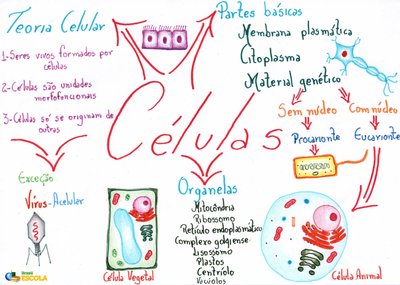
The Cell Theory
The cell theory is a fundamental concept in biology that describes the properties of cells, the basic unit of life. It consists of three main principles:
All living organisms are composed of cells.
The cell is the basic unit of structure and function in living things.
All cells arise from pre-existing cells.
Exception: Viruses are considered acellular because they lack cellular structure and cannot carry out life processes independently.
Basic Parts of a Cell
All cells, regardless of type, share certain basic structures:
Plasma Membrane (Membrana plasmática): A selective barrier that surrounds the cell, controlling the movement of substances in and out.
Cytoplasm (Citoplasma): The jelly-like substance within the cell where organelles are suspended.
Genetic Material (Material genético): DNA or RNA that contains the instructions for cellular activities.
Classification of Cells
Cells are classified based on the presence or absence of a nucleus:
Prokaryotic Cells (Procarionte): Cells without a true nucleus; genetic material is not enclosed within a membrane. Example: Bacteria.
Eukaryotic Cells (Eucarionte): Cells with a true nucleus, where genetic material is enclosed by a nuclear membrane. Examples: Plant and animal cells.
Cell Organelles
Organelles are specialized structures within cells that perform distinct processes. Major organelles include:
Mitochondria: Site of cellular respiration and energy (ATP) production.
Ribosomes: Responsible for protein synthesis.
Endoplasmic Reticulum (Retículo endoplasmático): Involved in protein and lipid synthesis; can be rough (with ribosomes) or smooth (without ribosomes).
Golgi Apparatus (Complexo golgiense): Modifies, sorts, and packages proteins and lipids for storage or transport.
Lysosomes: Contain digestive enzymes to break down waste.
Centrioles: Involved in cell division (mainly in animal cells).
Vacuoles: Storage organelles; large central vacuole in plant cells stores water and nutrients.
Types of Eukaryotic Cells
Plant Cells (Célula Vegetal): Have a cell wall, chloroplasts for photosynthesis, and a large central vacuole.
Animal Cells (Célula Animal): Lack a cell wall and chloroplasts, but contain centrioles and smaller vacuoles.
Summary Table: Prokaryotic vs. Eukaryotic Cells
Feature | Prokaryotic Cells | Eukaryotic Cells |
|---|---|---|
Nucleus | Absent | Present |
Organelles | Few (no membrane-bound organelles) | Many (membrane-bound organelles) |
Examples | Bacteria, Archaea | Plants, Animals, Fungi, Protists |
Additional info: The cell theory and classification of cells are foundational for understanding all biological processes, from genetics to physiology and ecology.
