 Back
BackChapter 8 part 1
Study Guide - Smart Notes
 Tailored notes based on your materials, expanded with key definitions, examples, and context.
Overview: The Energy of Life
Introduction to Cellular Energy
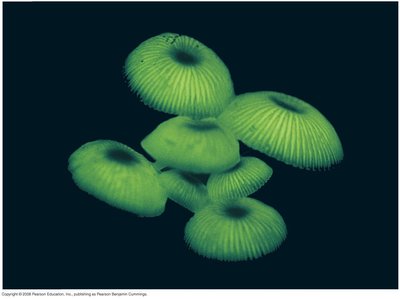
The living cell functions as a miniature chemical factory, carrying out thousands of chemical reactions essential for life. Cells extract energy from their environment and use it to perform various types of work, including movement, synthesis, and transport. Some organisms, such as certain marine species, can even convert energy into light, a phenomenon known as bioluminescence.
Concept 8.1: Metabolism and Thermodynamics
Metabolism: Definition and Organization
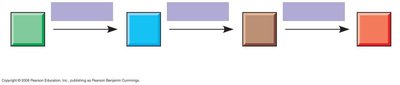
Metabolism refers to the totality of an organism’s chemical reactions. It is an emergent property resulting from the interactions of molecules within the cell. Metabolic reactions are organized into metabolic pathways, where a specific molecule is transformed through a series of steps, each catalyzed by a specific enzyme, ultimately yielding a final product.
Types of Metabolic Pathways
Catabolic pathways: Release energy by breaking down complex molecules into simpler compounds. Example: Cellular respiration, where glucose is broken down in the presence of oxygen.
Anabolic pathways: Consume energy to build complex molecules from simpler ones. Example: Protein synthesis from amino acids.
Bioenergetics is the study of how organisms manage their energy resources.
Forms of Energy in Biological Systems
Types of Energy
Energy: The capacity to cause change or perform work.
Kinetic energy: Energy associated with motion.
Heat (thermal energy): A form of kinetic energy due to the random movement of atoms or molecules.
Potential energy: Energy possessed due to location or structure.
Chemical energy: A type of potential energy available for release in a chemical reaction.
Energy can be converted from one form to another, such as the conversion of chemical energy in food to kinetic energy for movement.

The Laws of Energy Transformation
Thermodynamics in Biology
Thermodynamics is the study of energy transformations. Biological systems are considered open systems because they exchange energy and matter with their surroundings, unlike closed systems which do not exchange with the environment.
The First Law of Thermodynamics
States that the energy of the universe is constant.
Energy can be transferred and transformed, but cannot be created or destroyed (principle of conservation of energy).
The Second Law of Thermodynamics
Every energy transfer or transformation increases the entropy (disorder) of the universe.
Some energy becomes unusable, often lost as heat.

Biological Order and Disorder
Cells create ordered structures from less ordered materials, but overall, organisms replace ordered forms of matter and energy with less ordered forms. Energy flows into ecosystems as light and exits as heat. The evolution of complex organisms does not violate the second law because the total entropy of the universe still increases.
Concept 8.2: Free-Energy Change and Spontaneity
Free-Energy Change (ΔG)
Free energy is the portion of a system’s energy that can perform work when temperature and pressure are uniform. The change in free energy (ΔG) during a process is calculated as:
ΔH = change in enthalpy (total energy)
ΔS = change in entropy
T = temperature in Kelvin
Only processes with a negative ΔG are spontaneous. Spontaneous processes can be harnessed to perform work.
Free Energy, Stability, and Equilibrium
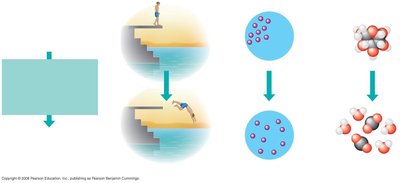
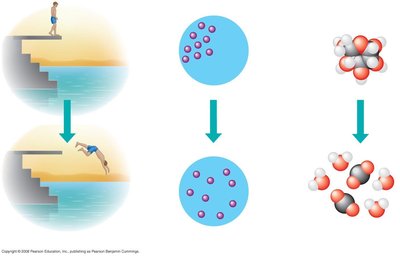
Free energy measures a system’s instability. During spontaneous changes, free energy decreases and stability increases. Equilibrium is a state of maximum stability, and only processes moving toward equilibrium are spontaneous and can perform work.
Free Energy and Metabolism
Exergonic and Endergonic Reactions
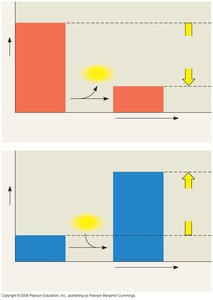
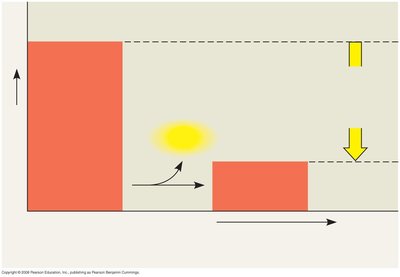
Exergonic reactions: Proceed with a net release of free energy (ΔG < 0) and are spontaneous.
Endergonic reactions: Absorb free energy from surroundings (ΔG > 0) and are nonspontaneous.
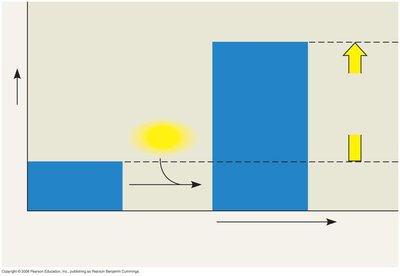
Equilibrium and Metabolism
Reactions in a closed system eventually reach equilibrium and do no work. Cells, as open systems, maintain a constant flow of materials and never reach equilibrium. This continuous flow is essential for life, as it allows metabolism to proceed and energy to be harnessed for cellular work. Hydroelectric systems are often used as analogies for these concepts.
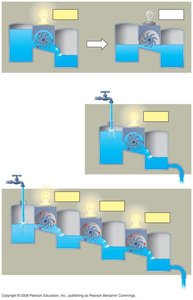
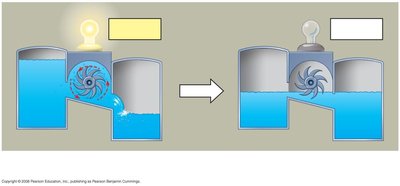
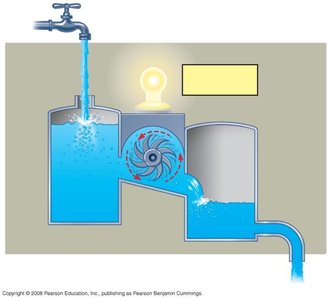
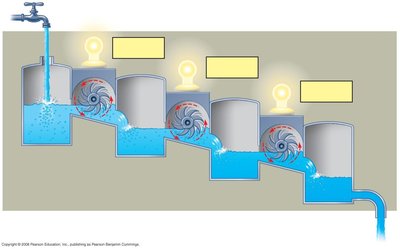
Additional info: The hydroelectric system analogy illustrates how cells, like open systems, maintain a flow of energy and materials, preventing equilibrium and enabling continuous work.
