 Back
BackCh 8
Study Guide - Smart Notes
 Tailored notes based on your materials, expanded with key definitions, examples, and context.
Metabolism and Energy Transformations
Overview of Metabolism
Metabolism encompasses all chemical reactions occurring within an organism, enabling the transformation of matter and energy necessary for life. These reactions are organized into metabolic pathways, where each step is catalyzed by a specific enzyme. Metabolism is an emergent property resulting from the orderly interactions between molecules.
Catabolic pathways break down complex molecules into simpler ones, releasing energy (e.g., cellular respiration).
Anabolic pathways build complex molecules from simpler ones, consuming energy (e.g., protein synthesis).
Bioenergetics is the study of how energy flows through living organisms.
Example: The breakdown of glucose in cellular respiration is a catabolic pathway, while the synthesis of proteins from amino acids is anabolic.
Forms of Energy
Energy is the capacity to cause change and exists in various forms relevant to biological systems:
Kinetic energy: Energy associated with motion. Moving objects can perform work by imparting motion to other matter.
Thermal energy: A form of kinetic energy due to the random movement of atoms or molecules. Transfer of thermal energy is called heat.
Potential energy: Energy possessed due to location or structure. For example, water behind a dam has potential energy due to its position.
Chemical energy: A type of potential energy stored in chemical bonds, available for release in chemical reactions.
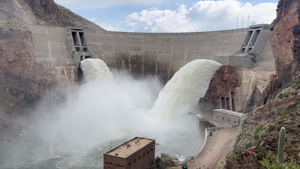
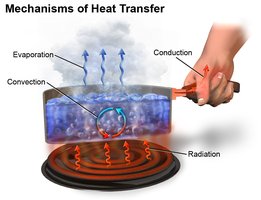
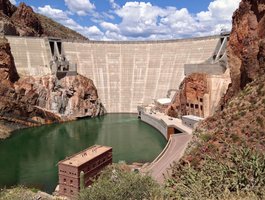
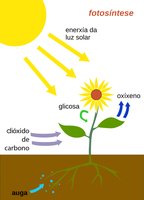
Example: The chemical energy in food is converted to kinetic energy for movement and thermal energy as heat.
Energy Conversion and the Laws of Thermodynamics
Energy can be converted from one form to another, such as chemical energy from food being used for muscle movement or photosynthesis converting light energy to chemical energy.
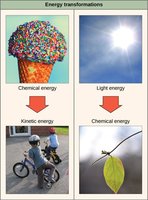
Thermodynamics is the study of energy transformations. Biological systems are open systems, exchanging energy and matter with their surroundings.
First Law of Thermodynamics: Energy can be transferred and transformed, but not created or destroyed (principle of conservation of energy).
Second Law of Thermodynamics: Every energy transfer or transformation increases the entropy (disorder) of the universe. Some energy is lost as heat, becoming unavailable to do work.
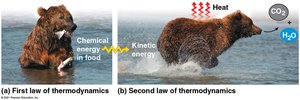
Example: The breakdown of food in metabolism releases heat and small molecules, increasing entropy.
Biological Order and Disorder
Living organisms maintain order and structure by creating ordered structures from less organized materials. However, this increase in order is balanced by the release of heat and waste, increasing the disorder of the surroundings.
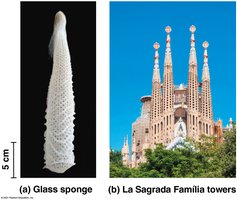
Energy flows into ecosystems as light and exits as heat, maintaining the balance of order and disorder.
Free Energy and Spontaneity of Reactions
Gibbs Free Energy (G)
Free energy is the portion of a system's energy that can perform work at constant temperature and pressure. The change in free energy (ΔG) during a reaction determines whether the process is spontaneous.
ΔG = ΔH – TΔS
Where:
ΔG = change in free energy
ΔH = change in enthalpy (total energy)
ΔS = change in entropy
T = temperature in Kelvin
- If ΔG is negative, the process is spontaneous. - If ΔG is zero or positive, the process is nonspontaneous.
Equilibrium and Metabolism
Equilibrium is the state of maximum stability, where forward and reverse reactions occur at the same rate. Systems never spontaneously move away from equilibrium. In living cells, metabolic reactions are kept out of equilibrium, allowing continuous work.
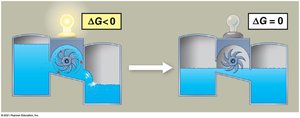
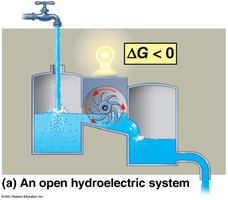
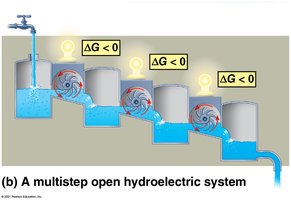
Example: Cellular respiration is a multistep pathway where products of one reaction are reactants for the next, preventing equilibrium.
ATP and Cellular Work
ATP: Structure and Function
ATP (adenosine triphosphate) is the main energy currency of the cell. It consists of ribose (a sugar), adenine (a nitrogenous base), and three phosphate groups. ATP powers cellular work by coupling exergonic reactions (energy-releasing) to endergonic reactions (energy-consuming).
The ATP Cycle
ATP is regenerated by the addition of a phosphate group to ADP (adenosine diphosphate). The energy for this phosphorylation comes from catabolic reactions. The ATP cycle couples energy-yielding and energy-consuming processes.
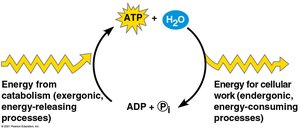
Example: ATP hydrolysis provides energy for muscle contraction, active transport, and biosynthesis.
Enzymes and Metabolic Reactions
Enzyme Function and Catalysis
Enzymes are biological catalysts, usually proteins, that speed up metabolic reactions by lowering the activation energy (EA) barrier. They do not change the ΔG of a reaction but allow reactions to occur at moderate temperatures.
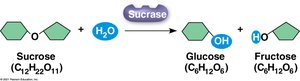
Activation energy is the initial energy required to start a reaction. Enzymes lower this barrier, enabling faster reaction rates.
Substrate Specificity and Induced Fit
Each enzyme is specific to its substrate, binding at the active site. The enzyme changes shape slightly to fit the substrate more closely, a phenomenon known as induced fit.
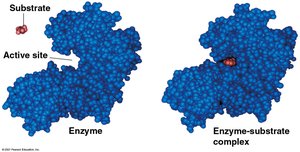
The substrate is converted to product and released, allowing the enzyme to catalyze further reactions.
Enzyme Activity and Regulation
Enzyme activity can be affected by:
Substrate concentration: Higher concentrations increase reaction rate until the enzyme is saturated.
Temperature and pH: Each enzyme has optimal conditions for activity. Deviations can reduce activity or denature the enzyme.
Cofactors: Nonprotein helpers (inorganic ions or organic coenzymes) required for enzyme function.
Enzyme Inhibition
Enzyme inhibitors can reduce or block enzyme activity:
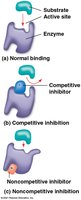
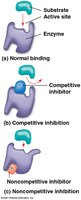
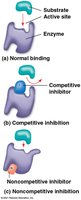
Competitive inhibitors: Resemble the substrate and bind to the active site, blocking substrate access. Can be overcome by increasing substrate concentration.
Noncompetitive inhibitors: Bind to another part of the enzyme, causing a conformational change that reduces activity.
Regulation of Metabolic Pathways
Allosteric Regulation
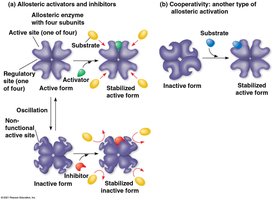
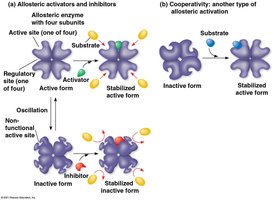
Allosteric regulation involves regulatory molecules binding to sites other than the active site, affecting enzyme activity. This can either inhibit or activate the enzyme. In cooperativity, substrate binding to one active site increases activity at other sites.
Feedback Inhibition
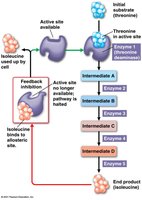
In feedback inhibition, the end product of a metabolic pathway inhibits an enzyme involved earlier in the pathway. This prevents the cell from producing excess product and conserves resources.
Additional info: Mutations in genes encoding enzymes can alter enzyme activity or specificity, and beneficial changes may be favored by natural selection. Cells regulate metabolism by controlling enzyme production and activity, ensuring efficient and responsive metabolic control.
