 Back
Back9.1 Island Biogeography and Species Richness: Principles and Applications
Study Guide - Smart Notes
 Tailored notes based on your materials, expanded with key definitions, examples, and context.
Biogeography
Definition and Scope
Biogeography (also known as geographic ecology) is the study of ecological structure and processes at large geographic scales. It focuses on the variation in species composition and diversity among geographic locations, seeking to understand patterns and mechanisms that drive biodiversity across regions.
Species Richness and Area
Relationship Between Area and Species Richness
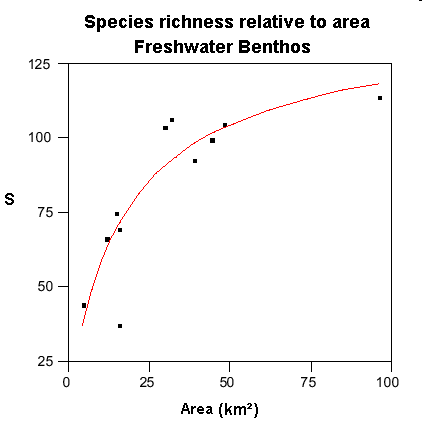
Species richness refers to the number of different species present in a defined area. Empirical data, especially from islands, show that species richness increases with the area sampled. However, this increase can reach a saturation point, where additional area does not result in a significant increase in species number.
Larger islands generally support more species than smaller islands.
This relationship is often described by the species-area curve, which can be represented mathematically as:
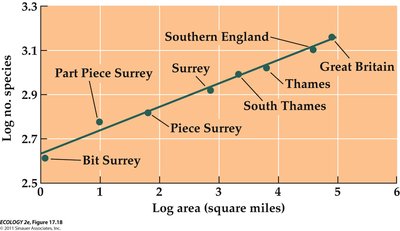
Where S is the number of species, A is the area, c is a constant, and z is the slope of the log-log plot.
Log-Transformed Data and Linear Regression
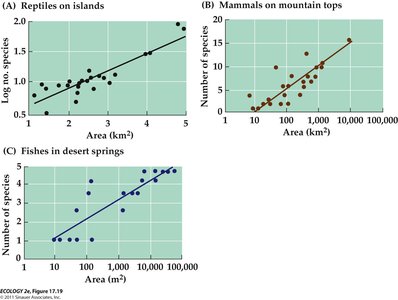
When data are log-transformed, the relationship between area and species richness often becomes linear, allowing for statistical analysis using linear regression models. This approach helps ecologists compare different regions and taxa.
Equilibrium Theory of Island Biogeography
MacArthur and Wilson's Model (1967)
The Equilibrium Theory of Island Biogeography was developed to explain species richness on oceanic islands. It posits that the number of species on an island is determined by a dynamic balance between immigration and extinction rates.
Immigration rate: Higher for islands closer to the mainland.
Extinction rate: Lower for larger islands due to more resources and habitat diversity.
The equilibrium number of species is reached when immigration equals extinction.
Key Predictions
Islands closer to the mainland will have higher immigration rates and thus more species.
Larger islands will have lower extinction rates and thus more species.
Empirical Tests of Island Biogeography
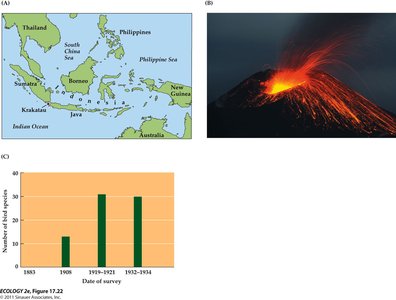
The Krakatau Test
The eruption of Krakatau provided a natural experiment to test island biogeography theory. After the island was sterilized, scientists observed the recolonization process, which supported the equilibrium model's predictions.
Mangrove Island Experiments in Florida
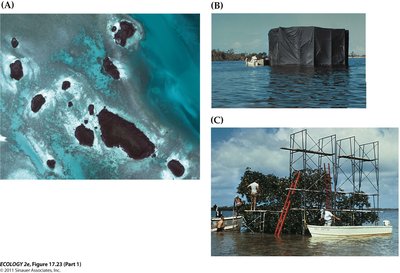
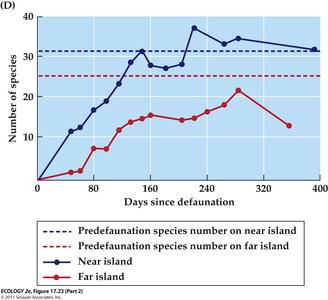
Experimental defaunation of mangrove islands and subsequent monitoring of recolonization rates further validated the equilibrium theory. Near islands recovered species richness more quickly than far islands.
Biological Factors Affecting Immigration and Extinction
Extinction Rates
Lower for primary producers and smaller organisms.
Higher for species at higher trophic levels, those with mutualistic partners, and larger organisms.
Immigration Rates
Good dispersers: Birds, plants with wind-dispersed seeds, marine mammals, large mammals.
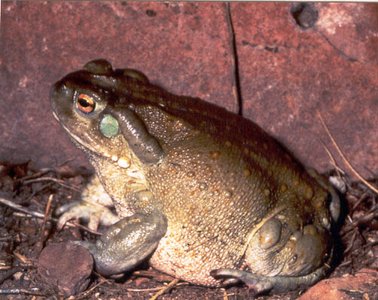
Poor dispersers: Amphibians, plants with heavy seeds, freshwater fish.
Island Formation and Types
How Islands Form
The origin of an island influences its species composition and richness. Most oceanic islands form in two main ways:
Continental islands: Formed when land breaks away from continents.
Volcanic islands: Created by volcanic activity.
Other Island Types
Islands can also form through sediment accumulation (e.g., corals, mangroves) or landslides.
Other 'islands' include lakes formed by filling depressions or being cut off from water sources, and mountaintops isolated by erosion or uplift.
Species Richness and Composition: Additional Factors
Beyond Area and Isolation
Biodiversity can vary even among islands or habitats with similar latitude, longitude, biome, or distance from the mainland. This variation is influenced by:
Regional processes: Such as dispersal and colonization events.
Time: The age of the island or habitat affects species accumulation.
Geographic history: Past climatic and geological events shape present-day diversity.
Example: Two lakes at the same latitude may have different species due to differences in their formation history or age.
Additional info: The principles of island biogeography are widely applied to conservation biology, especially in the design of nature reserves and understanding the effects of habitat fragmentation.
