 Back
BackLab 1: The Metric System and Measurement in Biology
Study Guide - Smart Notes
 Tailored notes based on your materials, expanded with key definitions, examples, and context.
Introduction to the Metric System
Overview of Measurement in Biology
The metric system is the standard system of measurement used in scientific laboratories worldwide, including biology. It provides a universal language for scientists, ensuring consistency and accuracy in data collection and analysis. Understanding the metric system is essential for conducting experiments, recording results, and communicating findings.
Metric System: An international decimal-based system of measurement, using units such as meter (m), liter (L), and gram (g).
Imperial System: A system of measurement primarily used in the United States, with units such as inches, feet, and pounds.
Importance: The metric system's use of base-10 and standardized prefixes makes conversions straightforward and calculations easier.

Basic Units and Prefixes of the Metric System
Base Units and Derived Units
The metric system is built on a set of base units for different types of measurements. Derived units are created by combining base units with prefixes that indicate multiples or fractions of ten.
Length: meter (m)
Volume: liter (L)
Mass: gram (g)
Temperature: degree Celsius (°C)
Prefixes such as kilo-, centi-, milli-, micro-, and nano- are used to indicate the size of the unit relative to the base unit.
Prefix | Symbol | Factor | Example |
|---|---|---|---|
kilo- | k | 1 kilometer (km) = 1000 meters (m) | |
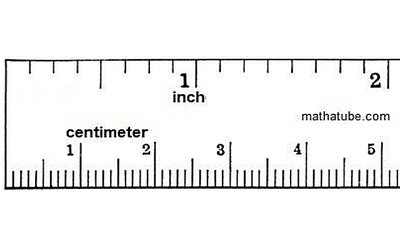
centi- | c | 1 centimeter (cm) = 0.01 meters (m) | |
milli- | m | 1 milliliter (mL) = 0.001 liters (L) | |
micro- | \mu | 1 microliter (\mu L) = 0.000001 liters (L) | |
nano- | n | 1 nanogram (ng) = 0.000000001 grams (g) |



Conversions and Scientific Notation
Converting Between Units
Conversions within the metric system are simplified by its base-10 structure. Moving between units involves shifting the decimal point according to the prefix.
To convert from a smaller unit to a larger unit: Move the decimal to the left (divide by powers of ten).
To convert from a larger unit to a smaller unit: Move the decimal to the right (multiply by powers of ten).
Example: (move decimal three places to the right).
Scientific notation is used to express very large or very small numbers in a compact form.
Example (large number):
Example (small number):
To convert from scientific notation to decimal notation, move the decimal point to the right for positive exponents and to the left for negative exponents.
Measuring in the Laboratory
Measuring Mass
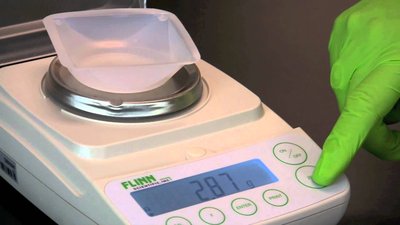
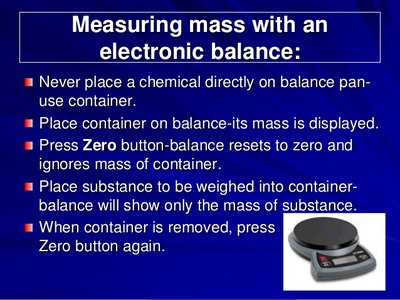
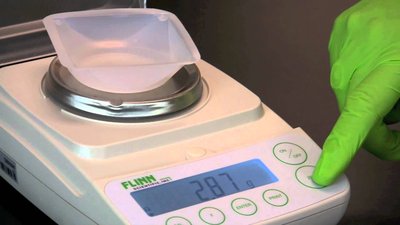
Mass is measured using electronic balances. Proper technique ensures accurate and reliable results.
Never place chemicals directly on the balance pan; always use a container.
Press the "Zero" or "Tare" button to subtract the container's mass.
Record the mass displayed for your sample.
Measuring Volume
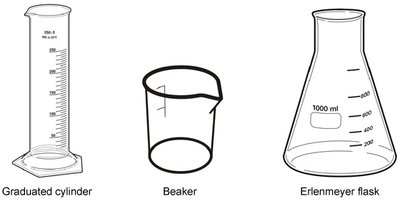
Volume is commonly measured using beakers, graduated cylinders, and pipets. Graduated cylinders provide the most accurate measurements for most laboratory purposes.
Beaker: Used for mixing and rough volume measurements.
Graduated Cylinder: Used for precise volume measurements.
Erlenmeyer Flask: Used for mixing and storing solutions.

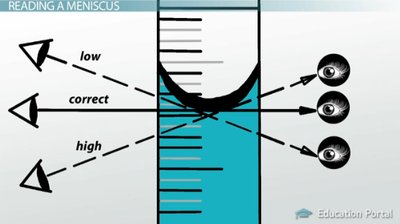
Reading a Meniscus
When measuring liquid volume, always read the measurement at the bottom of the meniscus at eye level for accuracy.
Measuring Exact Volumes: Pipets
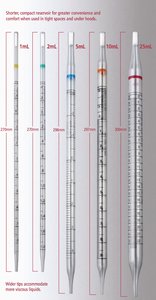
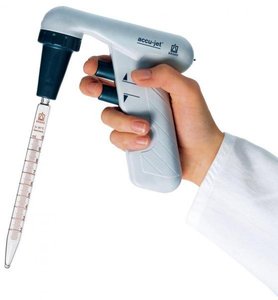
Pipets are used for transferring and measuring small, exact volumes of liquid. Motorized pipet fillers or dispensers can be used for ease and precision.
Types of Pipets: Graduated and volumetric pipets, each designed for specific accuracy requirements.
Application: Essential for experiments requiring precise reagent volumes, such as preparing solutions or performing titrations.
Summary Table: Metric System Prefixes and Conversions
Unit | Symbol | Equivalent |
|---|---|---|
1 kilometer | km | m |
1 meter | m | Base unit |
1 centimeter | cm | m |
1 millimeter | mm | m |
1 micrometer | \mu m | m |
1 nanometer | nm | m |
Practice and Application
Understanding and applying the metric system is foundational for all laboratory work in biology. Practice converting between units, using scientific notation, and measuring accurately with laboratory equipment to ensure experimental success.
