 Back
BackLipids: Structure, Types, and Biological Functions
Study Guide - Smart Notes
 Tailored notes based on your materials, expanded with key definitions, examples, and context.
Lipids
Overview of Lipids
Lipids are a diverse group of hydrophobic biological molecules that play essential roles in energy storage, membrane structure, and signaling. The main classes of lipids discussed here include saturated fats, unsaturated fats, cholesterol, and phospholipids.
Saturated fats: Typically solid at room temperature, found in animal products like butter.
Unsaturated fats: Usually liquid at room temperature, found in plant oils such as olive oil.
Cholesterol: A steroid molecule crucial for cell membrane structure and as a precursor for steroid hormones.
Phospholipids: Major components of cell membranes, forming bilayers due to their amphipathic nature.
Chemical Properties of Lipids
Saturated fats: Nonpolar, hydrophobic molecules with no double bonds between carbon atoms.
Unsaturated fats: Nonpolar, hydrophobic molecules containing one or more cis double bonds, causing kinks in the structure.
Cholesterol: Nonpolar, hydrophobic molecule with a characteristic four-ring steroid structure.
Phospholipids: Amphipathic molecules with both polar (hydrophilic head) and nonpolar (hydrophobic tails) regions.
Types of Lipids
Saturated vs. Unsaturated Fats
Saturated and unsaturated fats differ in their chemical structure and physical properties.
Saturated fats have the maximum number of hydrogen atoms attached to each carbon, resulting in straight chains that pack closely together. This makes them solid at room temperature (e.g., butter).
Unsaturated fats contain one or more cis double bonds, introducing kinks that prevent tight packing. This makes them liquid at room temperature (e.g., olive oil).
Comparison Table:
Property | Saturated Fat | Unsaturated Fat |
|---|---|---|
Hydrogen Content | Maximum | Less (due to double bonds) |
Structure | Straight chains | Kinked chains |
Physical State (Room Temp) | Solid | Liquid |
Example | Butter | Olive oil |
Cholesterol
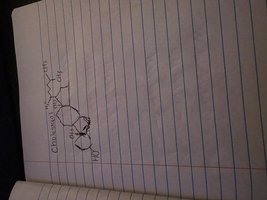
Cholesterol is a type of steroid lipid with a characteristic four-ring structure. It is a precursor for all steroid hormones and is essential for maintaining cell membrane fluidity in animals.
Function: Precursor for steroid hormones, stabilizes cell membranes.
Chemistry: Nonpolar, hydrophobic.
Example: Cholesterol molecule.
Phospholipids
Phospholipids are composed of a glycerol backbone, two fatty acid tails, and a phosphate group. Their amphipathic nature allows them to form the basis of biological membranes.
Components:
Glycerol
Fatty acid(s)
Phosphate group
Example: Soy lecithin
Phospholipid Bilayer and Cell Membranes
A phospholipid bilayer forms when phospholipids arrange themselves so that the hydrophobic tails face inward, shielded from water, while the hydrophilic heads face outward toward the aqueous environment. This structure is fundamental to the formation of cell membranes.
Importance: The bilayer creates a selective barrier, allowing cells to maintain distinct internal environments.
Properties: Amphipathic nature is crucial for membrane formation and function.
Summary Table: Major Lipid Types
Lipid Type | Polarity | Function | Example |
|---|---|---|---|
Saturated fat | Nonpolar | Energy storage | Butter |
Unsaturated fat | Nonpolar | Energy storage | Olive oil |
Cholesterol | Nonpolar | Precursor for steroids, membrane structure | Steroid |
Phospholipid | Both (amphipathic) | Membrane structure | Soy lecithin |
Key Terms
Hydrophobic: Repelled by water; nonpolar.
Hydrophilic: Attracted to water; polar.
Amphipathic: Molecule with both hydrophobic and hydrophilic regions (e.g., phospholipids).
Steroid: Lipid with a four-ring structure (e.g., cholesterol).
Additional info: The structural formula of cholesterol is a classic example of a steroid, with four fused hydrocarbon rings and a hydrocarbon tail. This structure is essential for its role in membranes and as a hormone precursor.
