 Back
BackMembrane Structure and Function: Chapter 7 Review
Study Guide - Smart Notes
 Tailored notes based on your materials, expanded with key definitions, examples, and context.
Membrane Structure and Function
Fluid Mosaic Model of Membranes
The fluid mosaic model describes the structure of cellular membranes as a mosaic of diverse protein molecules embedded in a fluid bilayer of phospholipids. This model explains how membranes maintain both stability and flexibility, essential for cell function.
Phospholipids are amphipathic molecules, containing both hydrophobic and hydrophilic regions, which allows them to form bilayers in aqueous environments.
Membrane fluidity is influenced by the presence of unsaturated hydrocarbon tails (which prevent tight packing) and cholesterol (which buffers fluidity against temperature changes).
Membrane proteins serve various functions: transport, enzymatic activity, signal transduction, cell-cell recognition, intercellular joining, and attachment to the cytoskeleton and extracellular matrix.
Carbohydrates attached to proteins (glycoproteins) and lipids (glycolipids) are involved in cell recognition and communication.
Membrane components are synthesized in the endoplasmic reticulum (ER) and modified in the ER and Golgi apparatus, resulting in distinct inside and outside faces of the membrane.
Example: The presence of glycoproteins on red blood cells determines blood type and compatibility for transfusions.
Selective Permeability of Membranes
Cell membranes are selectively permeable, allowing some substances to cross more easily than others. This property is crucial for maintaining homeostasis and controlling the internal environment of the cell.
Hydrophobic molecules (e.g., O2, CO2) dissolve in the lipid bilayer and pass through rapidly.
Polar molecules and ions (e.g., glucose, Na+, K+) require specific transport proteins to cross the membrane.
Aquaporins are channel proteins that facilitate the rapid transport of water across the membrane.
Example: The kidney uses aquaporins to reabsorb water efficiently during urine formation.
Passive Transport: Diffusion and Osmosis
Passive transport is the movement of substances across a membrane without energy input from the cell. It includes simple diffusion, osmosis, and facilitated diffusion.
Diffusion is the spontaneous movement of molecules from an area of higher concentration to an area of lower concentration (down the concentration gradient).
Osmosis is the diffusion of water across a selectively permeable membrane.
Cells in a hypertonic solution lose water, causing them to shrink; in a hypotonic solution, they gain water and may burst; in an isotonic solution, there is no net water movement.
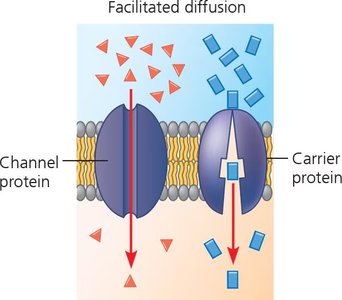
Facilitated diffusion uses transport proteins (channel or carrier proteins) to move substances down their concentration gradients.
Example: Glucose enters red blood cells via facilitated diffusion through a specific carrier protein.
Active Transport and Electrochemical Gradients
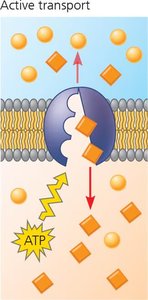
Active transport moves substances against their concentration gradients, requiring energy, usually from ATP. This process is essential for maintaining concentration differences of ions across the plasma membrane.
Pumps (e.g., sodium-potassium pump) use ATP to transport ions against their gradients.
Electrochemical gradient combines the chemical gradient (difference in solute concentration) and the electrical gradient (difference in charge) across the membrane.
Cotransport occurs when the downhill movement of one solute drives the uphill transport of another. Although ATP is not directly used by the cotransporter, the gradient was established by active transport, so the process is considered active.
Example: The sodium-glucose cotransporter in the intestine uses the sodium gradient (established by the sodium-potassium pump) to import glucose into cells.
Bulk Transport: Exocytosis and Endocytosis
Large molecules and particles cross the membrane via bulk transport mechanisms, which require energy.
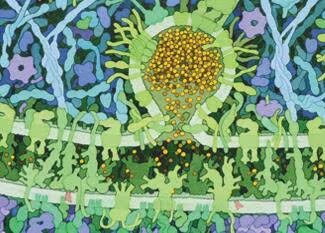
Exocytosis: Transport vesicles fuse with the plasma membrane to release their contents outside the cell.
Endocytosis: The cell takes in molecules by forming vesicles from the plasma membrane. Types include:
Phagocytosis: "Cell eating"—engulfing large particles.
Pinocytosis: "Cell drinking"—ingesting extracellular fluid and dissolved solutes.
Receptor-mediated endocytosis: Specific molecules bind to receptors, triggering vesicle formation. This allows cells to acquire bulk quantities of specific substances.
Example: Cholesterol uptake by animal cells occurs via receptor-mediated endocytosis.
Summary Table: Types of Membrane Transport
Transport Type | Energy Required? | Direction | Example |
|---|---|---|---|
Simple Diffusion | No | Down gradient | O2, CO2 |
Facilitated Diffusion | No | Down gradient | Glucose, ions via channels |
Active Transport | Yes (ATP) | Against gradient | Na+/K+ pump |
Bulk Transport (Exocytosis/Endocytosis) | Yes | Both | Secretion of proteins, uptake of cholesterol |
