 Back
BackMembrane Structure and Function: Regulating Cellular Traffic
Study Guide - Smart Notes
 Tailored notes based on your materials, expanded with key definitions, examples, and context.
Membrane Structure and Function
The Plasma Membrane: Structure and Composition
The plasma membrane is a dynamic boundary that separates the cell's internal environment from the external surroundings. Its structure is essential for maintaining cellular integrity and regulating the movement of substances. The membrane is primarily composed of phospholipids, proteins, and carbohydrates, each contributing to its function and organization.
Lipids: The main structural component, forming a phospholipid bilayer with amphipathic molecules (hydrophilic heads and hydrophobic tails).
Proteins: Embedded or associated with the bilayer, responsible for most membrane functions, including transport and signaling.
Carbohydrates: Attached to lipids (glycolipids) or proteins (glycoproteins), playing a key role in cell recognition.
Fluid Mosaic Model and Membrane Fluidity
The fluid mosaic model describes the plasma membrane as a flexible layer with proteins "bobbing" in or on the fluid lipid bilayer. Membrane fluidity is crucial for function and is influenced by several factors:
Amphipathic Nature: Both phospholipids and many proteins have hydrophilic and hydrophobic regions, allowing self-assembly in water.
Phospholipid Bilayer: Hydrophobic tails face inward, hydrophilic heads face outward, creating a semi-permeable barrier.
Temperature: Lower temperatures solidify membranes; unsaturated fatty acids (with kinks) increase fluidity, while saturated fatty acids decrease it.
Cholesterol: In animal cells, cholesterol buffers fluidity—reducing movement at high temperatures and preventing tight packing at low temperatures.
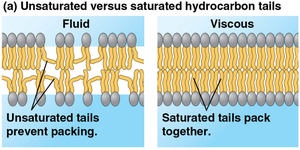
Example: Fish in cold water have membranes rich in unsaturated fatty acids to maintain fluidity.
Membrane Proteins and Carbohydrates
Integral Proteins: Span the membrane, often as transmembrane proteins with hydrophobic and hydrophilic regions.
Peripheral Proteins: Loosely attached to the membrane surface, not embedded in the hydrophobic core.
Attachment: Proteins may be anchored to the cytoskeleton or extracellular matrix for stability and function.
Membrane Carbohydrates: Short, branched chains attached to lipids or proteins, crucial for cell-to-cell recognition and signaling.
Membrane Asymmetry: The distribution of proteins, lipids, and carbohydrates is not identical on both sides of the membrane, reflecting specialized functions.
Membrane Transport: Regulating the Flow of Molecules
Selective Permeability
The plasma membrane exhibits selective permeability, allowing only certain molecules to cross freely while restricting others. This property is vital for maintaining cellular homeostasis.
Freely Permeable: Small, nonpolar molecules (e.g., O2, CO2) diffuse rapidly through the lipid bilayer.
Impermeable: Large, polar molecules and ions require assistance from transport proteins to cross the membrane.
Types of Membrane Transport
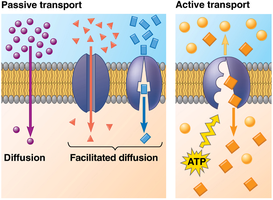
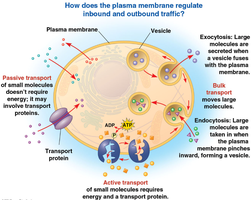
Passive Transport: Movement of substances down their concentration gradient without energy input.
Active Transport: Movement of substances against their concentration gradient, requiring energy (usually ATP).
Bulk Transport: Movement of large molecules or quantities via vesicles (endocytosis and exocytosis).
Passive Transport
Simple Diffusion: Spontaneous movement of molecules from high to low concentration.
Facilitated Diffusion: Passive movement aided by transport proteins (channel or carrier proteins).
Osmosis: Diffusion of water across a selectively permeable membrane, driven by differences in solute concentration.
Tonicity: The effect of a solution on cell volume (isotonic, hypertonic, hypotonic).
Key Equations:
Osmosis: Water moves from regions of low solute concentration to high solute concentration.
Dynamic Equilibrium: Molecules continue to move, but there is no net change in concentration across the membrane.
Active Transport
Carrier Proteins: Use energy (ATP) to move substances against their concentration gradient.
Sodium-Potassium Pump (Na+/K+ pump): Pumps 3 Na+ out and 2 K+ into the cell, maintaining membrane potential.
Proton Pump: Main electrogenic pump in plants, fungi, and bacteria, moving H+ out of the cell.
Cotransport: The downhill movement of one solute drives the uphill transport of another (e.g., sucrose-H+ cotransport).
Key Equation:
ATP Hydrolysis:
Bulk Transport
Exocytosis: Vesicles fuse with the plasma membrane to release contents outside the cell (e.g., secretion of insulin).
Endocytosis: The plasma membrane engulfs material to form vesicles that bring substances into the cell.
Types of Endocytosis:
Phagocytosis: "Cell eating" of large particles.
Pinocytosis: "Cell drinking" of extracellular fluid.
Receptor-Mediated Endocytosis: Specific uptake of molecules via receptor proteins.
Summary Table: Types of Membrane Transport
Transport Type | Energy Required? | Direction | Example |
|---|---|---|---|
Simple Diffusion | No | Down gradient | O2, CO2 |
Facilitated Diffusion | No | Down gradient | Glucose, ions via channels |
Active Transport | Yes (ATP) | Against gradient | Na+/K+ pump |
Bulk Transport (Exocytosis/Endocytosis) | Yes | Bulk movement | Secretion of proteins, uptake of large particles |
Additional info: Membrane transport is fundamental for processes such as nutrient uptake, waste removal, signal transduction, and maintaining ionic balances essential for cell survival.
