Back
BackChapter 7: Membrane Structure and Function: Study Guide
Study Guide - Smart Notes
 Tailored notes based on your materials, expanded with key definitions, examples, and context.
Membrane Structure and Function
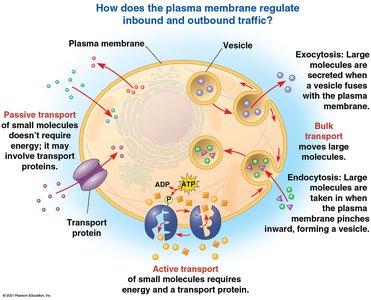
Overview of Membrane Transport
The plasma membrane is a dynamic structure that regulates the movement of substances into and out of the cell. It is essential for maintaining cellular homeostasis and communication with the environment. Transport across the membrane can occur via passive, active, or bulk transport mechanisms.
Passive transport: Movement of small molecules without energy input; may require transport proteins.
Active transport: Movement of small molecules against their concentration gradient; requires energy (usually ATP) and transport proteins.
Bulk transport: Movement of large molecules via vesicles; includes exocytosis and endocytosis.
Exocytosis: Vesicles fuse with the plasma membrane to release contents outside the cell.
Endocytosis: Plasma membrane forms a vesicle to bring substances into the cell.
Membrane Composition and Structure
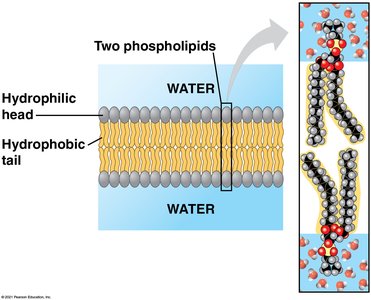
Cellular membranes are primarily composed of lipids, proteins, and carbohydrates. The main lipid component is the phospholipid, which is amphipathic, containing both hydrophobic and hydrophilic regions. This property allows phospholipids to form a bilayer, with hydrophobic tails facing inward and hydrophilic heads facing outward toward water.
Phospholipid bilayer: Provides the basic structure of the membrane.
Amphipathic nature: Hydrophobic tails are shielded from water, while hydrophilic heads interact with aqueous environments.
Membrane proteins: Most are also amphipathic, with hydrophilic regions exposed to the cytosol and extracellular fluid, and hydrophobic regions embedded in the bilayer.
The Fluid Mosaic Model
The fluid mosaic model describes the membrane as a mosaic of proteins floating in a fluid bilayer of phospholipids. Proteins are not randomly distributed; they often form functional groups. Membranes are held together by weak hydrophobic interactions, allowing lipids and some proteins to move laterally within the membrane.
Fluidity: Most lipids and some proteins can move sideways; rare flip-flop movement across the bilayer.
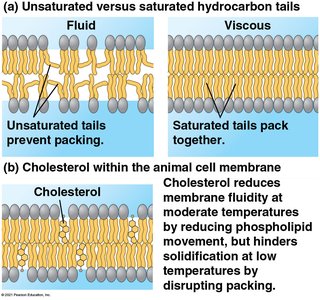
Temperature effects: Membranes become less fluid at lower temperatures; unsaturated fatty acids increase fluidity.
Cholesterol: Buffers membrane fluidity in animal cells, restraining movement at high temperatures and preventing tight packing at low temperatures.
Membrane Proteins and Their Functions
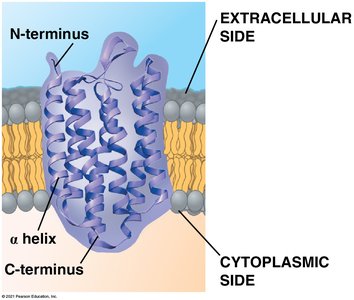
Proteins embedded in the membrane determine most of its functions. There are two main types: peripheral proteins (bound to the membrane surface) and integral proteins (penetrate the hydrophobic core). Transmembrane proteins span the entire membrane.
Peripheral proteins: Attached to the membrane surface.
Integral proteins: Penetrate the hydrophobic core; often contain nonpolar amino acids in α helices.
Transmembrane proteins: Span the membrane, facilitating transport and communication.
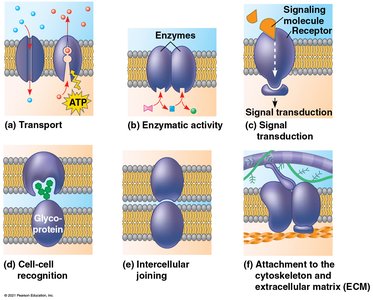
Attachment: Some proteins are anchored by the cytoskeleton or extracellular matrix.
Functions of Membrane Proteins
Transport: Move substances across the membrane.
Enzymatic activity: Catalyze reactions at the membrane surface.
Signal transduction: Relay signals from outside to inside the cell.
Cell-cell recognition: Identify and interact with other cells.
Intercellular joining: Connect cells together.
Attachment: Anchor the membrane to the cytoskeleton and extracellular matrix.
Membrane Carbohydrates and Cell Recognition
Carbohydrates attached to lipids (glycolipids) or proteins (glycoproteins) on the cell surface serve as markers for cell recognition. The diversity of these carbohydrates enables specific identification and communication between cells.
Glycolipids: Carbohydrates bonded to lipids.
Glycoproteins: Carbohydrates bonded to proteins.
Cell recognition: Important for immune response and tissue formation.
Synthesis and Sidedness of Membranes
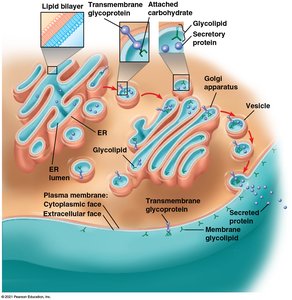
Membranes have distinct inside and outside faces, with asymmetrical distribution of proteins, lipids, and carbohydrates. This sidedness is established during membrane synthesis in the endoplasmic reticulum and Golgi apparatus.
Selective Permeability of Membranes
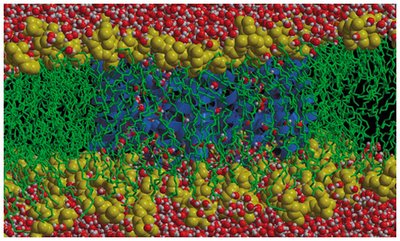
The plasma membrane exhibits selective permeability, allowing some substances to cross more easily than others. Hydrophobic (nonpolar) molecules pass rapidly, while hydrophilic (polar) molecules require transport proteins.
Hydrophobic molecules: Hydrocarbons, CO2, O2 pass easily.
Hydrophilic molecules: Sugars, water, ions pass slowly or require transport proteins.
Transport proteins: Channel proteins (hydrophilic tunnels) and carrier proteins (bind and shuttle molecules).
Passive Transport: Diffusion and Osmosis
Passive transport involves the movement of substances down their concentration gradient without energy input. Diffusion is the random movement of molecules, while osmosis is the diffusion of water across a selectively permeable membrane.
Diffusion: Movement of molecules from high to low concentration.
Osmosis: Movement of water from low solute concentration to high solute concentration.
Tonicity: Ability of a solution to cause a cell to gain or lose water (isotonic, hypertonic, hypotonic).
Facilitated Diffusion
Facilitated diffusion is passive transport aided by proteins. Channel proteins provide corridors for specific molecules or ions, while carrier proteins change shape to move substances across the membrane.
Channel proteins: Facilitate diffusion of water (aquaporins) and ions.
Carrier proteins: Undergo shape changes to transport molecules.
Gated channels: Open or close in response to stimuli (electrical or chemical).
Active Transport
Active transport moves substances against their concentration gradients using energy, typically from ATP hydrolysis. All active transport proteins are carrier proteins.
Sodium-potassium pump: Maintains high K+ and low Na+ inside animal cells.
ATP hydrolysis: Provides energy for transport.
Membrane Potential and Electrochemical Gradients
Membrane potential is the voltage across a membrane, created by differences in ion distribution. The electrochemical gradient combines the chemical and electrical forces driving ion diffusion.
Electrogenic pumps: Generate voltage across membranes (sodium-potassium pump in animals, proton pump in plants).
Cotransport: Active transport of one solute indirectly drives transport of another.
Bulk Transport: Exocytosis and Endocytosis
Bulk transport moves large molecules across the membrane via vesicles. Exocytosis releases substances outside the cell, while endocytosis brings substances in. Endocytosis includes phagocytosis, pinocytosis, and receptor-mediated endocytosis.
Phagocytosis: Cell engulfs particles in a food vacuole.
Pinocytosis: Cell "gulps" extracellular fluid in vesicles.
Receptor-mediated endocytosis: Specific solutes bind to receptors, triggering vesicle formation.
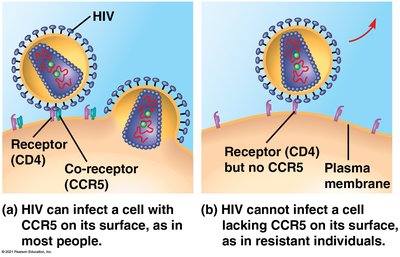
Medical Relevance: HIV and Membrane Proteins
Cell-surface proteins are important in medicine. HIV enters immune cells by binding to CD4 and CCR5 proteins. Individuals lacking CCR5 are resistant to HIV infection, and drugs are being developed to block HIV entry.