 Back
BackChapter 5 Membrane Transport and Cell Signaling: Structure, Function, and Mechanisms
Study Guide - Smart Notes
 Tailored notes based on your materials, expanded with key definitions, examples, and context.
Membrane Structure and Function
Overview of the Plasma Membrane
The plasma membrane is a fundamental cellular structure that separates the cell from its external environment and regulates the movement of substances in and out of the cell. It is selectively permeable, allowing certain molecules to cross more easily than others. - Plasma membrane: Boundary between the cell's interior and exterior. - Selectively permeable: Controls passage of substances. - Fluid mosaic model: Describes the membrane as a mosaic of proteins floating in a fluid bilayer of phospholipids. 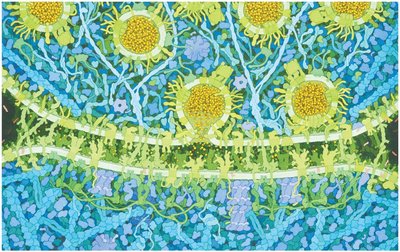
Composition of Cellular Membranes
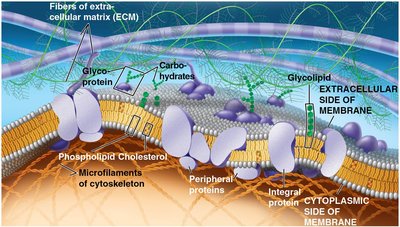
Cellular membranes are composed primarily of amphipathic lipids, proteins, and some carbohydrates. - Phospholipids: Amphipathic molecules with hydrophilic heads and hydrophobic tails. - Proteins: Integral (span the membrane) and peripheral (bound to membrane surface). - Carbohydrates: Found only on the extracellular surface, often attached to lipids (glycolipids) or proteins (glycoproteins). 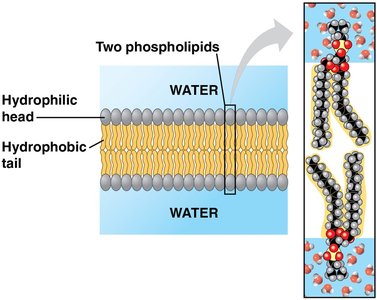
Fluidity of Membranes
Membrane fluidity is essential for function and is influenced by lipid composition, temperature, and cholesterol content. - Unsaturated fatty acid tails: Increase fluidity due to kinks that prevent tight packing. - Saturated fatty acid tails: Decrease fluidity by allowing tight packing. - Cholesterol: Modulates fluidity; reduces fluidity at moderate temperatures, prevents solidification at low temperatures. 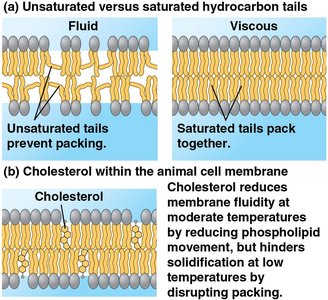
Membrane Proteins and Their Functions
Membrane proteins are diverse and perform a variety of functions critical to cellular activity. - Integral proteins: Penetrate the hydrophobic interior; most are transmembrane proteins. - Peripheral proteins: Loosely bound to the membrane surface. - Glycoproteins: Proteins with covalently attached carbohydrates, important for cell recognition. 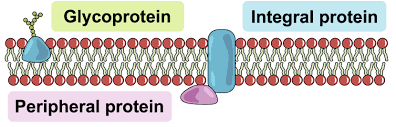
Major Functions of Membrane Proteins
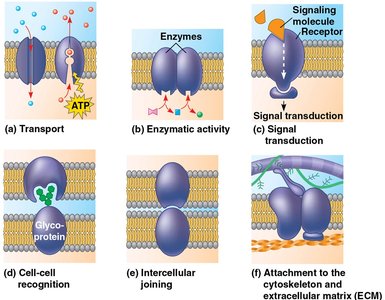
Transport: Move substances across the membrane.
Enzymatic activity: Catalyze reactions at the membrane surface.
Signal transduction: Relay signals from outside to inside the cell.
Cell-cell recognition: Identify and interact with other cells.
Intercellular joining: Connect cells together.
Attachment to cytoskeleton and ECM: Maintain cell shape and stabilize membrane.
Carbohydrates in Cell Recognition
Carbohydrates attached to lipids (glycolipids) or proteins (glycoproteins) on the extracellular surface are key for cell-cell recognition. - Glycolipids: Carbohydrates attached to lipids. - Glycoproteins: Carbohydrates attached to proteins. - Cell recognition: Different species and cell types have unique carbohydrate patterns.
Membrane Permeability and Transport
Selective Permeability
The lipid bilayer is selectively permeable, allowing hydrophobic molecules to cross easily while restricting hydrophilic and large molecules. - Hydrophobic molecules (e.g., O2, CO2): Cross easily. - Hydrophilic molecules (e.g., glucose, water): Require transport proteins.
Transport Proteins
Transport proteins facilitate the movement of hydrophilic substances across the membrane. - Channel proteins: Provide hydrophilic tunnels for molecules/ions. - Aquaporins: Specialized channels for water. - Carrier proteins: Bind and change shape to Rshuttle molecules across. 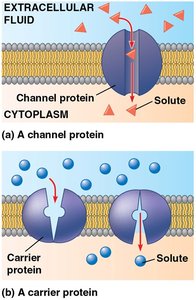
Passive Transport
Diffusion
Diffusion is the movement of molecules from high to low concentration, driven by the concentration gradient. - Dynamic equilibrium: Achieved when net diffusion ceases. - Passive transport: No energy required. 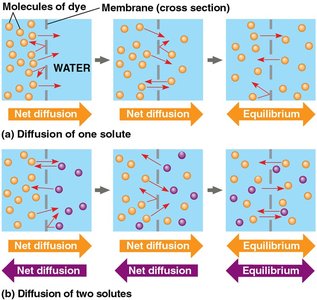
Osmosis
Osmosis is the diffusion of water across a selectively permeable membrane. - Water moves from lower solute concentration to higher solute concentration. - Equilibrium is reached when solute concentrations are equal. 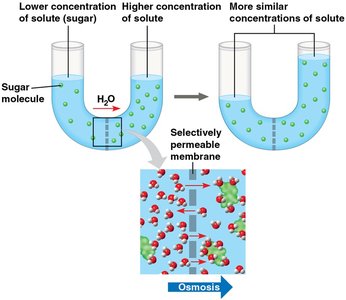
Tonicity and Water Balance
Tonicity describes the effect of a solution on cell water balance. - Hypotonic: Cell gains water, may burst (lysis). - Isotonic: No net water movement. - Hypertonic: Cell loses water, shrivels.
Facilitated Diffusion
Facilitated diffusion is passive transport aided by proteins. - Channel proteins: Provide corridors for specific molecules/ions. - Carrier proteins: Change shape to move solutes. - Aquaporins: Facilitate water movement. 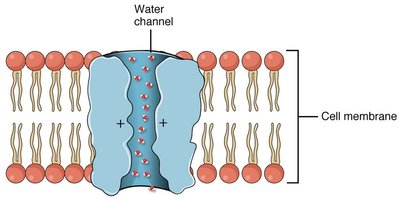
Active Transport
Mechanism and Importance
Active transport moves substances against their concentration gradient, requiring energy (usually ATP). - Maintains concentration gradients (e.g., high [K+] inside, low [Na+] outside). - Sodium-potassium pump: Exchanges Na+ for K+ across animal cell membranes.
Membrane Potential and Ion Pumps
- Membrane potential: Voltage across the membrane due to ion distribution. - Electrochemical gradient: Combination of electrical and chemical forces driving ion movement. - Electrogenic pumps: Generate voltage (e.g., sodium-potassium pump, proton pump).
Cotransport
Cotransport couples the downhill diffusion of one solute to the uphill transport of another. - Example: Sucrose transport in plant cells coupled with H+ movement.
Bulk Transport: Exocytosis and Endocytosis
Exocytosis
Exocytosis is the process by which cells export large molecules via vesicles that fuse with the plasma membrane.
Endocytosis
Endocytosis is the process by which cells import large molecules by forming vesicles from the plasma membrane. - Phagocytosis: "Cellular eating"; cell engulfs particles. - Pinocytosis: "Cellular drinking"; cell engulfs fluid. - Receptor-mediated endocytosis: Specific molecules bind to receptors and are internalized.
Cell Signaling and Communication
Local and Long-Distance Signaling
Cell-to-cell communication coordinates activities in multicellular organisms. - Local signaling: Direct contact (gap junctions, plasmodesmata), paracrine signaling, synaptic signaling. - Long-distance signaling: Endocrine signaling via hormones.
Stages of Cell Signaling
Cell signaling involves three main stages:
Reception: Detection of the signal by a receptor.
Transduction: Conversion of the signal to a cellular response via a signal transduction pathway.
Response: Cellular activity in response to the signal.
Membrane Receptors
There are two main types of membrane receptors: - G protein-coupled receptors - Ligand-gated ion channels: Act as gates for ions when the receptor changes shape.
Signal Transduction Cascades
Signal transduction often involves cascades of molecular interactions, amplifying the signal and leading to a cellular response.
Cellular Responses
Cellular responses to signals may involve regulation of transcription (gene expression) or cytoplasmic activities. - Many pathways regulate enzyme/protein synthesis by turning genes on or off in the nucleus. Additional info: Academic context was added to clarify mechanisms, provide definitions, and ensure completeness for exam preparation.
