 Back
BackMembrane Transport: Passive and Active Mechanisms
Study Guide - Smart Notes
 Tailored notes based on your materials, expanded with key definitions, examples, and context.
Membrane Structure and Function
Passive Transport: Diffusion Across Membranes
Passive transport is a fundamental process by which substances move across cell membranes without the expenditure of cellular energy. This movement relies on the inherent thermal energy of molecules, resulting in diffusion—the spontaneous movement of particles from regions of higher concentration to regions of lower concentration.
Diffusion: The net movement of molecules down their concentration gradient, driven by random molecular motion.
Equilibrium: Achieved when the concentration of molecules is equal on both sides of the membrane, resulting in no net movement.
Example: Oxygen and carbon dioxide gases diffuse across plasma membranes in cells.
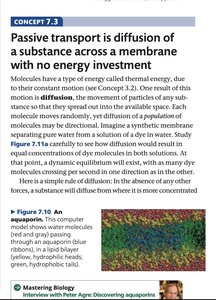
Additional info: Diffusion is a passive process and does not require ATP or other energy sources.
Osmosis: Diffusion of Water
Osmosis is a specialized form of diffusion involving water molecules. Water moves across a selectively permeable membrane from areas of lower solute concentration to areas of higher solute concentration, balancing solute levels on both sides.
Osmosis: The movement of water through a membrane to equalize solute concentrations.
Hypertonic Solution: Higher solute concentration; water moves out of the cell.
Hypotonic Solution: Lower solute concentration; water moves into the cell.
Isotonic Solution: Equal solute concentration; no net water movement.
Equation: (where is the free energy change, is the gas constant, is temperature, and , are concentrations)
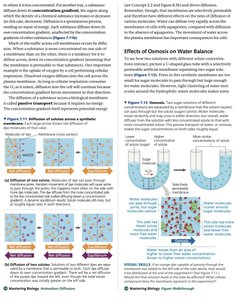
Additional info: Osmosis is critical for maintaining cellular homeostasis and is influenced by the presence of aquaporins—membrane proteins that facilitate water movement.
Water Balance of Cells Without Cell Walls
Animal cells and some protists lack cell walls, making them susceptible to osmotic changes. The tonicity of the surrounding solution determines whether cells gain or lose water, affecting their shape and function.
Isotonic Environment: No net water movement; cell remains stable.
Hypertonic Environment: Cell loses water and shrivels.
Hypotonic Environment: Cell gains water and may burst (lyse).
Example: Red blood cells in hypotonic solutions swell and may undergo hemolysis.
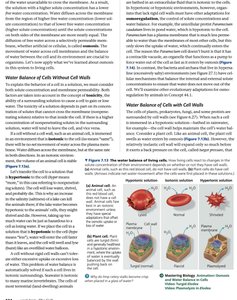
Additional info: Osmoregulation is the process by which cells control water balance, often using contractile vacuoles in protists.
Water Balance of Cells with Cell Walls
Plant cells possess rigid cell walls that provide structural support and influence water balance. The cell wall prevents excessive swelling, allowing plant cells to maintain turgor pressure, which is essential for plant rigidity and growth.
Turgid: Plant cell in a hypotonic solution; cell is firm due to water uptake.
Flaccid: Plant cell in an isotonic solution; cell is limp.
Plasmolysis: Plant cell in a hypertonic solution; cell membrane pulls away from the wall.
Example: Wilting occurs when plant cells lose turgor pressure.
Additional info: The central vacuole plays a key role in maintaining turgor pressure in plant cells.
Facilitated Diffusion: Passive Transport Aided by Proteins
Facilitated diffusion is a type of passive transport in which specific membrane proteins assist the movement of polar or charged molecules across the membrane. This process does not require energy and is essential for transporting substances that cannot diffuse freely through the lipid bilayer.
Channel Proteins: Form hydrophilic channels for ions and water.
Carrier Proteins: Bind to molecules and change shape to shuttle them across the membrane.
Example: Glucose transporters facilitate the movement of glucose into cells.
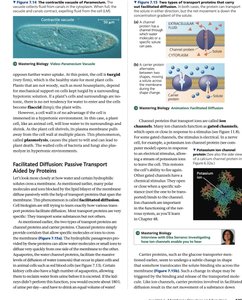
Additional info: Aquaporins are channel proteins specifically for water, increasing membrane permeability to water.
Active Transport: Moving Solutes Against Gradients
Active transport is the process by which cells use energy, typically in the form of ATP, to move solutes against their concentration gradients. This mechanism is vital for maintaining cellular concentrations of ions and other substances that differ from their surroundings.
Active Transport: Requires energy input to move substances from low to high concentration.
ATP: The primary energy source for active transport.
Example: Sodium-potassium pump maintains electrochemical gradients in animal cells.
Equation: (energy released drives transport)
Additional info: Active transport is essential for nerve impulse transmission and nutrient uptake in cells.
Summary Table: Types of Membrane Transport
Type | Energy Required | Direction | Example |
|---|---|---|---|
Simple Diffusion | No | High to Low | Oxygen, CO2 |
Osmosis | No | High to Low (water) | Water movement |
Facilitated Diffusion | No | High to Low | Glucose, ions |
Active Transport | Yes (ATP) | Low to High | Sodium-potassium pump |
