 Back
BackMendel and the Gene: Foundations and Extensions of Mendelian Genetics
Study Guide - Smart Notes
 Tailored notes based on your materials, expanded with key definitions, examples, and context.
Chapter 14: Mendel and the Gene
The Garden Pea as a Model Organism
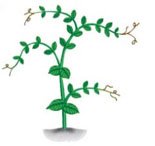
Gregor Mendel established the foundation for modern genetics through experiments with garden peas (Pisum sativum). He selected peas because they were inexpensive, easy to grow, had a short generation time, produced many seeds, and allowed controlled matings. These features made peas an ideal model organism for studying inheritance.
Key Terms in Mendelian Genetics
Mendelian genetics uses specific terminology to describe inheritance patterns:
Gene: A hereditary factor that determines a trait.
Allele: Different forms of a gene.
Genotype: The genetic makeup of an organism.
Phenotype: The observable traits of an organism.
Homozygous: Having two identical alleles for a gene.
Heterozygous: Having two different alleles for a gene.
Dominant allele: Expressed in the phenotype when present.
Recessive allele: Expressed only when two copies are present.
The Principle of Segregation
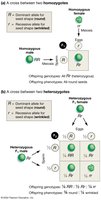
Mendel's principle of segregation states that two members of each gene pair separate into different gametes during egg and sperm formation. This explains why offspring inherit one allele from each parent. Mendel used letters to represent alleles (e.g., R for dominant, r for recessive).
Mendel’s Experiments with Two Traits: The Dihybrid Cross
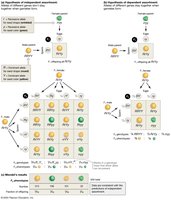
Mendel's dihybrid crosses (crosses involving two traits) led to the principle of independent assortment. This principle states that alleles of different genes are transmitted independently of one another. A Punnett square for a dihybrid cross predicts four possible phenotypes in a 9:3:3:1 ratio.
Testcrosses
A testcross is used to determine the genotype of an individual with a dominant phenotype by crossing it with a homozygous recessive individual. The phenotypes of the offspring reveal the unknown genotype. Mendel used testcrosses to confirm the principle of independent assortment.
Meiosis Explains Mendel’s Principles
The behavior of chromosomes during meiosis explains Mendel’s principles:
Principle of Segregation: Homologous chromosomes (and thus alleles) separate during meiosis I.
Principle of Independent Assortment: Genes on different chromosomes assort independently because chromosomes align randomly during metaphase I.
Extending Mendel’s Rules
Further research revealed exceptions and extensions to Mendel’s rules:
Linkage: Genes located close together on the same chromosome tend to be inherited together.
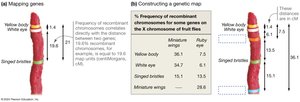
Crossing Over: Genes far apart on a chromosome are more likely to be separated by crossing over, producing recombinant offspring. The frequency of recombination can be used to create genetic maps showing the relative positions of genes.
Multiple Alleles and Blood Types
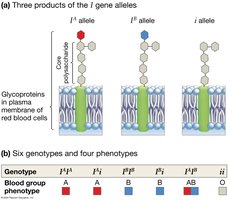
Some genes have more than two alleles in a population, a phenomenon called multiple allelism. For example, the human ABO blood group is determined by three alleles (IA, IB, and i), which produce four phenotypes (A, B, AB, O).
Codominance and Incomplete Dominance
Codominance: Both alleles in a heterozygote are fully expressed (e.g., AB blood type).
Incomplete Dominance: Heterozygotes have an intermediate phenotype (e.g., red and white flowers produce pink offspring).
Environmental Effects on Phenotype
Most phenotypes are influenced by both genes and the environment. Mendel controlled environmental variables in his experiments, but in nature, factors like sunlight, water, and soil can affect trait expression.
Quantitative Traits
Some traits do not fall into discrete categories but vary continuously (quantitative traits). These traits are usually influenced by multiple genes (polygenic inheritance) and environmental factors, resulting in a bell-shaped curve of phenotypes.
Applying Mendel’s Rules to Human Inheritance
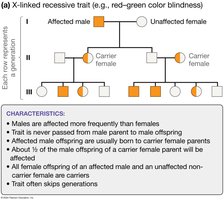
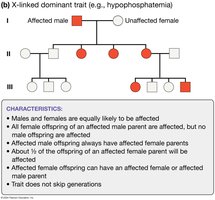
Human geneticists use pedigrees (family trees) to study inheritance patterns. The mode of transmission describes whether a trait is autosomal or sex-linked and whether it is dominant or recessive. Pedigrees can help distinguish between these patterns.
Autosomal dominant: Trait appears in every generation; affected individuals have at least one affected parent.
Autosomal recessive: Trait can skip generations; affected individuals may have unaffected parents.
X-linked recessive: More common in males; affected males often have carrier mothers.
X-linked dominant: Affects both sexes; affected males pass the trait to all daughters but no sons.
Mode of Inheritance | Key Features |
|---|---|
Autosomal Dominant | Appears in every generation; both sexes equally affected |
Autosomal Recessive | Can skip generations; both sexes equally affected |
X-linked Recessive | More males affected; trait often skips generations |
X-linked Dominant | Both sexes affected; affected males pass trait to all daughters |
Additional info: The study of Mendelian genetics provides the foundation for understanding more complex patterns of inheritance, including polygenic traits, gene-environment interactions, and the molecular basis of gene function.
